Home
Benefits
News
entertainment
shop
finance
careers
education
join military
community


Quick Links | Home | Discount Travel | Military Travel Privileges | Travel Resources | Travel Alerts


Travel Spotlight
Guam's Attractions Satisfy Vacation Cravings


Content provided by the Guam Visitors Bureau


4 Ways to Get the Best Lodging Deals


3 Ways to Get the Cheapest Flights


Travel Discounts


Travel Resources


Travel Discussions


Travel Spotlight Index

  Travel Home

Guam is one of the Western Pacific's most beautiful and multicultural islands. From its quaint villages to its pristine beaches, this Micronesian paradise has welcomed travelers to its shores for centuries.

Its unique environment and cultural history offer something for every traveler. Water sports, golf, shopping, village fiestas, entertainment, restaurants, sightseeing and nightlife are among the many activities in which visitors partake.

Guam is the largest island in Micronesia and the gateway to the region.  It is approximately 6,000 miles from San Francisco, 3,800 miles west of Honolulu and 1,500 miles south of Japan.  The southernmost of the Mariana Islands, Guam shares a common culture with the rest of the group, which also includes Saipan, Rota and Tinian.  The island was created from the peaks of two ancient volcanoes that sank into the sea and were fused together millions of years ago.
Guam is the largest island in Micronesia and the gateway to the region. It is approximately 6,000 miles from San Francisco, 3,800 miles west of Honolulu and 1,500 miles south of Japan. The southernmost of the Mariana Islands, Guam shares a common culture with the rest of the group, which also includes Saipan, Rota and Tinian. The island was created from the peaks of two ancient volcanoes that sank into the sea and were fused together millions of years ago.
Here's a sampling of Guam's most popular visitor attractions:

Beaches and Water Sports

Although Guam offers a diverse range of attractions - including hiking, touring and shopping - Guam is first and foremost a tropical destination. The Western Pacific island is attracting a growing number of water-sports enthusiasts and sun-worshippers from Asia and North America. And for good reason: Guam's beaches are plentiful and magnificent.

Tumon Bay
Tumon Bay
The many beaches that fringe this 32-mile-long island are among the most beautiful anywhere, and the island's water-sports facilities offer a wide variety of activities.

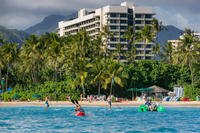
For many visitors, the beach experience begins with Tumon Bay, where most of the island's resorts are located. Verdant cliffs rise above both ends of Guam's most popular beach, providing a backdrop for the swimmers and snorkelers who enjoy its waters and the beachcombers who stroll along its shore.

While Tumon Bay receives the most visitors, many of Guam's peaceful and isolated beaches are located off the beaten path. Some are minutes from the main tourist beach, while others are within a short drive from most hotels.

Just south of the Guam Hilton is Ypao Point Beach, located a short walk around Ypao Point. This less-inhabited beach, which rests against a 120-foot cliff, is accessible during low tide. Just a short drive north of Tumon Bay lies another less crowded
The many beaches that fringe the 32-mile-long island of Guam are among the most beautiful anywhere.  While the beaches of popular Tumon Bay receive the most visitors, many of Guam's peaceful and isolated beaches are located off the beaten path.
The many beaches that fringe the 32-mile-long island of Guam are among the most beautiful anywhere. While the beaches of popular Tumon Bay receive the most visitors, many of Guam's peaceful and isolated beaches are located off the beaten path.
stretch of coastline where Fafai Beach and Tanguisson Beach are located.

On Guam's remote northern coast is Ritidian Beach, equally beautiful with unspoiled flora and fauna. This peaceful, secluded beach is managed by the military, which provides public access during daylight hours. Ritidian, which has been incorporated into a wildlife refuge, is easily accessible by automobile.

More adventurous visitors will find pristine and protected beaches awaiting them at the end of hiking trails. Some of the island's most beautiful beaches lie south of the village of Agat, along Sella Bay, where hikers will be rewarded by secluded stretches of white sand and waters rich with corals, ledges and caves.

Other excellent beaches are located on private land. Some of these can be explored with Discover Guam, a local tour operator. The most accessible is Star Sand Beach, with its unique star-shaped grains of sand, at the edge of Anderson Air Force Base on the island's northeast corner. Uruno Beach, another private beach along the north shore, remains in its original state - rugged and ecologically intact. Discover Guam, which specializes in tours with a local perspective, regularly takes groups to both private beaches.

Water Sports

Swimming in the sea and walking along the sand are not the only things to do on Guam's beaches. The warm waters are also popular for scuba diving, snorkeling, wind surfing, parasailing, jet skiing, kayaking and canoeing. Several companies operate charter fishing boats.

Guam's location at the edge of the 37,000-foot-deep Marianas Trench affords a treasure chest of opportunities for divers of all skill levels, from beginners to the most advanced.
Snorkeling spots for beginners include the protected bays inside the reef at Tumon Bay, Family Beach within Apra Harbor and Merizo Bay. Another ideal location is Cocos Island, a 15-minute boat ride from the southwestern village of Merizo, has calm waters that make conditions great for snorkeling.

Several hotels have snorkeling water pools. The Pacific Islands Club (PIC) offers a saltwater swim-through aquarium, one of only three in the world. The aquarium, home to more than 2,000 fish, allows novice snorkelers and divers to develop their skills under the guidance of specially trained staff members before venturing into the open water.

Many of Guam's other resorts have water-sports facilities, and several, including the Hilton Guam Resort and Spa, Onward Beach Resort, Guam Plaza Hotel and Hyatt Regency, have elaborate swimming pools with water slides, Jacuzzis and other special features.

Tumon Bay and Merizo Bay are the most popular places for wind surfing, water-skiing and jet skiing. Equipment-rental facilities located throughout these areas also offer instruction. The PIC has the largest wind surfing pool in Micronesia. Cocos Island is also an established wind surfing, parasailing, scuba diving and jet skiing locale.

Submarines and Boats

Visitors who prefer to stay dry can board the Atlantis Submarine to explore ocean depths of up to 150 feet. The one-hour voyage takes visitors to the Gab-Gab Reef, where they observe marine life from large viewing windows. The S.S. Neptune and the Nautilus Guam also offer the opportunity for reef viewing. These semi-submersibles launch from Apra Harbor in Piti and Hotel Wharf near Commercial Port, respectively.

Several boating tours offer travelers the chance to visit jungles and sites that are inaccessible by car or aircraft. Jungle Riverboat Cruise Inc. takes visitors up the Talofofo River to see ancient latte stone sites and dense jungles.

Chamorro Culture

A popular outing for almost every visitor to Guam is a visit to an authentic Chamorro village or other sites that offer a glimpse of Guam's rich cultural history. The Chamorros are native to Guam and their history extends as far back as 3000 B.C., when the
Today, the combined influences of Guam's rich cultural history and its native Chamorro people make Guam an appealing travel destination.
first Chamorros arrived from the Malay Peninsula. These ancient people lived alone on the island until Ferdinand Magellan landed there in 1521

Gef Pa'go in Inarajan is reminiscent of the traditional Chamorro village of 300 years ago. Here, tourists can experience Chamorro culture, lifestyle, food and dance. Native Chamorros demonstrate traditional activities including coconut-candy making, rice basket weaving, fish net throwing and palm-leaf hat and purse making.

The Chamorro Village in Hagatna is a marketplace that highlights the varied ethnicity of the island. Farmers, artisans and craftspeople sell their Guam-made goods directly to locals and visitors, and authentic Chamorro and multiethnic food is cooked and served here. At the Folk Arts Center, events and demonstrations by local artisans are scheduled throughout the year. For more information on these activities, contact the Chamorro Village by calling (671) 475-0376, sending a fax request to (671) 472-9446, or visiting www.admin.gov.gu/commerce/chamorro_village.htm.

The Chamorros' most interesting relics are latte stones, monuments as high as 13 feet, that once supported the homes of the upper class. The pillar base for these Chamorro homes was used as early as 500 A.D.

Horseback Riding

At the Southern Comfort Ranch, visitors can experience the countryside of Guam on horseback. Guam's largest operating horse ranch is located along the beach and below the mountains between the pristine villages of Inarajan and Merizo. Rides take visitors through low jungle areas, banana plantations, over graceful hills, past rock formations and to a panoramic mountain overlook for a breathtaking view of southern Guam.

War Memorials

Visitors can view more than 100 World War II sites located across the island, including the remains of a Japanese bunker at Gun Beach and the War Dog Cemetery honoring canine "soldiers."
Visitors can view more than 100 World War II sites located across the island, including the remains of a Japanese bunker at Gun Beach and the War Dog Cemetery honoring canine 'soldiers.'  The visitor center at the War in the Pacific National Historical Park showcases exhibits and films on the island's military history.
Visitors can view more than 100 World War II sites located across the island, including the remains of a Japanese bunker at Gun Beach and the War Dog Cemetery honoring canine "soldiers." The visitor center at the War in the Pacific National Historical Park showcases exhibits and films on the island's military history.
The visitor center at the War in the Pacific National Historical Park showcases exhibits and films on the island's military history. A special Web site - www.LiberationDay.com - gives an overview of Guam's WWII history and a detailed accounting of the July 1944 battle that liberated the people of Guam from Japanese forces.

Three memorial statues commemorate those who fought in WWII: two are located in front of the Governor's Office in Adelup; the third is at the Asan Beach overlook. At the Governor's Office, a life-sized statue of three GIs and two Chamorros honors the soldiers and Chamorros who battled the Japanese. A second large statue of women and children marching to Manengon Hills memorializes the journey of the Chamorro people to one of the Japanese detention camps prior to the infiltration of U.S. troops during World War II. At the Asan Beach overlook, several National Park Service bronze relief sculptures depict Guam's occupation by the Japanese and its liberation by U.S. troops.

South Pacific Park's Queen of Peace is the site of the last Japanese garrison on Guam and commemorates the 500,000 Japanese and American soldiers, civilians and Pacific islanders who lost their lives in the war. The 50-foot Memorial Tower of hands clasped in prayer symbolizes a hope for world peace.

Located in Tumon across from the Tumon Trade Center, the Pacific War Museum features relics and other historic
Many of Guam's beautiful waterfalls, pristine beaches, unique caves, historic sites and vista points are found at the end of hiking trails, and visitors who set off in search of them will explore parts of the island less populated with tourists.
memorabilia from World War II, the Korean War, and the Vietnam War. The museum showcases war vehicles, a water mine, and anti-aircraft artillery.

Boonie Stomps

Every Saturday at 9 a.m., the Department of Parks and Recreation (DPR) offers "Boonie Stomps," three-to-four-hour walks ranging from one to eight miles long, to waterfalls, beaches and jungles highlighting the flora and fauna of the island along the way. The cost is $2 per person. For a Boonie Stomp schedule, contact DPR at (671) 472-2887 or (671)477-8280, or visit www.admin.gov.gu/dpr/boonie/home.html.

In addition, an abundance of hiking trails allows visitors to explore Guam on their own. A good example is the trail to 30-foot Talofofo Falls, a popular spot for swimming and picnicking.

For more information on these and other attractions, contact the Guam Visitors Bureau, 1301 Marina Village Parkway, Suite 210, Alameda, Calif. 94501, or call (800) US-3-GUAM, or (800-873-4826) or e-mail guam@avisoinc.com. Or, visit the Guam Web site at www.visitguam.org.