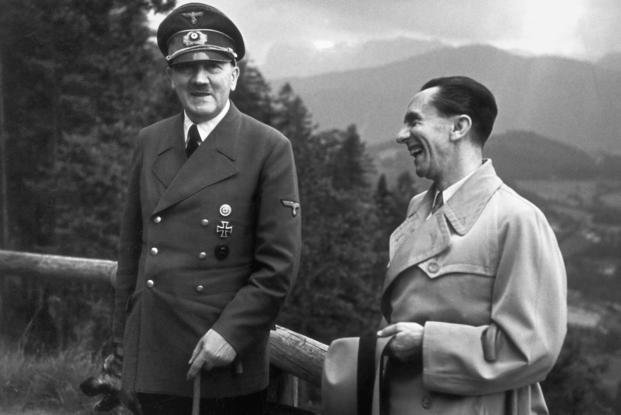
A German Army officer activated a bomb disguised as two bottles of Cointreau orange liqueur, handed the package to an unsuspecting member of Adolf Hitler’s staff, and watched it get loaded onto the Führer’s plane at Smolensk on the Eastern Front. It was March 13, 1943, and the bomb was supposed to explode 30 minutes later over Minsk. Hitler landed safely two hours later at his Rastenburg headquarters. A defective detonator was all that stood between the conspirators and the end of the war.
The Men Behind Operation Flash
The plot was led by Maj. Gen. Henning von Tresckow, a senior staff officer at Army Group Center who had turned against Hitler after witnessing the mass executions of Jewish civilians and Soviet prisoners by SS Einsatzgruppen squads behind the front lines. When Tresckow learned about the massacre of thousands of Jews at Borisov, he confronted his commanding officer directly: “Never may such a thing happen again. And so we must act now.”
Tresckow’s aide, Lt. Fabian von Schlabrendorff, served as the operational link between the conspirators on the Eastern Front and resistance figures in Berlin, including Gen. Ludwig Beck and Col. Friedrich Olbricht, who had prepared a coup plan that would use the Replacement Army to seize control of Berlin, Vienna and Munich the moment Hitler’s death was confirmed.
Tresckow had prepared multiple options for the assassination, including an ambush by anti-Nazi cavalry officers in the forest between the airfield and headquarters. He settled on the bomb because it offered the best chance of success without a firefight that could fail.
Read More: Pershing Crossed Into Mexico to Hunt Pancho Villa, Changing Warfare Forever
What Happened
Hitler flew to Smolensk on March 13 to meet with Army Group Center’s commander, Field Marshal Günther von Kluge. During lunch in the officers’ mess, Tresckow asked Lt. Col. Heinz Brandt, a member of Hitler’s traveling staff, whether he would carry a package of Cointreau to a colleague at Rastenburg as payment for a lost bet. Brandt agreed. The package contained a British-made plastic explosive fitted with an acid-based timer that would silently dissolve a wire, release a striker and trigger the detonator 30 minutes after activation.
As Hitler’s Condor aircraft prepared to depart, Schlabrendorff activated the fuse with a pair of pliers, resealed the package and handed it to Brandt as he boarded. A coded message went to Berlin: Operation Flash was underway. Tresckow waited with a stopwatch. Twenty minutes passed. Thirty. An hour. More than two hours later, a routine message confirmed Hitler had landed at Rastenburg alive.
Schlabrendorff later recalled: “We were stunned and could not imagine the cause of the failure. Even worse would be the discovery of the bomb, which would unfailingly lead to our detection and the death of a wide circle of close collaborators.” Tresckow immediately phoned Brandt and told him there had been a mix-up with the package. The next day, Schlabrendorff flew to Rastenburg, swapped the bomb for two real bottles of brandy and carried the live explosive back to Smolensk. When he opened it, he found the acid had dissolved the wire, the striker had hit the detonator, but the detonator itself was a dud. The cold temperatures in the unheated cargo hold likely caused it to fail.
Read More: The 5 Longest-Distance Sniper Kills in Military History
What Came After
Eight days later, on March 21, the conspirators tried again. Col. Rudolf von Gersdorff volunteered to be a human bomb at a Berlin exhibition of captured Soviet weapons that Hitler was scheduled to tour. He started the 10-minute fuse on explosives hidden inside his overcoat and planned to embrace Hitler when the timer ran out. Hitler walked through the exhibit in eight minutes and left. Gersdorff rushed to a restroom and barely defused the bomb in time.
The conspirators continued. The same explosives Schlabrendorff recovered from the plane were eventually used in the most famous attempt: the July 20, 1944, briefcase bomb planted by Col. Claus von Stauffenberg at the Wolf’s Lair. That bomb detonated but failed to kill Hitler.
Tresckow, knowing the Gestapo was closing in, walked into a minefield on the Eastern Front the next day and killed himself with a grenade. Schlabrendorff was arrested, tortured by the Gestapo and brought before the Nazi People’s Court on Feb. 3, 1945. An American air raid struck the courthouse that morning, killing Judge-President Roland Freisler with a falling beam.
Schlabrendorff survived the war, aided the Nuremberg prosecution and later served as a judge on West Germany’s Federal Constitutional Court. The United States awarded him the Presidential Medal of Freedom.
Sources: Fabian von. Schlabrendorff, “They Almost Killed Hitler” (1947); William L. Shirer, “The Rise and Fall of the Third Reich: A History of Nazi Germany” (1960); History.com, "6 Assassination Attempts on Adolf Hitler"; Post Alley, "Those Who Opposed Hitler" by Joel Connelly (2025)
Want to Learn More About Military Life?
Whether you're thinking of joining the military, looking for fitness and basic training tips, or keeping up with military life and benefits, Military.com has you covered. Subscribe to Military.com to have military news, updates and resources delivered directly to your inbox.




")