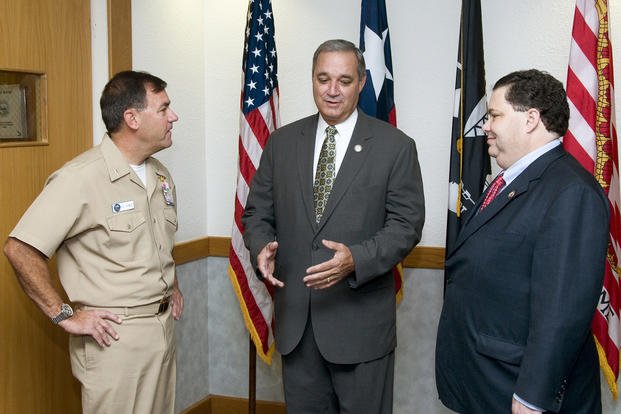
WASHINGTON -- Rep. Jeff Miller, Chairman of the House Committee on Veterans' Affairs, introduced complementary legislation to the Veterans Opportunity to Work (VOW) Act of 2011 (H.R. 2433) today to help curb rising veteran unemployment. The Tax Credit to Hire Veterans Act of 2011 (H.R. 2443) would provide a tax credit to be applied toward capital equipment purchases for small businesses that hire unemployed veterans.
"When I became chairman, I pledged to take a comprehensive approach to reducing veterans' unemployment. I firmly believe that approach must include incentives for small businesses to invest in hiring veterans," Miller said. "This unique approach not only employs veterans, but also incentivizes small businesses to purchase capital equipment, creating even more jobs for all Americans.
"I am confident that with the partner legislation I have introduced today, we can bring veteran unemployment below 5% in the next two years."
The tax credit provides small businesses, including veteran-owned businesses, the option to grow their companies while also hiring a jobless veteran. Several protections within the legislation ensure that veterans will be hired for the right reasons and prevent abuse.
"We all agree that the tax code must be simplified. Thousands of regulations hinder small businesses, the engine of our economy, from prospering," Miller said.
"Coupled with broader efforts to keep taxes and regulations on small businesses to a minimum, this credit will incentivize job creators and provide our veterans with meaningful employment."
A legislative hearing on the VOW Act will be held on July 15, 2011, at 10 a.m.
Background: The Veterans Opportunity to Work Act of 2011
Nearly one million unemployed veterans are in the United States today. As Iraq and Afghanistan veterans come home -- and as Vietnam, Cold War and Persian Gulf War veterans can't find or lose their jobs -- the economy is losing some of its best and brightest leaders and workers.
The House Committee on Veterans' Affairs is committed to helping the men and women who have served our nation and protected our liberty compete in today's austere economic climate through comprehensive legislation that provides a 360 solution to veteran unemployment. Introducing the Veterans Opportunity to Work Act of 2011 (H.R. 2433).
A breakdown of veterans out of work:
- Vietnam era veterans: 250,000
- Cold War era veterans: 278,000
- Persian Gulf War era veterans: 167,000
- Iraq and Afghanistan era veterans: 232,000
The Veterans Opportunity to Work Act of 2011
The Transition Assistance Program (TAP)
TAP provides service members who are about to be discharged with job-seeking skills, such as resume writing, to help their transition to the civilian world. But are these programs working? The VOW Act enhances TAP to ensure it is effective, measures success and requires an ongoing review of the program to strengthen it for the 21st century. In addition, the VOW Act will make attendance at TAP classes mandatory for all service members.
Education and Training
Through the Post-9/11 GI Bill, more veterans are getting a secondary education more than ever before. Forty-eight percent of veterans using education benefits are enrolled in four-year colleges and universities, 33% are enrolled in two-year colleges, 8% are enrolled in graduate school, and 11% are enrolled in an on-the-job training program or apprenticeship. We have laid the foundation to have the most robust, qualified veteran workforce since World War II.
The VOW Act will also enable 100,000 unemployed veterans of past wars to receive up to one year of Montgomery GI Bill benefits. This opportunity will allow veterans to acquire the skills to find employment in today's global market.
To give state governors maximum flexibility in the funds they receive to help veterans find jobs, the VOW Act will give governors the option of using up to 25% of the funding for direct training services for veterans.
National Guard and Reserve
The VOW Act honors the service of our National Guard and Reserve, 14% of which is currently unemployed. After leaving their job to serve their nation, their employer, by law, must reemploy them upon return. Unfortunately, this is not always the case. The VOW Act strengthens the protections provided by the Uniformed Services Employment and Reemployment Rights Act (USERRA).
Licensing and Certification
Despite America's military having some of the best-trained professionals, the inability to be credentialed or licensed in their field prevents these men and women from obtaining meaningful and gainful employment that makes use of their military training. These professions include, but are not limited to, combat medics, truck drivers and aircraft technicians.
The VOW Act will work with the Department of Labor and the states to identify roadblocks to obtaining employment.
Find the Right Veteran Job
Whether you want to polish your resume, find veteran job fairs in your area or connect with employers looking to hire veterans, Military.com can help. Sign up for a free Military.com membership to have job postings, guides and advice, and more delivered directly to your inbox.