


Home
Benefits
News
entertainment
shop
finance
careers
education
join military
community
Career Center for combat injured and disabled veterans
Taking care of America's heroes ... Connecting the combat injured and disabled veteran to employment and a career image Military OneSource 1-800-342-9647 24/7 Family Support
Wounded Warriors Find Work ; Army Aids Soldiers Looking for Jobs

Career Center > Article Archives

Wounded Warriors Find Work ; Army Aids Soldiers Looking for Jobs
by Charles D. Brunt
2008 Albuquerque Journal

 
Having been forced to leave the Marine Corps in 1997 after tearing a ligament in his right knee while running an obstacle course at Kirtland Air Force Base, Sgt. Robert Begaye, felt certain his days as a New Mexico National Guardsman were numbered last year when he blew out his other knee.

His knee gave way during hand-to-hand combat training in Fort Dix, N.J., just two weeks before he was scheduled to go to Iraq. The injury prevented him from deploying with his Rio Rancho-based unit and, he feared, would put his livelihood in jeopardy.

"I was wondering what was going to happen to me, and whether -- with this second injury -- the Army would just let me go," said Begaye, 38, a longtime Albuquerque resident and father of four.

If that happened, the former construction worker -- who now had two bad knees -- faced a difficult job search and uncertain future.

Fellow Guardsman Master Sgt. Fernando Vasquez, whose military service began when he was drafted in 1970 and sent to Vietnam for 18 months, had similar worries when after 20 years in the Guard his right hand was badly damaged during a combat mission in Afghanistan in 2006.

When Vasquez was shipped back home, he wasn't sure whether the Army would keep a wounded 56-year-old soldier.

Many wounded service members have shared those worries over the years.

As recently as the Vietnam era, severely wounded soldiers were ushered out of the military as quickly as possible and funneled to an overburdened and unprepared Veterans Administration. Medical outcomes weren't always the best.

Today, the military focuses more on getting their wounded healthy again and, whenever possible, returning them to active duty.

That refocusing has led to a number of "wounded warrior" programs, including one that now has Begaye and Vasquez employed in their home town and still in uniform -- the Army's Community Based Health Care Organization, or CBHCO.

Eddie Paulsgrove, a geologist for the Albuquerque District of the U.S. Army Corps of Engineers and volunteer director of its Employees With Disabilities program, learned about the CBHCO program about two years ago. The former Army paratrooper, who has service-related disabilities himself, soon sold his superiors on the program, which allows recuperating soldiers to live at home, receive local medical care and work in Defense Department jobs.

Besides relieving pressure on military medical facilities, the program helps the soldiers adjust to new military or civilian jobs.

Vasquez, a native of Mexico who moved to New Mexico as an infant, heard about the CBHCO program from his military caseworker in February 2007 and, despite being unable to use his hand, checked into the program.

A year later, he became the local Corps of Engineers' first CBHCO participant.

"The neat thing about this program is it's a real confidence builder," said Vasquez, who has a wife and three sons. "Not only do you get the support of your family, but people here at the Corps are really helpful."

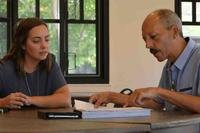
Vasquez, who worked in accounting before joining the National Guard in 1986, is now an internal review auditor for the Corps -- and says he looks forward to going to work each day.

Begaye, having recovered enough from his first knee injury to pass the Guard's entry physical, joined the Guard in 2002, serving as an infantryman. The second knee injury could have been a career- ender.

"When I first came home (from Fort Dix) I was at the armory just answering phones -- not exactly meaningful work or gainful employment," Begaye said.

A few months later, he sat in on Paulsgrove's presentation about the CBHCO program to National Guard members in Santa Fe. The two quickly figured out that Begaye's civilian construction experience dovetailed with the Corps' needs.

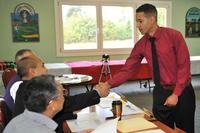
Today, Begaye oversees construction projects for the Corps, including a multimillion-dollar expansion of the Guard's armory on Wyoming Boulevard.

Getting into the program, Begaye said, "took away all the worry of having to come back on the civilian side and look for a job with two knee injuries."

The CBHCO program requires Vasquez and Begaye to work in a Department of Defense facility and to report daily to a platoon sergeant who keeps tabs on their medical progress. While in the program, they are full-time, active duty Army National Guardsmen. They receive military pay, but the Corps of Engineers provides the job and other needs.

"One of the key things with the program is that your medical rehabilitation comes first, and the job comes second," Vasquez said. "When I wasn't able to use my hand, they were able to accommodate me with voice-recognition software and a special keyboard that I could use with the other hand," he said.

Bruce Hill, public information officer for the Corps' Albuquerque district, said the program pays two-way dividends.

"We get to bring in highly qualified, well-trained individuals who bring a certain diversity to the table because of their (military) experiences," Hill said. And, he said, the soldiers get local medical care, meaningful work and the opportunity to continue their military career.

Paulsgrove said CBHCO participants can stay in the program "as long as medically required," and that they may eventually be able to return to their Guard or Reserve duties, retire from the military with disability benefits, or transition into their CBHCO jobs as civilians.

Vasquez, Begaye and Corps officials said they'd like to see the program encompass other military jobs -- and perhaps civilian jobs.

"I would really like to see this expand," Paulsgrove said. "It is it the right thing to do for our wounded warriors." -ST_ART- Caption: JIM THOMPSON/JOURNAL Master Sgt Fernando Vasquez thought he might lose his Army job after being injured in Afghanistan Instead, he works as an auditor at the U S Army Corps of Engineers ; RICHARD PIPES/JOURNAL New Mexico National Guard Sgt Robert Begaye oversees construction projects for the U S Army Corps of Engineers as part of a program that lets injured soldiers work jobs in their home towns while undergoing treatment and rehabilitation