










|

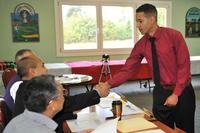
WASHINGTON (Aug. 17, 2004) Spc. Marcus
Colon of the 1st Armored Division's 1st Battalion, 94th Field
Artillery Regiment, tells his wife Heike what he wants written
in the remembrance book in the Pentagon 9-11 Memorial. "I
couldn't do it without her", he said. His injuries from
a vehicle accident in Iraq left him unable to do many things
on his own. Colon is one of 23 servicemembers from Walter
Reed Army Medical Center who visited the Pentagon Aug. 13.
U.S. Army Photo by Jennifer Sowel
|
By Sgt. 1st Class Doug Sample
American Forces Press Service
WASHINGTON (Nov. 10, 2004) – The Army today hosted a Pentagon
media roundtable to discuss a new support program aimed at helping
those Soldiers and their families through the rehabilitation and
transition process.
The Army began work on Disabled Soldier Support System (DS3) eight
months ago to provide counseling and help to severely disabled Soldiers
and their families through a “direct support” system,
said Col. Robert H. Woods Jr., director of the Army’s Human
Resources Policy Directorate. Dealing with injuries can be a traumatic
experience, he said. And we want to be there, right there with them,
taking them through the entire process.
DS3 began after Acting Army Secretary Les Brownlee and Veterans
Affairs Secretary Anthony J. Principi sought ways in which disabled
vets could be better served.
Veterans eligible for the program must have received a disability
rating of 30 percent or greater and be in a “special category”
as a result of injuries or illness. Those injuries may include amputees,
severe burns and head injuries and loss of eyesight, Wood said.
According to Army statistics, recent conflict has so far resulted
in more than 880 disabled veterans, 230 of them now enrolled in
the DS3 program, he said. Soldiers entered into the program will
go through three phases.
The first phase is getting the Soldier through medical stabilization
and rehabilitation, and then on to proper medical treatment channels.
The Soldier is then provided medical care and evaluated for continued
service on active duty or help with disability decision.
Phase 3 includes helping the Soldier with decisions on retirement
and transition back to civilian life. Soldiers also will be offered
help with educational and employment decisions.The Department of
the Army is the largest employer of veterans, who make up 25 percent
the department’s civilian work force. Of that number, 7 percent
are disabled veterans.
He added that the Army plans to have one caseworker for every 30
disabled Soldiers. Caseworkers will help Soldiers with problems
that arise throughout the rehabilitation and transition process.
The Army has a toll-free hotline for Soldiers to call during normal
business hours.
Woods said that currently most of the disabled Soldiers returning
from combat are being treated at Walter Reed Army Medical Center
in Washington. As the program continues to grow, Woods said, the
Army envisions placing DS3 counselors at Army regional medical centers
throughout the United States.
Sgt. Michael Cain of the 299th Engineer Battalion, 4th Infantry
Division (Mechanized), a truck driver, was injured during a re-supply
mission in Tikrit when his truck rolled over an antitank mine. The
blast severed his right leg below the knee. Although Cain said he
used DS3 counselors only sparingly during his two-month hospital
stay, counselors were able to help find a place for his parents
when they came to visit and were readily available to help during
his recovery.“ They do let you know what they have to offer
to you. They let you know what they do and how they can help you,”
he said.
Woods said the focus of the DS3 program is in the final statement
of the Army Ethos: “I will never leave a fallen comrade behind.”
“ That’s the focus of the DS3 program,” he emphasized.
“We didn’t leave them when they got hurt on the battlefield;
we brought them home, we medically stabilized them. And now we’re
not going to leave them at all.”Woods said the program is
being briefed to the other services so that they can consider offering
similar programs to their servicemembers.
# # # #
|