

Military Bookshelf: War in Fact & Fiction

Military.com - Tom Miller

Hallam's War, by Elisabeth Payne Rosen.

Unbridled Books, $25.95 (464p) ISBN 978-1-932961-49-2

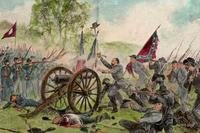
Civil War buffs will want to check out this debut novel from Rosen, a Louisiana native and a hospital Chaplain in Marin County, Calif. 

Rosen chronicles the odyssey of West Tennessee planter Hugh Hallam and his family as secession fever builds across the South and their hitherto quiet lives are inexorably engulfed by war.

Hallam, wife Serena, a beautiful belle from a prominent Charleston family, and their three children oversee a growing and prosperous farm with the help of a dozen or so slaves.  An interest in scientific farming, a genuine concern for the well-being of his slaves, and "conflicted loyalties" regarding the brewing sectional conflict set Hallam apart from his neighbors. 

But, when forced to choose following Ft. Sumter, Hallam joins his neighbors and, because of his West Point education and former service in the Mexican War, is appointed as commander of the 8th Tennessee Infantry Regiment.  Soon enough, he's in the thick of the fight at Shiloh.   Wounded and captured, Hallam is moved to Washington, D.C. where he's imprisoned at the Old Capitol Prison.

Left to run the farm, Serena struggles to keep going in the face of increasing privations, and when most of the slaves flee to the freedom of Union lines, she finally admits defeat.  Expecting that Hugh will be included in a prisoner exchange eventually, she moves to Richmond to await their reunion. 

A Civil War buff herself, Rosen knows her subject.  Her description of antebellum plantation life rings true as does her harrowing portrait of medical treatment in Confederate hospitals.  But, this works best as a family saga and moving love story. 
*******************************************************

Mr. Gatling's Terrible Marvel: The Gun That Changed Everything and the Misunderstood Genius Who Invented It, by Julia Keller. 

Viking, $25.95 (304p) ISBN 978-0-670-01894-9

Keller, a Pulitzer Prize-winning journalist and the culture critic for the Chicago Tribune, examines the life and times of Richard Jordan Gatling, the inventor of the Gatling gun, in this informative and entertaining cultural history.

A native of North Carolina, Gatling pulled up stakes and headed west to St. Louis as a young man.  Physically and mentally restless, like the country in the nineteenth-century, Gatling was always tinkering with mechanical things.  He recorded his first patent—for a mechanical seed planter—in 1844 at twenty-six-years-old.  He would eventually be credited with forty-three patents—mostly in the agricultural field.

Ironically, the invention that would make Gatling famous was a gun.  But, not just any gun.  Gatling's 1862 invention, prompted by the Civil War, was the world's first successful machine gun.  Based on Gatling's seed planter, the six-barrel gun could fire an astonishing 200 rounds per minute.  As the author notes, the machine gun represented the "mechanization of death."  Whether it also "changed everything" as her subtitle promises is problematic.  But, it would most definitely change war and the perception of combat.

That change, however, would have to wait.  Offered to the Union Army, it was rejected by the hidebound chief of ordnance and would not finally be added to the U.S. Army's inventory until 1866.  It wasn't until World War I, a decade after Gatling's death at 85, that the machine gun's awful legacy would be realized in the no-man's-land between trench lines. 

Even as Gatling's gun became a cultural symbol, its inventor faded into obscurity.  Keller's excellent account restores Gatling to his proper place in history.

----

More book reviews

Sound Off...What do you think? Join the discussion

Advertisement