













 |
William Sturgiss Lind,
Director of the Center for Cultural Conservatism
at the Free Congress Foundation, is a native
of Cleveland, Ohio, born July 9, 1947. He
graduated magna cum laude, Phi Beta Kappa
from Dartmouth College in 1969 and received
a Master's Degree in History from Princeton
University in 1971. He worked as a legislative
aide for armed services for Senator Robert
Taft, Jr., of Ohio from 1973 through 1976
and held a similar position with Senator Gary
Hart of Colorado from 1977 through 1986. He
joined Free Congress Foundation in 1987.
Mr. Lind is author of the Maneuver Warfare
Handbook (Westview Press, 1985); co-author,
with Gary Hart, of America Can Win: The Case
for Military Reform (Adler & Adler, 1986);
and co-author, with William H. Marshner, of
Cultural Conservatism: Toward a New National
Agenda (Free Congress Foundation, 1987). He
has written extensively for both popular media,
including The Washington Post, The New York
Times, and Harper's, and professional military
journals, including The Marine Corps Gazette,
U.S. Naval Institute Proceedings and Military
Review.
Mr. Lind co-authored the prescient article,
"The Changing Face of War: Into the Fourth
Generation," which was published in The Marine
Corps Gazette in October, 1989 and which first
propounded the concept of "Fourth Generation
War." Mr. Lind and his co-authors predicted
that states would increasingly face threats
not from other states, but from non-state
forces whose primary allegiance was to their
religion, ethnic group or ideology. Following
the events of September 11, 2001, the article
has been credited for its foresight by The
New York Times Magazine and The Atlantic Monthly.
Mr. Lind is co-author with Paul M. Weyrich
of the monograph: "Why Islam is a Threat to
America and The West." He is the author of
"George W. Bush's `War on Terrorism': Faulty
Strategy and Bad Tactics?" Both were published
in 2002 by the Free Congress Foundation.
William
Lind Article Archive
Discussion
Board
Have an opinion on this article? Sound off.
|
|
|
|
December 22, 2004
[Have an opinion on a William Lind column? Sound off in the Discussion
Boards.]
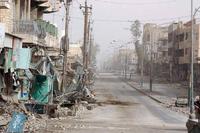
According to people who have been there, Fallujah is not a very big city. You can walk across it in half an hour. Yet when the history of this miserable war is written, I suspect it may loom large. Like Stalingrad, it will mark the point where the war turned against the invader.
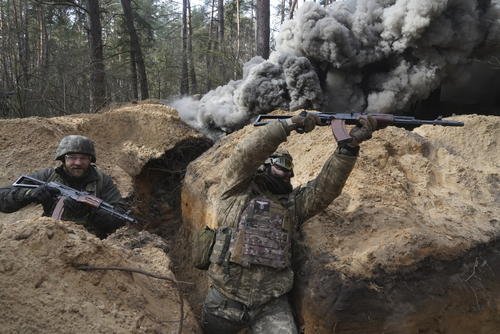
You may recall that the U.S. Marine commanders on scene declared some weeks ago that the battle was won and Fallujah was ours. It now appears they were Panglissading through reality, in a way that seems universal among American generals. Fighting still continues in Fallujah. Far from fleeing, resistance fighters are now infiltrating back into the city. Sectors we have "pacified" spring back to life in IED attacks and ambushes. There is talk about letting a few civilians return to Fallujah's ruins, but only under conditions that would make normal civilian life impossible.
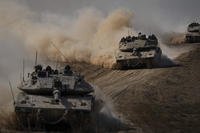
Of course, Fallujah itself was largely destroyed in the American assault. The American military did the only thing a Second Generation military can do: it put firepower on targets. 2GW armed services are one-trick ponies: they only have one act, and they perform it regardless of whether it fits the circumstances or not. In Fourth Generation war, the usual result is what has happened in Fallujah: a moral victory for the other side. As Colonel Boyd argued, and as this column has pointed out time and time again, the moral level of war is the most powerful, the physical level the least powerful.
Correspondent Patrick Cockburn, who is in Iraq, reports another result of Fallujah:
just at the moment that the U.S. troops were moving into Fallujah, suddenly, most of Mosul - a city in the north, which is at least five or six times the size of Falluja - fell to the insurgents... This is far more important in some ways that what's happened in Falluja.
Not only did most of the insurgents leave Fallujah before our assault, they realized that if we had concentrated in Fallujah, we had left openings elsewhere. They took full advantage of those openings. It is perhaps time to ask which side has the better commanders?
Stalingrad is now seen as one of history's great defeats. But in fact, the Germans had largely won in Stalingrad on the tactical level, before they were outflanked and encircled operationally, then defeated strategically.
If we look at Fallujah through that lens, the parallels become clearer. It is not certain we will ever fully control Fallujah, just as the Germans never took full control of Stalingrad. Nevertheless, we will claim a tactical victory.
Operationally, Fallujah, like Stalingrad, proved to be a trap. It led us to concentrate so many of our few combat troops in one place that the insurgency was able to make major gains in other, more important places. It again drew a glaring contrast between how America fights - by pouring in firepower - and the stated aim of the American invasion of Iraq, liberating the Iraqi people. You cannot liberate people by destroying their homes, their jobs and their cities. If operational art is the art of linking
tactical actions to strategic goals, American generals have once again shown the world that they have no operational skill - a situation that is typical of a Second Generation military. (It may be useful to remember that the American military failed operationally in the first Gulf War as well; Saddam's' Republican Guard escaped 7th Corps' slow, inept attempt at operational encirclement.)
After the first Marine assault on Fallujah in April - an assault that was wisely abandoned, since it threatened to set off a nationwide uprising against the occupation - Pat Buchanan said that Fallujah will probably mark the high water line of neo-con imperialism. I think the outcome of the second battle of Fallujah will confirm that prescient assessment. Just as Stalingrad marked the turning point in Fall Barbarossa, so Fallujah will go down in history as the "tipping point" in America's Last Crusade.
NB: This will be the last column for this year, though sadly not for this war. Let me close by wishing a hearty "Bah! Humbug" to fellow Realists everywhere.
Email
this page to friends
© 2004 William S. Lind. William S. Lind
is Director for the Center for Cultural Conservatism for the Free
Congress Foundation. All opinions expressed in this article are
the author's and do not necessarily reflect those of Military.com.
|