
















 |
William Sturgiss Lind,
Director of the Center for Cultural Conservatism
at the Free Congress Foundation, is a native
of Cleveland, Ohio, born July 9, 1947. He
graduated magna cum laude, Phi Beta Kappa
from Dartmouth College in 1969 and received
a Master's Degree in History from Princeton
University in 1971. He worked as a legislative
aide for armed services for Senator Robert
Taft, Jr., of Ohio from 1973 through 1976
and held a similar position with Senator Gary
Hart of Colorado from 1977 through 1986. He
joined Free Congress Foundation in 1987.
Mr. Lind is author of the Maneuver Warfare
Handbook (Westview Press, 1985); co-author,
with Gary Hart, of America Can Win: The Case
for Military Reform (Adler & Adler, 1986);
and co-author, with William H. Marshner, of
Cultural Conservatism: Toward a New National
Agenda (Free Congress Foundation, 1987). He
has written extensively for both popular media,
including The Washington Post, The New York
Times, and Harper's, and professional military
journals, including The Marine Corps Gazette,
U.S. Naval Institute Proceedings and Military
Review.
Mr. Lind co-authored the prescient article,
"The Changing Face of War: Into the Fourth
Generation," which was published in The Marine
Corps Gazette in October, 1989 and which first
propounded the concept of "Fourth Generation
War." Mr. Lind and his co-authors predicted
that states would increasingly face threats
not from other states, but from non-state
forces whose primary allegiance was to their
religion, ethnic group or ideology. Following
the events of September 11, 2001, the article
has been credited for its foresight by The
New York Times Magazine and The Atlantic Monthly.
Mr. Lind is co-author with Paul M. Weyrich
of the monograph: "Why Islam is a Threat to
America and The West." He is the author of
"George W. Bush's `War on Terrorism': Faulty
Strategy and Bad Tactics?" Both were published
in 2002 by the Free Congress Foundation.
William
Lind Article Archive
Discussion
Board
Have an opinion on this article? Sound off.
|
|
|
|
August 3, 2005
[Have an opinion on a William Lind column? Sound off in the Discussion
Boards.]
I spent last week in Pittsfield, Maine, at a symposium on modern war called by Colonel Mike Wyly, USMC (Ret). Col. Wyly was one of the heroes of the maneuver warfare movement in the Marine Corps in the 1970s and 80s, and when he suggests it's time for a new effort, people listen. My hope was that we might make some progress on Fourth Generation war theory, and while I am not sure we accomplished that, we did gain some ground on one important question: what might a state armed service designed for 4GW look like?
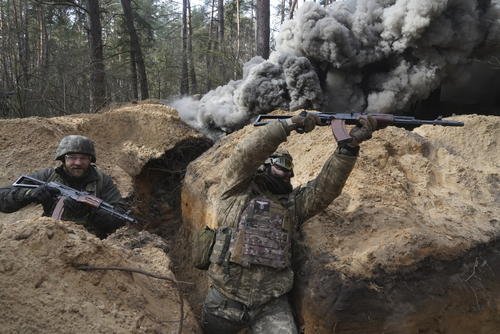
To address that question, we first had to answer another one: what would such a force's mission be? Not being neo-Trotskyites, we derived our answer within the framework of a defensive grand strategy. The new service's (and it should be a new armed service) primary mission would be to prevent outbreaks of Fourth Generation war on American soil. The focus must be on prevention, not “first response,” because if we are forced into a response mode, the enemy has already won. And, the new service must be oriented not only to preventing imported 4GW, like what we saw on 9/11, but also the homegrown variety such as London just experienced.
But -- and here was the kicker -- the new service has to keep us safe without pushing America further toward Big Brother, the all-powerful, centralized, national security state represented by the Department of Homeland Security, the “Patriot Act” and much else coming out of Washington.
So what should this new 4GW armed service be? The answer of our working group at the symposium was, “a militia.”
The militia was the basis of America's defense through most of our history as a republic. Moreover, there are two contemporary models. One is the volunteer fire department, which small town and rural America depend on, and which almost always performs well. The other is community policing, where cops walk the same beat in the same neighborhood for a long time, long enough to understand the neighborhood and prevent crimes instead of just responding to them. Neither volunteer fire departments nor community police serve as control mechanisms for the federal government. They respond to their local communities, not to Washington.
The new militia's most important function would be neighborhood watch. The only way to prevent 4GW attacks is to find out about them before they happen, and that means the militia, like community police, must know what is happening in their neighborhoods. But again, we don't want to feed Big Brother. Almost all of what the militia knows should remain on the local level.
How can we make this happen? Our working group decided the militia should normally report to the county sheriff, a local, elected official who has a lot of independence. Sheriffs' powers, defined over centuries in common law, allow them to tell the feds to stick it. Nor are they under the thumb of local or state politicians. If they violate citizens' rights, they can be unelected real fast. The militia, we also decided, would not have powers of arrest unless deputized. A separation of powers between the militia and law enforcement would also help maintain citizens' rights.
Another danger we wanted to avoid was allowing the First Generation culture of order, still characteristic of America's Second Generation armed forces, to carry over to the new service. Like Third Generation militaries, the militia must be outward-focused, prize initiative over obedience, and depend on self-discipline, not imposed discipline. We therefore determined that there should be very little in the way of formal ranks or commands and no saluting, drill, uniforms (at least none required) etc. The largest unit would be the company, with an elected captain. The captain's duties would be mostly administrative, and sub-units could elect adjutants to handle their paperwork if they wanted to. The militiamen would be free to choose leaders on a task basis, picking whoever they thought was best qualified depending on what they had to do. Yes, this means trusting ordinary citizens to show some common sense. Republics do that; if they can't or won't, they are no longer republics.


|
Another characteristic of our anti-4GW militia is that unless mobilized, the militiamen would not be paid. Instead of pay, they would collect points toward retirement benefits and -- we thought this could kill two birds with one stone -- they would receive health insurance for themselves and their families. Instead of health coverage just becoming another “entitlement,” citizens who did something for their country would find their country doing something for them. We thought long-term benefits like pensions and health insurance would also help recruit the kind of people the militia needs, solid citizens capable of delayed gratification.
Next week's column will continue this report on the results of Colonel Wyly's symposium, including the militia. And no, the fact that we met in Maine did not lead us to consider using moose as crew-served weapons carriers.
Email
this page to friends RSS feed
© 2005 William S. Lind. William S. Lind
is Director for the Center for Cultural Conservatism for the Free
Congress Foundation. All opinions expressed in this article are
the author's and do not necessarily reflect those of Military.com.
|