







 |
H. Thomas Hayden
recently concluded over 35 years of service,
which included the Agency for International
Development, the Marine Corps, defense industry
and the Pentagon. His specialties are Intelligence,
Counterinsurgency Operations, Counter-terrorism,
and Joint Concepts Development and Experimentation.
His Marine Corps assignments have included
command of two separate battalions; AC/S G-2,
4th MARDIV & AC/S G-2 FMFEurope; Branch Head,
HQMC, Special Operations and Low Intensity
Conflict (SO/LIC); Special Assistant to the
Assistant Secretary of Defense for SO/LIC;
and, Senior Program Analysts at HQMC with
the Joint Staff and DoD at the Pentagon. Overseas
assignments included Vietnam, Japan & Okinawa,
Europe, Central America, Saudi Arabia and
Kuwait, Somalia, Singapore, Philippines, and
Colombia. He has an MBA (Pepperdine) and an
MA in International Relations (University
of Southern California). He has written two
books and is working on a third.
Thomas
Hayden Article Archives
Sound
Off! - Have an opinion about this
article? Visit the discussion forum.
|
|
|
|
December 9, 2004
[Have an opinion on this column? Sound off in the discussion
forum.]
Iraqi Sunni boycott of the January 30th elections could mean political suicide for the Sunnis. Sunni religious leaders have called for a boycott of the January 30th ballot, and elements of the radical Sunni insurgency have warned voters against taking part. Others threaten civil war if the election proceeds.
It should be of no surprise to anyone that Iraq's Shiite Muslim majority has started to put aside their differences and present a unified list of candidates for the parliamentary elections. If the Sunnis boycott the election, this would surely mean a Shiite-dominated government and would probably lead to dire consequences for Saddam Hussein's former power base in the Sunni population.
The United Iraqi Alliance, organized under the leadership of Grand Ayatollah Ali Sistani, has brought together the main Shiite religious parties. This includes the radical group allied with Al Sadr, who until two months ago was leading an insurgent group fighting the Coalition forces. The United Iraqi Alliance is cementing the politics of Iraq's majority population. The slate of 240 candidates assumes major proportions in an electoral process anticipated by Shiites, who have embraced the prospect of attaining power at the ballot box after years of oppression by Saddam Hussein.
News reports on December 8th indicate that the Shiites are still bickering and the "alliance" may fall apart. The Sunnis had better hope this is so.
The January 30th election will choose a 275-member National Assembly, which will then name a new government and appoint the body that writes Iraq's new constitution. Iraqi voters will be asked to select an entire slate, and membership in the National Assembly will be distributed proportionally to each slate's share of the total vote. The United Iraqi Alliance's slate includes candidates from the country's minority Sunni Arabs and ethnic Kurdish and Turkmen; however, it is over two-thirds Shiite. Kurds have announced their intention to draft a separate slate that will probably command most of the votes in the Kurdish-dominated northern part of Iraq.
Let us be very clear of one thing, the insurgency will continue until the Sunni population, 20 percent of Iraq's 25 million people, is convinced that they have a viable future in the rebuilding of Iraq.
There is no doubt that the U.S. must shoulder much of the blame for the current insurgency in Iraq. It was originally reported that the Bush administration had planned to remove only the senior leadership of Saddam Hussein's Ba'athist Party. However, when Ambassador L. Paul Bremer assumed control of the U.S. effort in Iraq, he removed every Baa'thist government worker down to street cleaners and then disbanded the entire Iraqi army. All were sent home without compensation, and no possibility of any future employment. This is what has fueled much of the insurgency.
It's not a matter of winning "hearts and minds." When people have no work and the enemy, the U.S, is doing nothing to improve their lot, there will continue to be unrest and an insurgency. It is funny how the U.S. has had great success in building bases in Iraq but cannot rebuild the Iraqi economic infrastructure.
Audrey Hudson wrote in the Washington Times, December 6, 2004, "Iraq's president said yesterday the insurgency will have won if his country's January elections are postponed, and he asked the international community to help quell the surge of violence that some fear might force a delay. 'There is no sacred date,' President Ghazi Mashal Ajil al-Yawer said. 'But the thing is, this is a challenge that Iraqis have to take.
After reviewing the situation, I think the worst thing to do is to postpone elections. This will give a tactical victory to the insurgents, to the forces of darkness.'"
However, former U.N. special envoy to Iraq Lakhdar Brahimi, who is responsible for organizing the elections, is wavering on whether the elections can go forward amid the increasing violence.
Quoted in the Washington Times, Brahimi said, "Elections are no magic potion, but part of a political process. They must be prepared well and take place at the right time to produce the good effects that you expect from them."
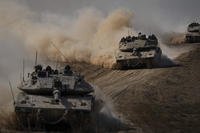
Recent reports from the Pentagon indicate that an additional 12,000 U.S. troops will be sent to Iraq for election security, raising the total to 150,000.
Asked on "Fox News Sunday" whether that number was enough, Sen. John McCain, Arizona Republican, said, "It probably isn't." But he also added, the military is too small to do much more. "Many of us, as long as a year and a half ago, said you have to have more people there. You have to have more linguists, you have to have more Special Forces, and the Pentagon has reluctantly, obviously, gradually made some increases."
It was reported earlier this summer by a Washington, D.C, "think tank" that there are only three possibilities for the future of the Iraqis: 1) Balkanization like the break up of Yugoslavia, 2) civil war, or 3) continued civil (read insurgent) unrest.
The recent "classified" CIA Station Chief's memo stating that things were getting worse is absolutely true. The Rumsfeld crowd is in denial. They refuse to accept any measure of failure. Many in the Administration are now predicting American troops will complete their mission in Iraq within months. Rumsfeld says that U.S. troops will be home by the end of the Bush presidency.
I expect Iraqi security problems will continue long after the elections.
Email
this page to friends
[Have an opinion on this article? Sound
off here.]
© 2004 H. Thomas Hayden. All opinions
expressed in this article are the author's and do not necessarily
reflect those of Military.com.
|