
























 |
H. Thomas Hayden
recently concluded over 35 years of service,
which included the Agency for International
Development, the Marine Corps, defense industry
and the Pentagon. His specialties are Intelligence,
Counterinsurgency Operations, Counter-terrorism,
and Joint Concepts Development and Experimentation.
His Marine Corps assignments have included
command of two separate battalions; AC/S G-2,
4th MARDIV & AC/S G-2 FMFEurope; Branch Head,
HQMC, Special Operations and Low Intensity
Conflict (SO/LIC); Special Assistant to the
Assistant Secretary of Defense for SO/LIC;
and, Senior Program Analysts at HQMC with
the Joint Staff and DoD at the Pentagon. Overseas
assignments included Vietnam, Japan & Okinawa,
Europe, Central America, Saudi Arabia and
Kuwait, Somalia, Singapore, Philippines, and
Colombia. He has an MBA (Pepperdine) and an
MA in International Relations (University
of Southern California). He has written two
books and is working on a third.
Thomas
Hayden Article Archives
Sound
Off! - Have an opinion about this
article? Visit the discussion forum.
|
|
|
|
March 11, 2005
[Have an opinion on this column? Sound off in the discussion
forum.]
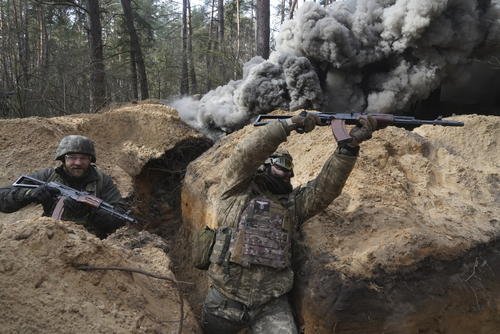
Recent statements by the Taliban in Afghanistan reveal serious weaknesses in their capability to conduct combat operations. This indicates that they are more concentrated in Pakistan than many may have thought.
A Taliban spokesman said that the insurgency would be renewed in the spring of 2005. He said the movement has been preparing for a new offensive, according to the "Central Asia Newsline," March 18, 2005.
"As soon as the weather changes, the snow melts, and the cold season is over, our attacks will be intensified," said Taliban spokesman Latifullah Hakimi. "We believe that our campaign is quite a success, and intend to achieve better results. The resistance to the pro-American authorities is mounting."
The snow must be making it difficult to traverse the mountains between Pakistan and Afghanistan. The Taliban statement seems to indicate that they cannot mount an effective winter campaign inside Afghanistan, and need reinforcements from across the border.
Another interesting comment by Hakimi may indicate that some of the Taliban are a concern to the old Taliban leadership, where local commanders are negotiating with the Afghan authorities to join the political process: "We did not initiate any talks with the pro-American government of Afghanistan and did not delegate anyone to negotiate on our behalf. The people who are allegedly in talks with the pro-American government in reality represent themselves only."
On March 14th, Afghan authorities reported security forces captured three Taliban insurgents in a battle in the southeast. Afghan officials then reported that Army soldiers eliminated the Taliban presence from the Arghandab district, Zabul Province.
It's hard to say if this is government propaganda or facts
Afghanistan's first fully free parliamentary elections -- originally scheduled for last year but repeatedly pushed back for "logistics and security reasons" -- will be held September 18, 2005, according to recent government statements.
Elections for the country's 34 provincial councils will also be conducted on September 18th. However, voting for hundreds of district councils and a portion of the seats in the upper house of parliament will be postponed until district boundary lines can be set.
The announcement on the elections was made at a news conference held by Besmillah
Besmil, Chairman of the Joint Electoral Management Body. The management body is an independent group consisting of nine Afghans, and four foreign members that are charged with administering the elections.
The political process seems to be gaining supporters, but it is unclear why President Hamid Karzai announced a delay in parliamentary elections.
My guess is that there are more problems with bringing the warlords into the political process than with the Taliban. Additionally, there are the lawless regions in the west where opium farming is a major problem for the new government. Karzai cannot stop the opium farmers from growing the poppy plants until they have an alternative means of making a living.
I have always made a pitch for the US to just buy the damn crop and quit spending billions on trying to interdict the flow of opium, and more billions on criminal prosecutions and unworkable so-called "rehabilitation programs."
Buy the crop, burn it in front of the farmers, then offer them an incentive to farm another crop that the US will continue to buy until the economic forces take over to make the crop pay the farmers a decent wage.
Some may wonder why there seems to be no interaction between Afghanistan and Iraq. The answer is simple. Afghanistan is Sunni and Iraq is mostly Shi'ite. Additionally, The Sunnis of Afghan do not trust the Shi'ites of Iran. The real question is can any central government ever rule in Afghanistan with the challenges of a large multi-ethnic population, tribal and religious leadership opposed to a central government and the warlords.
Like Iraq, there are major ethnic differences in Afghanistan. The major ethnic group is the Pushtu-speaking Pathans of the east and southeast -- about 42% of the population. The Dari-speaking Tadjiks of the north and west are about 23% of the population. The Turkomen and Uzbeks of the north each speak a separate Turkic language. Baluchis are about 15% and live in the south.
The Baluchis in Afghanistan are closely tied to the Baluchis in Pakistan and the Pathans feel kinship in the North-West Frontier Province of Pakistan. So we see the close interaction of Taliban relations with their Pakistan border relations.
In a classic work in 1815 by Mountstuart Elphinstone, An Account of the Kingdom of Caubul, summarized the character of the Afghanistan people: "…their vices are revenge, envy, avarice, rapacity, and obstinacy; on the other hand, they are fond of liberty, faithful to their friends, kind to their dependents, hospitable, brave, frugal, laborious, and prudent; and they are less disposed than the nations in their neighborhood to falsehood, intrigue, and deceit."
Wonder what happened between 1815 and now?
The Kingdom of Kabul ceased to exist a long time ago when the British drew an arbitrary line between Pakistan and what is now Afghanistan with no interest in ethnic centers of population.
Email
this page to friends
[Have an opinion on this article? Sound
off here.]
© 2005 H. Thomas Hayden. All opinions
expressed in this article are the author's and do not necessarily
reflect those of Military.com.
|