







Joseph L. Galloway
is the senior military correspondent for Knight Ridder Newspapers and a nationally syndicated columnist.
One of America's preeminent war correspondents,
with more than four decades as a reporter
and writer, he recently concluded an assignment
as a special consultant to Gen. Colin Powell
at the State Department.
Galloway, a native of Refugio, Texas, spent
22 years as a foreign and war correspondent
and bureau chief for United Press International,
and nearly 20 years as a senior editor and
senior writer for U.S. News & World Report
magazine. His overseas postings include tours
in Japan, Vietnam, Indonesia, India, Singapore
and three years as UPI bureau chief in Moscow
in the former Soviet Union. During the course
of 15 years of foreign postings Galloway served
four tours as a war correspondent in Vietnam
and also covered the 1971 India-Pakistan War
and half a dozen other combat operations.
In 1990-1991 Galloway covered Desert Shield/Desert
Storm, riding with the 24th Infantry Division
(Mech) in the assault into Iraq. General H.
Norman Schwarzkopf has called Galloway "The
finest combat correspondent of our generation
-- a soldier's reporter and a soldier's friend."
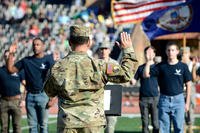
WASHINGTON - There are nearly 140,000 American troops in Iraq. An additional 17,000 in Afghanistan. More still in Bosnia and Kosovo and Guantanamo and on our bases and ships around the world.
Some suggest that military votes may be the key to a very close presidential election this year. Some say that fearfully. I say if that comes to pass, our country's future could not be in better hands than those of the young men and women putting their lives on the line protecting that future.
If you doubt that, read the following carefully. It is an e-mail essay, written by a young woman, an enlisted U.S. Army Reserve soldier from Duluth, Minn., now serving in Iraq. We reached her by e-mail, after a friend passed the essay to us, and she agreed to its publication if we not reveal her name, only the facts of her present duty. What she has to say resonates as our country prepares to vote next week.
---
"I got my ballot the other day, and it was a relief to find that it didn't have any blood stains on it. You expect there to be some sign of the effort it took -- the lives it cost -- to accomplish that delivery in a combat zone. With all the hits we've been taking lately, that was all the cautious good news one could find. There was no sign of what happened to the soldiers who died getting the mail here. It's almost like it didn't happen.
"I left the post office, and looked up at the palace on the hill: Saddam's palace, now a place where soldiers from several countries are bumbling around, trying to bring democracy to this place. Some of them have only recently acquired it themselves in their countries. One of the most touching things I've ever seen was the prime minister of Bulgaria, tearing up on TV as his country was inducted into NATO.
"Democracy is one of those things that people expect when they see that palace on the hill. They want it to be big and shiny, with trumpets and armies and flags. Instead, I think of that man, trying not to weep in front of the world. I had never really thought before about what it means to be a citizen of a democracy, because it's always been there for me.
"It shouldn't be a big thing, this concept of freedom. That palace on the hill has gorgeous marble but very crudely carved. From that vantage point one could almost see Saddam's eyes, looking for enemies. Yet the people of Iraq still smile at us, offer us tea, smiles, handshakes -- able, even in this war, of trying to find some common ground. These are people who hope for freedom, for self-determination. For safety.
"Some people say, `My country, love it or leave it,' and insist that that's patriotism. It's not. These are the summer soldiers of our history, loving only what is easy to love, accepting only what is easy to accept, and hating anything that's difficult to comprehend. They love the big and the brash, and miss out on the small details. They see only the surface of the water, never the depths, and in its surface they see only their own reflection.
"They say they love their country, but they only love the good parts. Their love is like a saying of my father's: `Cold indeed is the love blown out by one gust of wind.' They love her only as long as they can believe she's perfect.
"Others love her not because she's perfect but because of what she tries to be, what she tries to overcome. Love her as a whole, and you cherish her all the more, for her potential and her efforts -- and her vulnerability. Love her as she is, for what she might become, and you might be able to see potential elsewhere, too, in the love other people have for their countries, for their faith, for their culture.
"Democracy, like any virtue, can be promoted through small acts and gestures. Its central premise is that every person's voice should be heard, and that concept never really hit me till I stood in front of that post office with the dust of a hundred histories on my boots and wrote my candidate's name on my ballot. My handwriting was messy and blotchy. The heat does something to the ink. It was perfectly ordinary -- one pays bills in this humble fashion every day. And yet there was that building high above me, the historic river flowing by, the ruins nearby. It was a small act in extraordinary circumstances.
"People ask how we can do the job we do here, undertake the risks we do? It's simple: It is for moments such as this. How often do you get to say that you voted in Iraq? But it's more than that. We know that we're preserving that right for other people, too. As long as some people are free, they can offer hope to those who are not.
"I took an oath to defend the Constitution, and to me that means its principles. Once you recognize that you're free, you also have to recognize that other people are not, and that until they are, you can't really be free either. Freedom carries with it that burden. It's not enough to be a beacon, a symbol, a hope. You have to act to uphold it.
"I suspect the sunshine patriots Thomas Paine spoke about got a distinct jolt when they realized that freedom doesn't mean disconnection from other people -- in fact, it means the exact opposite. Free people are linked to those who aren't free. No one can really be free till everyone is free.
"There's something about being a Reservist that makes this especially vivid. We throw our fates to chance. We put aside our individuality, our homes, our jobs, and we take up someone else's life and hopes. We feel part of a larger purpose, a larger cause. And we like it.
"People ask why we do the job we do, and there's an answer: Because of you. The act of taking up that banner links us all together, even if you never take up a weapon. Freedom doesn't mean isolation; it means connection. We have a common desire. There are lots of different battles. Some happen at home: some happen on foreign soil.
"People ask how they can support us. It's very simple. Vote. I don't care who you vote for, I just care that you do. Our deaths, our injuries, our sacrifices are all payment for that concept of giving people a voice. We've given you a gift. We've paid for it with our blood.
"People ask how they can support us. Vote! Take up the banner for all the people, living and dead, who fought for this right. Do your part. Remember them. Remember us. Vote!"