





























Joseph L. Galloway
is the senior military correspondent for Knight
Ridder Newspapers and a nationally syndicated
columnist. One of America's preeminent war
correspondents, with more than four decades
as a reporter and writer, he recently concluded
an assignment as a special consultant to Gen.
Colin Powell at the State Department.
Galloway, a native of Refugio, Texas, spent
22 years as a foreign and war correspondent
and bureau chief for United Press International,
and nearly 20 years as a senior editor and
senior writer for U.S. News & World Report
magazine. His overseas postings include tours
in Japan, Vietnam, Indonesia, India, Singapore
and three years as UPI bureau chief in Moscow
in the former Soviet Union. During the course
of 15 years of foreign postings Galloway served
four tours as a war correspondent in Vietnam
and also covered the 1971 India-Pakistan War
and half a dozen other combat operations.
In 1990-1991 Galloway covered Desert Shield/Desert
Storm, riding with the 24th Infantry Division
(Mech) in the assault into Iraq. General H.
Norman Schwarzkopf has called Galloway "The
finest combat correspondent of our generation
-- a soldier's reporter and a soldier's friend."
Your Two Cents Submit your stories, news items, or a benefits update -- and help Military.com bring the best, most important stories to your fellow servicemembers, veterans, and family members. Contribute here
WASHINGTON - A new generation of American war veterans is being born
of the combat in Afghanistan and Iraq,
and it is high time Congress crafted a new GI
Bill with the same enhanced benefits that were provided for their
grandfathers in World
War II and Korea,
and for their fathers and uncles who fought in Vietnam.
The original GI bill, signed by President Franklin D. Roosevelt in June 1944, provided educational benefits to 8 million veterans. It also provided low-cost guaranteed loans for veterans to buy homes or farms, as well as medical assistance after they were discharged. Similar benefits were provided to veterans of the Korean War. In 1966 a new GI bill was passed providing the same benefits for veterans of the Vietnam War.
In the peacetime year of 1984, with an all-volunteer military emerging from the shadow of Vietnam, Congress passed a stripped-down version of veterans' benefits known as the Montgomery GI Bill Program. It was a temporary program made permanent in June 1987.
It is that program that now applies to America's new war veterans, and it provides little enough.
Only if a new enlistee signs up for the college benefit at the time of enlistment, or during boot camp, and agrees to have his pay reduced by $100 a month for his first 12 months of service, is he eligible for the education benefits - 36 months of assistance at the rate of approximately $1,000 per month.
What is missing from this picture?
Well, the dependents of service members killed or disabled on active duty receive 45 months of education benefits, and that is little enough given the sacrifice their families have made.
But the 36 months of benefits for a newly returned veteran is simply not enough. Most of them have been in the military for four years or more. They are a long way from their last high school classroom and most require remedial classes, especially in math and writing skills needed to perform up to college standards.
There is no room in the 36 months of benefits for that, which means these new veterans coming up on their fourth and final year in college see their monthly checks dry up and disappear.
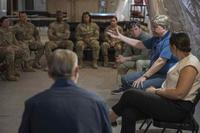
Jeremy Clements, a Marine veteran of service in Afghanistan and a sophomore at Santa Fe Community College in Gainesville, Fla., says more than half the veterans entering his school have to take the remedial classes.
"If there is a change of your major that's a big problem," Clements said. "If it's a big shift you've wasted two years of your benefits."
Jesse Bishop, an Army Ranger veteran of Afghanistan and a junior at the University of Florida in Gainesville, said the dependents of killed or disabled service members "get a semester and a half to take remedial courses before tapping into their 45 months of benefits."
Rosanna Powers is a Marine
veteran of service in Kuwait and the mother of a young child whose
father was killed in Iraq. Her brother also was killed in Iraq. She
is a freshman at Santa Fe Community College, and says it takes the
average student at all schools 40 months to complete a four-year degree.
"The Vietnam-era veterans received 44 months of educational benefits and did not have to contribute (from their military pay)," Powers said. "Benefits for wartime veterans should be different from those of peacetime veterans. This can be resolved with more educational benefits for recent veterans."
In the beginning, in 1944, the GI Bill was viewed as an investment - an investment in our future - and what an investment it proved to be. Eight million tapped educational benefits, and their impact on the colleges and on the nation's economy as they poured out into the workforce was phenomenal. The home loan guarantees for those veterans had a similar impact on the economy and society in general.
It makes no sense at all that Congress votes all the money the Defense Department asks for to fight the wars in Iraq and Afghanistan, but is cheap when it comes to the young men and women who wear the uniform and risk their lives for our country.
It is high time for Congress to draft a new GI Bill for this new generation of war veterans who are just as deserving of our support as were their grandfathers and fathers in their day.