



















Joseph L. Galloway
is the senior military correspondent for Knight
Ridder Newspapers and a nationally syndicated
columnist. One of America's preeminent war
correspondents, with more than four decades
as a reporter and writer, he recently concluded
an assignment as a special consultant to Gen.
Colin Powell at the State Department.
Galloway, a native of Refugio, Texas, spent
22 years as a foreign and war correspondent
and bureau chief for United Press International,
and nearly 20 years as a senior editor and
senior writer for U.S. News & World Report
magazine. His overseas postings include tours
in Japan, Vietnam, Indonesia, India, Singapore
and three years as UPI bureau chief in Moscow
in the former Soviet Union. During the course
of 15 years of foreign postings Galloway served
four tours as a war correspondent in Vietnam
and also covered the 1971 India-Pakistan War
and half a dozen other combat operations.
In 1990-1991 Galloway covered Desert Shield/Desert
Storm, riding with the 24th Infantry Division
(Mech) in the assault into Iraq. General H.
Norman Schwarzkopf has called Galloway "The
finest combat correspondent of our generation
-- a soldier's reporter and a soldier's friend."
Your Two Cents Submit your stories, news items, or a benefits update -- and help Military.com bring the best, most important stories to your fellow servicemembers, veterans, and family members. Contribute here
The American military's future, at least for the next four years,
will be hammered out over the next six months in a massive review
of everything from people to equipment to strategies for dealing with
an unsettled and suddenly more dangerous world.
The Pentagon goes through this exercise every four years, on orders
from the Congress, and the decisions being made now will shape everything
from budgets to expensive new weapons systems to the training of soldiers
and the development of leaders.
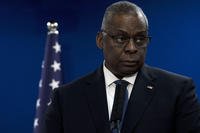
Defense Secretary Donald H. Rumsfeld, seeking to stamp his - and the
Bush administration's - view on this process, has set four major goals
for the military's thinkers and planners to work toward. That still-classified
document speaks to how Rumsfeld sees the world of the future.
Influenced heavily by the experience of Sept. 11, 2001, and by the
unexpectedly costly war in Iraq, Rumsfeld told the military that the
four core issues are:
-Building partnerships with threatened or failing states to defeat
terrorism.
-Defending the American homeland by all means, including pre-emptive
strikes against terrorists plotting attacks.
-Preventing the proliferation of weapons of mass destruction.
-Influencing the military choices of rising powers such as China or
India.
None of the markers laid down by Rumsfeld speaks to the issue of old-fashioned
state-against-state conventional warfare, which signals the beginning
of some serious in-fighting over high-dollar contracts for such things
as Navy destroyers and big submarines, short-range fighter-bombers
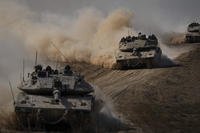
and main battle tanks. At the moment, there are two services at war
- the Army and the Marine Corps - and two others - the Air Force and
the Navy - which are essentially at peace.
Rumsfeld already had signaled a willingness to trade cuts in such
high-dollar items as the V/F-22 fighter plane and new Navy destroyers
to find money to pay the cost of keeping 150,000 Army and Marine troops
in Iraq and repairing and replacing the vehicles and equipment they're
using up at a rate few anticipated before the war began.
Left unsaid in the defense secretary's guidance was anything about
increasing the numbers of troops in either of those stressed and over-stretched
services that put the boots on the ground and keep them there long
after the other two have sent most of their people and weaponry home.
Rumsfeld's guidance calls for a military capable of getting in front
of international problems before they become all-out wars.
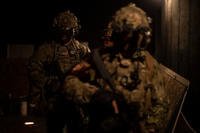
He wants a proactive military that can dispatch small teams to teach
counter-insurgency techniques to the armies of beleaguered countries
and help them survive, and yet is powerful enough to influence the
thinking and strategic choices of countries such as Russia and China.
That same military also must be capable of mounting swift strikes
anywhere in the world to take down terrorist groups plotting to attack
Americans at home.
It's the French who are fond of saying that "the more things change,
the more they remain the same."
There was a time, even within the memory of Rumsfeld, when the United
States put what were called Military Assistance and Advisory Groups
(MAAGs) in hotspots around the world to train and arm the armies of
faltering nations beset by insurgents, who in those days were often
communists or allied with communists.
Beginning in 1950, there was a MAAG in French Indochina, eventually
providing more than 70 percent of the cost of the French war against
the Viet Minh guerrillas. When the French were driven out in 1954,
the American MAAG began advising and supplying the forces of the new
nation of South Vietnam.
That adventure ended badly, both for us and for South Vietnam, in
1975. Until recently, the U.S. military avoided other such missions
out of fear that we'd become embroiled in civil wars and forced deeper
into various swamps. Instead, we've sold faltering nations the arms
with which to fight their own battles.
But that doesn't appear to be what Secretary Rumsfeld has in mind.
We will go in, teach the army of some faltering nation how to fight
better, give it the weapons and leave as quickly as we came. A much
better idea for certain, and one that was in the original plans for
those old, discredited MAAG groups.
It's unlikely that the American officers and soldiers who landed in
Saigon in 1950 had any inkling that what they were beginning would
end a quarter of a century later, in 1975, after the loss of 58,239
Americans and more than a million Vietnamese.