


















Army in New Push for Skilled Immigrants

Army in New Push for Skilled Immigrants

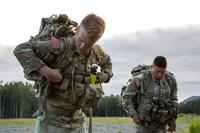
Ying Ji is like so many of her fellow Army recruits -- young, bristling with energy and determined to make a difference for America.
 
But there's one thing that separates the 21-year-old now at basic training from her peers: she's not an American -- at least, not yet anyway.
 
Ji is part of a revamped program introduced earlier this year that allows non-citizens without green cards to join the Army and, in the process, earn their citizenship.

Previously, non-American citizens wanting to join the service had to hold a green card, which is a permit for lawful permanent residence.
 
Recruited for their specialties, the Defense Department has ever-so-slightly cracked the door to what could one day be a vast recruiting pool of uniquely qualified immigrants.
 
Ji was studying economics at a community college in California earlier this year when she read about the new program - dubbed Military Accessions Vital to the National Interests - on a Web site for Koreans living in the United States.
 
"I decided to put everything on hold and to go for it," Ji said in a recent interview with Military.com. "This is a once-in-a-lifetime opportunity to give back to this great country and become a citizen, too. It's too good to pass up."
 
The program is not necessarily new, just a rehashed version of old policy that Defense Department officials were failing to take advantage of during the past eight years. Under the program, known as MAVNI, the military is allowed to widen its recruiting pool to non-citizens with critical skills during a time of war.
 
In this case, the wars have been long established with no clear end in sight. And the lack of critical skills is widely known: language experts and medical specialists, according to Army Lt. Col. Peter Badoian, project officer for the pilot program.
 
Green card holders have long been a sizable minority in the military, often earning their citizenship at tearful ceremonies aboard ships at sea or at combat zone installations.
 
But there are no less than 78 different kinds of temporary visas that non-residents can hold that allow them to remain in the United States for years without a path toward citizenship.
 
It took an immigration attorney who serves in the Army Reserve and teaches at West Point to connect all the dots and diplomatically advance renewing the MAVNI enlistments through the Defense Department.
 
That was no small effort. The immigration attorney, who declined to be identified, spent more than five years working behind the scenes to make it happen.
 
"It takes a long time to get buy in," Badoian said of the attorney's efforts.
 
The work paid off, and in February the Pentagon created a pilot program that allows 1,000 immigrants to enlist.
 
Since it launched five months ago, the Army, which filled more than 80 percent of available slots, has been inundated with applications.
 
"There's a very significant population that is here legally and wants to serve, but has lacked the legal ability to enlist," Badoian said. "We now have the opportunity to recruit from that population if they can meet these conditions."
 
But MAVNI is not open to any non-native resident. Certain language skills get priority, meaning a Pashtu or Persian speaker is more likely to be accepted or receive greater priority than a Russian speaker. Spanish doesn't even make the third tier priority list.
 
And despite the language priority, the recruits will be limited to certain jobs in the military open to non-citizens, thus excluding an intel billet for even a native Arabic speaker.
 
The language specialists must serve a five-year tour in the active Army while the medical specialists may serve a similar tour in the active or Reserve forces. Anyone who joins under the program can immediately apply for full citizenship, which may be revoked if they fail to complete their commitment.
 
So far, the quality of the recruits has allowed the Army to be very selective. Nearly 70 percent of the candidates accepted this year entered basic training with a bachelor's degree.
 
"We are finding very educated, very talented people knocking on our doors wanting to take advantage of this program," Badoian said. "Some of these folks have scored off the charts on the entry exams and we envision a very bright future for them in the Army."
 
Pakistanis, Indians and Bangladeshis have joined immigrants of Korean, Chinese and European ancestry thus far.
 
Army Chief of Staff Gen. George W. Casey Jr. administered the oath of enlistment to a group of MAVNI recruits earlier this year in New York City's Times Square.
 
Ji, who began basic training last month, said at first her Korean friends were apprehensive of her decision.
 
"A lot of tem are worried about me. Joining the Army, first thing that pops in their mind is that I am going to war," she said. "But once I explain my situation, and what is going to happen to me over the next 20 years, they are very excited for me to have this opportunity. A lot of them want to join now, too."

© Copyright 2009 Military.com. All rights reserved. This material may not be published, broadcast, rewritten or redistributed.
Bookmark and Share

Add Your Comment:

More Headlines

Latest Stories

   Latest Stories | RSS Icon RSS

What's Hot

Editor's Pick

   Editors Pick | RSS Icon RSS