

What is the U.S. Air Force?
The U.S. Air Force is one of the five branches of the U.S. Armed Forces.
It defends the United States through control and exploitation of air and space.
Non-prior service applicants must be in Basic Military Training before their
28th birthday. Officer Training School applicants must be commissioned prior
to their 35th birthday. Physician, Nurse and Allied Health applicants must be
in Commissioned Officer Training before their 40th birthday. Prior service applicant
age limitations may differ from what is stated above. Prior service applicants
should contact their local recruiter for age cut-offs.
The ASVAB is a test that measures your aptitudes. It consists of ten short individual
tests covering word knowledge, paragraph comprehension, arithmetic reasoning,
mathematics knowledge, general science, auto and shop information, mechanical
comprehension, electronics information, numerical operations and coding speed.
When you take the ASVAB prior to enlisting, not only do you receive scores on
each of these individual tests, but several individual test results are combined
to yield three academic composite scores: verbal, math and academic ability.
If you are in high school, your first concern should be your education. Stay
in school and graduate. Say no to drugs, keep yourself physically fit and stay
out of trouble. Remember, take the hard classes (i.e. , upper level Math, English
and Science, etc. ).
Steady Income:
You are paid twice a month, on the 1st and 15th, every month, based
on your pay grade and service requirements.
Advancement:
You are promoted based on job knowledge, your performance, time in
pay grade and service requirements.
Paid Vacation:
You earn 2.5 days paid vacation per month for a total of 30 days
each year up to 60 days.
Training: You
choose your career path based on your aptitude, physical abilities, security
clearance, motivation and determination. All specialties are open to women
- including combat roles.
Health Care:
While on active duty, you will receive complete medical and dental
care at no cost.
Life Insurance:
Active duty members select up to $200,000 in term life insurance
for $18 per month.
Allowances:
You may also receive additional tax-free money for Basic Allowance for Housing
(BAH) if government housing is not available; Basic Allowance for Subsistence
(BAS), if government food facilities are not available in the area you are
stationed; and a uniform allowance (for enlisted personnel only) to help
maintain your uniform.
Tax Advantage:
Only your basic monthly pay is subject to Federal or State income
tax.
GI Bill: The
Montgomery GI Bill will help pay for college education or vocational training.
Tuition Assistance:
While on active duty, you may continue your education, and may be
helped in defraying the cost of college-accredited courses.
Additional Benefits:
There are exchange and commissary privileges, moving allowances,
temporary lodging expenses, travel, survivor benefits, Veterans Administration
home loans and more.
What if I am not a U.S. citizen?
Only U.S. citizens or foreign nationals legally residing in the United States
with an Immigration and Naturalization Service Alien Registration Card ("Green
Card" -- INS Form I-151/551) may apply. Applicants must speak, write and
read English fluently.
What is BMT like?
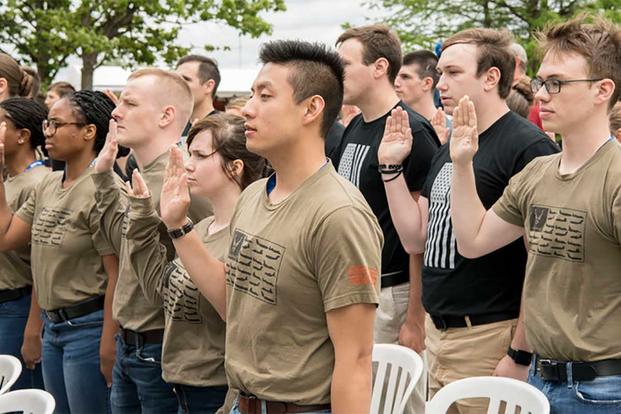
The United States Air Force Basic Military Training Program (often called BMT
for short), consists of 6 weeks of intense training (not including 4-5 in-processing days) intended to release the
potential within an individual and produce the best Airman possible.
Should I do anything before I go to BMT?
Yes. The more fit you are when you arrive, the better your chances are for avoiding
injury and graduating from Basic Military
Training. Start out slowly and work out at least 3 times
a week. Focus your training program on situps, pushups, and running
two miles.
You can become an officer through the U.S. Air Force Academy, ROTC, OTS, the Airmen Education and Commissioning Program, or Direct Commissioning programs. See our officer programs page.
The Airman Education and Commissioning Program is for active-duty airmen who
have already completed at least 45 semester hours of college credit. With such
a head start, you may apply for this very competitive program. AECP gives active-duty
airmen the opportunity to attend a full-time course of study in fields the Air
Force determines are most critical -- such as computer engineering, computer
science, electronic engineering, meteorology and nursing.
While enrolled in school, AECP participants are promoted to the grade of Staff
Sergeant (E-5) and receive their full Air Force pay and benefits plus money
for tuition and books.
What is the U.S. Air Force Academy?
The U.S. Air Force Academy at Colorado Springs trains prepares young men and
women to lead as Air Force officers. Cadets complete four years of studies
leading to a bachelor of science degree. Emphasis is given to academics, military
training, athletic conditioning, and spiritual and ethical development. Academics
includes classes in the basic sciences, engineering, the humanities and the
social sciences. Within this framework, all cadets complete a core curriculum
consisting of 91.5 semester hours. They can specialize in any of 25 academic
major.
How do I apply to the academy?
There are six steps: knowing the basic requirements applying for a nomination,
complete a candidate
questionnaire, complete the candidate kit, secure nomination form congressman
or other qualifying authorities, and complete testing.
General qualifications include:
Between 17 but not yet 23 years of age
by July 1 of year admitted
A U.S. citizen at time of enrollment (exception:
foreign students nominated by agreement between U.S. and another country)
Unmarried
Not pregnant or legally obligated to support
a child
An above-average high school or college academic
record
Strong performance on the standardized American
College Testing (ACT) Assessment Program Exam or the Scholastic Aptitude
Test (SAT)
Be in good physical and mental health
Pass a Medical Exam
Above-average strength, endurance and agility
Adequate performance on USAFA Physical Aptitude
Exam
What is Officer Training School?
Air Force Officer Training School prepares selected personnel in the fundamentals
of leadership; basic military skills; instills professional ethics; evaluates
leadership potential; and commissions those who qualify as second lieutenants
in all sixteen basic branches of the Air Force.
How do I qualify for OTS?
In general terms, an officer must be a college or university graduate prior to commissioning (except for enlisted soldiers on active duty), is trained by the Air Force to lead and manage, and can voluntarily leave the military if not under any officer service obligation at the time. Officers do not "enlist" in the Air Force and Air Force Reserve in the pure sense of the word, but individuals can compete for an enlistment option to go to Officers Training School to become a commissioned officer. To qualify you must:
Be a citizen of the United States
Take the AFOQT
Pass the Air Force Physical Fitness Test
Score well on the Scholastic Aptitude Test (SAT) or the American College Test (ACT)
Have at least 90 college credits (if currently enlisted)
Be at least 18 years old and less than 35. Pilots must turn in their applications prior to their 28-1/2 birthday.
Have a complete physical exam six months prior to application.
The Air Force trains pilots through its undergraduate pilot training program.
Air Force pilots are generally officers who compete for the pilot training slots.
Air Force flight training has strict vision requirements. The vision requirements
are 20/50 for pilots and 20/200 for navigators. Vision for both must be correctable
to 20/20. Applicants who have a history of Photo Refractive Keratectomy (PRK),
Radial Keratotomy (RK), or Laser In-Situ Keratomileusis (LASIK) are ineligible
for aviation duty. What
if I'm a physician or dentist?
The Air Force is also seeking qualified health professionals. For more information
about our medical programs. You can have someone contact you about applying
your medical trade in the service by completing this
form.
What are the qualifications to join the Reserve? You must be between 17 and 35 years old if you have no prior military service. Age requirements for healthcare professionals and those with prior military experience vary. An Air Force Reserve recruiter can answer your age related questions more thoroughly.
Note: If you have previous military service; your adjusted age must be less than 40 years. To get your adjusted age, take your chronological age, subtract actual time of service credit, and the result is your adjusted age. For example, if you are 48, and you have 10 years of creditable service, your adjusted age is 38.
In addition, the Air Force looks at your age and amount the total service time you have to make sure the individual can qualify for a 20 year retirement prior to age 60.
What is a drill?
This applies to Reserve and Guard duty. Drills are periods of Inactive
Duty Training (IDT), under orders, scheduled to augment training. No more than
two drills can be performed on one calendar day, and each drill must be at least
four hours long. Most units schedule multiple drills over one weekend each month
(two drills Saturday and two drills Sunday).
What training will I receive?
Depending on the program, you will receive boot camp and maybe technical training.
Weekend or weekday drills are considered training. Active Duty for Training
(ADT) is 12 days of active duty with your unit or in an Air Force school and
is required annually.
What if I have a problem getting time off from my employer
to fulfill my military service obligations?
By law, as a member of the Reserve, you must, upon request, be granted a leave
of absence to satisfy a requirement for military training. The Uniform Services
Employment and Reemployment Rights Act requires employers to provide Reservists
with time away from their jobs to perform military duty. However, you must notify
your employer that you intend to take military leave. You must be reemployed
after completion of your military duty and return to your job within a reasonable
time. You must be treated as though you had never left employment, including
schedule pay raises, promotions or credit for longevity or vacation. Your employer
only has to hold a job open for 60 months if you accept voluntary orders.
For additional information, see the USAF
Home Page.
Is technical training like boot camp?
No. This is training for a specialty you have chosen. It may involve work details
and duty, but the main focus is on technical and professional training.
Will I be paid while in training?
Yes, you will be paid for every day you serve according to published pay schedules
for your pay grade, in addition to any Temporary Duty or travel allowances.
Recruiters must present an accurate picture of service. You should be aware
of all aspects of military. Be sure you fully understand the enlistment contract.
You should ask about: