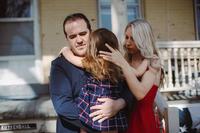
SAN DIEGO - A Naval Reserve commander who volunteered for the
Iraq war says the military doctored
his medical file to eliminate all traces of an anti malaria drug that he
believes made him severely ill, suicidal and aggressive, and that he has the
before and after evidence to prove it.
"I was given Lariam. I got sick from Lariam," said Cmdr. William Manofsky, 44,
who is based at the Naval Air Warfare Center in China Lake, Calif. "The Navy
does not want to talk about Lariam. There is no mention of it in my medical
record. I'm pretty upset."
Manofsky said there is no indication in his file of ever being prescribed the
drug, although the Navy handed it to him last November; that a page is missing
on which "Took Lariam" was written; and that a reference to the drug during an
emergency clinic visit on May 13 has mysteriously vanished from the page - even
though he has a copy that clearly shows it written there.
Manofsky and his wife, Tori, believe the military is covering up problems with
the drug - the Navy's main concern so far, they said, is to try to get the
medical records back. A spokesman for the Navy Bureau of Medicine and Surgery
would only say that it provides quality care and is working "to resolve the
issue."
"The military created the drug," Tori Manofsky said (it was developed by the
Walter Reed Army Institute of Research and licensed to Roche). "There is a lot
of money involved in the drug. I think there are a lot of careers at stake.
Anything that shows a problem with Lariam has to be hidden or covered up somehow
by the military. If all these people came back and it was clearly Lariam, there
would be lawsuits up the kazoo."
Lariam is the drug that at least two of the soldiers who killed their wives at
Fort Bragg last summer took while serving in Afghanistan. Both those soldiers -
and a third who apparently had taken the drug - subsequently killed themselves.
The drug's label warns of psychosis, aggression, hallucinations and reports of
suicide that can occur "long after" someone stops taking it. The Food and Drug
Administration this year ordered that everyone prescribed the drug be handed a
written statement listing those dangers and warning them to quit taking it if
they experience mental problems.
The government and the company that makes Lariam, Swiss drug giant Hoffmann-La
Roche, say the drug is safe and effective. The FDA says it doesn't know whether
the drug can trigger suicide. Roche says there is no reliable evidence it can
trigger violent behavior. The Pentagon says side effects are generally rare and
mild and are outweighed by the risk of getting malaria.
Manofsky, who never took Lariam before being deployed to Kuwait last December,
became suicidal after returning to California this spring and nearly slugged his
wife in a bizarre rage about the way she cast her fishing line. He also suffered
seizures, balance problems so severe he sometimes could not stand, panic attacks
and depression.
Tori Manofsky became convinced Lariam was the culprit after researching on the
Web the medications her husband was taking. On June 26, after several visits to
the China Lake clinic in which they raised the Lariam issue but felt they were
being ignored, Bill Manofsky went to the clinic to pick up his records on his
way to see a neurologist. He flipped through them to make sure Lariam was
documented.
"The first thing I noticed was a sheet missing," he said. "Both Tori and I had
seen the sheet. Someone had written on an angle, 'Took Lariam' and it was no
longer there. There was no entry for being issued Lariam."
Manofsky flipped more pages, looking for the record of a May 13 visit to the
clinic. That day, his wife had insisted a Navy doctor write the drug on that
record and both had watched him do it. He found the page on which he felt
certain that note had been written.
Nothing.
Manofsky knew his memory was shot, that he was acting strangely, and there was
no reason for anyone to believe him. But he had a backup. Tori Manofsky -
suspicious that Navy doctors were ignoring the drug - secretly photocopied the
page after the doctor wrote down "Lariam" on the May 13 visit and briefly left
the room.
Tori's copy clearly shows the reference, "Lariam for anti malaria" Underneath
that, four other medicines Manofsky was taking also are gone; they are mentioned
elsewhere on the visit.
Two independent document examiners consulted by UPI concluded that unless the
Manofskys themselves faked the doctor's writing and created bogus copies, only
the Navy can explain the omission.
The document experts could find no evidence that writing had been erased from
the May 13 record. One of the experts - a former head of an FBI questioned
documents office - told UPI that the likeliest scenario is that the clinic made
a copy of the May 13 page while the Manofskys were still there, and the doctor
wrote "Lariam" on that copy after Tori insisted. That sheet never made it into
his medical file.
While such a chain of events could theoretically be accidental, Tori Manofsky
believes the Navy knows it has a problem with the drug, and was keeping two sets
of records and recording Lariam problems on only one.
UPI contacted the doctor who saw Manofsky on the May 13 visit and asked if he
knew anything about changes in the medical record. He declined to comment and
said he had been told to refer questions to Twentynine Palms Marine base, which
forwarded them to the Navy Bureau of Medicine and Surgery in Washington.
Spokesman Brian Badura issued this statement:
"Successful medical treatment relies on accurate information, close cooperation
and communication between provider and patient, and follow-up by all parties
involved. Navy Medicine makes a concentrated effort to meet the needs of each
patient. Due to the number of circumstances surrounding the Manofsky case and
the ongoing efforts by Navy Medicine to resolve this issue, we cannot offer
additional input at this time."
Several other service members who served in Iraq have told UPI they had serious
problems with the drug - including one who says he was afraid of harming his
wife and that there was no record of him being prescribed Lariam, either. At
least two soldiers were medically evacuated from Iraq with suspected Lariam
problems, one an Army officer in charge of 300 soldiers, the other a soldier who
felt the way he was treated suggested the Army was "avoiding the Lariam
diagnosis." The Army is now discharging him.
The Washington Post reported in July that the military is investigating at least
seven suicides among troops in Iraq, among a larger number of deaths classified
as "non-combat weapons discharge" or "non-combat related."
The Pentagon hasn't identified any deaths as suicides since the war started.
Earlier this year, two more soldiers deployed out of Fort Bragg who took Lariam
in Afghanistan committed suicide after returning home - bringing the number of
suicides after that war to at least five. In one case, the soldier's father said
he asked Fort Bragg officials if the Lariam given to his son could have played a
role. "They have no comment," he told UPI.
The Pentagon insists that there have been few problems with the drug, prescribed
to soldiers around the world to prevent malaria. More 25 million people have
taken it worldwide, according to the manufacturer, 5 million of them in the U.S.
Assistant Secretary of Defense Dr. William Winkenwerder, Jr., wrote a U.S.
congressman last fall that any possible side effects are "greatly outweighed by
the drug's effectiveness in preventing the severe consequences of malaria
infections" among troops.
In the Fort Bragg homicide-suicides, a team of experts dispatched by the Army
Surgeon General's office concluded that Lariam was an "unlikely" explanation for
the entire cluster of deaths but acknowledged it had not investigated it in any
single case. It blamed the deaths on marital problems.
At the time, critics said some of the Fort Bragg deaths should have been
investigated as possibly drug related, especially because there was no history
of domestic abuse and all three of the soldiers who had been in Afghanistan
killed themselves - both unusual in domestic homicide cases.
A former Roche employee said that Lariam, known generically as mefloquine, is a
member of the quinolone family of drugs that can produce severe psychiatric
problems in some users.
"Any drug with a quinolone base to it, which includes Lariam, is likely to do
this," said Dr. Donald H. Marks, former associate director of clinical research
at Roche who now consults with attorneys suing drug manufacturers. "These types
of drugs can induce a temporary homicidal or suicidal rage."
The Army puts the rate of severe side effects at 1 in 13,000. A widely reported
British study completed in 1996 found that one person in 140 had such serious
problems that they temporarily couldn't carry out the function for which they
were traveling.
The Manofskys said they were willing to take on the Navy publicly because they
are convinced the truth is not being told, and concerned that other soldiers
returning from deployments overseas are getting the same treatment.
They showed UPI Bill Manofsky's complete medical file and Navy service record;
e-mails from the Navy psychiatrist who treated him before he decided not to work
with the Navy any more; a log Tori kept of Bill's symptoms, and all the
medicines he was taking including remaining Lariam pills. They gave interviews
in California and Washington in which they went over the events almost minute by
minute.
The Manofskys outlined this sequence of events.
A 17-year veteran of the Naval Reserve, Manofsky was handed Lariam last November
at China Lake before being deployed. There was no prescription written or
warning given of possible side effects, and Tori Manofsky said she has since
been told by a base medical worker that there were "special instructions for
dispensing and documenting" the drug.
Bill Manofsky served active duty at an air base in Kuwait during the war, using
his top-secret clearance on a targeting system. But he suffered what he now says
were bad Lariam side effects that started in Kuwait and got worse when he got
home and kept taking his pills as directed. He's had uncontrollable vomiting and
vertigo, depression and anxiety attacks requiring hospitalization. His hands
tremble. He stutters and repeats himself. He has frightening seizures.
After 11 years of marriage, Tori said that after taking Lariam, Bill's
personality changed drastically from the gentle husband she knew.
The drug is taken weekly while deployed and for four more weeks after a person
returns, so Manofsky was still taking the pills when he got back.
Tori kept a journal documenting her husband's problems. An entry for May 2
described his symptoms as "balance off, angry, moody, coping poorly, sad,
depressed. What really bothers me is 'aggressive - highly aggressive.'"
The couple tried to go fishing in early May in an effort to relax. But Bill got
so angry he scared his wife. When she cast her line in the water, "Bill came
over and said, 'Do it this way,'" she wrote in the journal documenting his
problems. "He kept saying it over and over - extremely angry!!!"
After she told him she was upset and wanted to stop fishing, "he leaned over me
like he was going to slug me in the head and said, 'If you don't do it this way
I'm going to ...'" He stopped in the middle of the sentence and backed off. She
said that a few hours later he had no memory of the incident.
Bill Manofsky told UPI later that, "I was trying not to pull a Fort Bragg."
"I wanted to make sure Bill had the proper care with Lariam toxicity," Tori
said, describing the May 13 visit to the China Lake clinic. The symptoms I read
on the Internet matched up with Bill's to a tee. I told the doctor that I
thought that Lariam was responsible for his symptoms. I said, 'Doctor, would you
write Lariam down.'"
"He wrote everything down and put the clipboard on the bed near Bill's legs. I
leaned over and I said, 'Bill, I need to copy this.' They had a copy machine
down the hall. I went down and copied it and did not say anything to anybody
about it."
Later in May, Manofsky became suicidal. On May 31, Tori said that while she was
driving them to a restaurant, "Bill's panic, anxiety and distress became so
acute that he proceeded to try and claw his way out of the truck so he could
jump out. I kept telling him, 'Bill, it's gonna be OK, it's gonna be OK.' He
said he was crawling out of skin, he had to get out of there."
At the restaurant, "Bill went to the bathroom and began vomiting, he then sat on
the floor and said repeatedly that he was going to blow his brains out.
The Manofskys say that Bill was referred to a Navy psychiatrist who also seemed
to resist the idea that a drug prescribed by the Navy could be causing his
problems. She diagnosed him with anxiety and "narcissistic" and "histrionic"
personality traits.
Then, on June 26, Bill Manofsky discovered the changes in his medical record.
Sound Off.....Do you think the U.S. should still be using Lariam on it's military personnel?
Join the discussion.
Use your GI Bill benefits to get ahead. Get free information from military-friendly schools.