


CAMP PALIWODA, Iraq - Tired, sore, but safe, the soldiers of Task Force 1-77
unloaded their gear Saturday night at their crude, dusty new home in central
Iraq.
The arrival followed a 450-mile, 34½-hour convoy ride from Camp New York,
Kuwait. Dozens of similar convoys have been carrying other 1st Infantry
Division units from holding camps in Kuwait to permanent posts in north central
Iraq, from Tikrit to Baqoubah.
The convoy - or "approach march," in Army terminology - lacked the drama and
misery of the wartime rides many units endured a year ago. Several trucks broke
down and the unit was stopped once near Baghdad while an improvised explosive
device beside the road was defused. But the unit was never under hostile fire.
"I've never been through something like that," said Master Sgt. Angel Negron,
38, of Utuado, Puerto Rico, "but it wasn't that bad. Just a lot of hurry up and
wait."
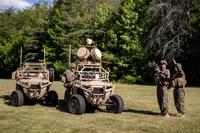
More than 100 troops from Company B and the headquarters company climbed
aboard 29 Humvees and trucks early Friday at Camp New York, having spent the
previous two days packing and loading. The rest of the task force left within a
day in separate convoys.
After 3½ weeks of training and tedium in Kuwait, they were more than eager to
head north in spite of the danger.
"I'm excited to get out of here and do my job," said Spc. David Bragg, 29, of
Inman, S.C., a scout team member who manned a .50-caliber machine gun atop the
unit's lead vehicle.
If anyone feared the threat posed by improvised bombs or guerrilla attacks,
they weren't saying so as they nonchalantly smoked and drank Cokes just before
departing.
"There's always going to be concerns," said 1st Lt. Alex Prezioso, 26, who is
attached to Task Force 1-77 with his New York National Guard unit, the 2nd
Battalion, 108th Infantry Regiment. "You just need to stay focused and do your
job."
"We're going to get where we're going and knock out anything that gets in our
way," boasted Pfc. Thomas Jones, 23, of Memphis, Tenn.
The unit rolled out of camp at 7:50 a.m., five minutes behind schedule.
Within 10 minutes, it had to pause for a convoy from the 299th Forward Support
Battalion based in Schweinfurt, Germany. The 299th FSB, slower moving because
it was made up mostly of heavy trucks, would hinder the Task Force 1-77 caravan
several times over the next two days.
It took barely 2½ hours over paved roads to reach Combat Support Center
Navistar, just south of the Iraq border on Highway 80. Navistar is one of
several fueling yards for military vehicles along the way.
At 12:50 p.m., fully gassed up, the convoy lined up to cross the border.
Three scout team soldiers - Pfc. Brian Heiss, 21, of Harrisburg, Pa.; Spc.
Brian Nethery, 20, of Englewood, Fla.; and Sgt. Aaron Haynes, 23, of Columbus,
Ohio - jumped out early and unfurled the U.S. and battalion flags atop the
10-foot sand berm that separates Iraq from Kuwait. They stood at attention and
held the colors until the whole convoy had passed.
"Welcome to Iraq, gentleman," said Sgt. Tony Gutierrez, 30, of Kerman,
Calif., who served in Iraq last year with the 2nd Armored Cavalry Regiment and
is now back with the 1st ID.
After speeding up Iraq's Baghdad-to-Basra highway all afternoon, the convoy
reached its second refueling stop just before sunset. It pulled out about 7
p.m., slowly at first because a 299th FSB truck had stalled in front of them
and the unit stopped to tow it.
The soldiers spent a bumpy evening driving 89 miles across unpaved roads.
Around midnight, they pulled into Scania, another fueling station about 60
miles south of Baghdad. After refueling the vehicles, the soldiers pulled out
their sleeping bags at about 2 a.m. and spread them anywhere to sleep — on the
roofs of Humvees, on trailers, even in the dirt.
Five hours later, they got up, ate and some shaved. It sobered them to know
they would be driving through more dangerous areas, through Baghdad and beyond.
Standing beside his Humvee, 1st Sgt. Mark Oldroyd, 38, of Turtle Lake, Wis.,
led a group of soldiers in prayer.
"We ask that you take care of each and every soldier in this task force," he
said. "If we must go into harm's way, let us be strong and courageous. … Please
bring us home to our families at the end of this tour."
They managed to stay out of harm's way thanks to someone in a convoy just
ahead who spotted a roadside bomb. Task Force 1-77 halted on a highway near
Baghdad International Airport at 10:15 a.m. for about 90 minutes while an Army
explosives team detonated it.
Around noon, the convoy finally saw Baghdad. The vehicles skirted the
downtown, though, and braved heavy traffic in the city's western suburbs.
Gunners kept watch, fingers on triggers. No one threatened them.
Task Force 1-77 made its last fuel stop that afternoon at the ruined former
Iraqi air force base in Taji. There they waited 3½ hours for other convoys to
arrive, joining up and splitting into two: one bound for Anaconda, the giant
Army-Air Force logistics support area at the former Balad air base; the other
for Paliwoda, a small, gritty forward operating base which Task Force 1-77 and
two of its companies will call home until next February.
After three weeks of training in worst-case scenarios, they were relieved,
and a little surprised, to arrive without incident.
"I was expecting some action," said Spc. Daniel Flounoy, 27, of Pavo, Ga. "We
didn't get it. I guess that's good."
"I was a little more nervous than I thought I would be," said Sgt. Anthony
Marchi, 28, of Stockholm, Sweden. "It's nice to finally be here, though."
- Steve Liewer is embedded in Iraq with Task Force 1-77.
Sound Off...What do you think?
Join the discussion.
This article is provided courtesy
of Stars & Stripes, which got its start as
a newspaper for Union troops during the Civil War, and
has been published continuously since 1942 in Europe and
1945 in the Pacific. Stripes reporters have been
in the field with American soldiers, sailors and airmen
in World War II, Korea, the Cold War, Vietnam, the Gulf
War, Bosnia and Kosovo, and are now on assignment in the
Middle East.
Stars & Stripes Website
|
|
|
Copyright 2004 Stars and Stripes. All rights reserved. This material may not be published, broadcast, rewritten or redistributed.