





BAGHDAD — The first part of a painstaking transition from the 1st Armored
Division to the 1st Cavalry Division is under way.
Members of the 1st Cavalry's 2nd Brigade Combat team, who arrived last week,
already are riding along with 1st AD soldiers to learn the finer points of
stability operations in Baghdad.
But even before the brigade arrived, it had built on the lessons learned from
its predecessors, unit commander Col. Michael Formica said Monday.
The 3,000-soldier combat team, called the Blackjack Brigade, brought 90
Abrams M1A2 tanks to Iraq. But it will rely
more heavily on its 120 armored Humvees to move through the city.
"That provides us a greater amount of flexibility," Formica said during a
news conference in Baghdad.
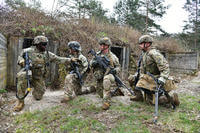
Troops from the Fort Hood, Texas-based 1st Cavalry — accustomed to shooting
artillery rounds — got extra training in how to be ground-pounding infantrymen,
Formica said.
In addition, the brigade's officers and noncommissioned officers received
cultural training in Jordan to prepare them for dealing with the predominantly
Muslim population.
The division also intends to display a rudimentary knowledge of Arabic
language and customs, Formica said.
"We will arrive culturally aware of the Arab culture and Islamic traditions,"
Formica said.
The adaptations are a common Army response to the fluid nature of any
mission, said Brig. Gen. Mark Hertling, assistant 1st Armored Division
commander for support.
The lighter, more mobile 2nd Brigade will take over duties for the 1st AD's
3rd Brigade, based in Fort Riley, Kan. Their area of responsibility is
primarily on the west side of the city.
By April, the 1st Cavalry Division will lead an estimated 25,000 to 30,000
soldiers in the Baghdad metropolitan area. At its peak, the 1st AD and troop
contingents under its command numbered 37,000, Hertling said.
The two divisions are swapping information, intelligence and troops in the
midst of another transition. In the coming months, the U.S. military will
shrink its presence in the Baghdad area from 26 to eight base camps, most
located farther out on the city's perimeter.
The change is meant to hasten Iraq's reliance on its own police and civil
defense corps, both of which are being trained by the U.S. military. And it is
meant to lesson the "distress" some Iraqis feel by having major U.S. military
camps in the center of the city, Hertling said.
The official transition of authority from the Wiesbaden, Germany-based 1st
Armored Division to the 1st Cavalry Division takes place April 15.
Sound Off...What do you think?
Join the discussion.
This article is provided courtesy
of Stars & Stripes, which got its start as
a newspaper for Union troops during the Civil War, and
has been published continuously since 1942 in Europe and
1945 in the Pacific. Stripes reporters have been
in the field with American soldiers, sailors and airmen
in World War II, Korea, the Cold War, Vietnam, the Gulf
War, Bosnia and Kosovo, and are now on assignment in the
Middle East.
Stars & Stripes Website
|
|
|
Copyright 2004 Stars and Stripes. All rights reserved. This material may not be published, broadcast, rewritten or redistributed.