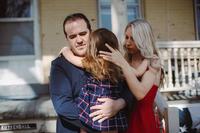
Convicted GI Haunted By Decision
Chicago Tribune
April 5, 2005
Former U.S. Army Capt. Roger Maynulet knows it is the image that will haunt him for the rest of his life.
The highly decorated combat soldier will always remember his split-second
decision to shoot Karim Hassan Abed Ali Al-Haleji and watch him bleed to
death.
The court-martialed officer will forever be bound by the decision he made
on May 21, 2004. That's when the Chicago native chose to ease the suffering of
the wounded Iraqi man who lay before him on a dirt road in Kufa, Iraq, in what he said was a mercy killing.
"He was unconscious, and he had his mouth open. It was not something
pleasant to look at. You project yourself on him. I saw a guy who was
suffering," said Maynulet, who was convicted and received a dishonorable
discharge last week.
"I knew I couldn't fix this guy. It was an unbelievable feeling of
helplessness."
Speaking to the Tribune from the small home in Germany he rents with his
wife, Brooke, a former Army captain from Freeport in northwestern Illinois,
the sordidness of the Iraq war is a long way from this German village where
farm tractors clog one-lane roads.
As he and his wife start to think about their lives after the military,
the same feeling continues to haunt him that he had nine months ago when he
and Al-Haleji crossed paths. Amilitary jury of four colonels and two majors
convicted Maynulet of voluntary manslaughter Thursday in a tiny courtroom in
neighboring Wiesbaden, where his unit, the 1st Armored Division is based.
"I thought I was doing the humane thing," Maynulet said. "I still believe
it was morally right but obviously it was legally wrong. I hope to God I never
have to be put in that situation ever again."
He and his soldiers had been on a classified mission to "capture or kill"
an enemy leader who sources have told the Tribune was Moqtada Sadr, the
militant Shiite cleric whose Mahdi militia was exacting many U.S. casualties.
U.S. soldiers mortally wounded Al-Haleji and Maynulet killed him.
During the mission, "I'm thinking of a million different things," he
said. "As a commander, you eventually learn to prioritize. It's like looking
at a dashboard when you drive and you're scanning your instruments."
Overhead, a military drone with a camera captured his actions, creating a
videotape that was played nearly continuously at Maynulet's trial.
Watching the videotape was difficult for Maynulet and impossible for his
mother, Carmen, who refused to look at it. Her younger son Daniel, an Army
private, is set to deploy to Afghanistan later this year.
Maynulet said he expects Al-Haleji's family, which includes his seven
children, to be angry with him. But hasn't tried to reach out to them because
he has nothing to say. The man made a choice to be part of the enemy, Maynulet
said.
"What people have to realize is that this guy was part of the Mahdi
militia run by Sadr that was killing Americans every day."
Maynulet always thought that part of his job was to rebuild and care for
the innocent civilians who were injured as part of combat. His father, who
served as the chief of staff for Edgewater Hospital before retiring, was a
physician who told his son about his efforts to save lives.
The citation for the Bronze Star that Maynulet, 30, received in August
pointed out several occasions when he treated injured Iraqis, including
insurgents. Often, he treated injured people whom other units had left in the
field, Maynulet said.
But the May 21 mission was so important that he did not have a chance to
treat the wounded Iraqi he later killed, Maynulet said.
Instead, he ordered his medic, Sgt. Thomas Cassady, to treat him.
In testimony, Cassady said he disregarded the order because he was
"spazzed" out when he saw the gravity of the man's injuries. Cassady, who
testified under a grant of immunity, admitted lying nearly 30 times and
committing perjury.
After pausing for several seconds to think about Cassady and to take a
slow breath, Maynulet called the six-year Army veteran and former Marine a
good soldier.
He blames himself, Maynulet said.
"I was his commander... I still think I need to take responsibility for
the fact that I didn't push him enough. I didn't question him," he said.
At his trial, telling the details of the mission was difficult because he
had to verbalize what happened that day. Still, he said it was nothing
compared to combat.
"It's no substitute to the fear and the feeling you get when people are
trying to kill you," he said.
Another emotional moment at the trial came when the jury returned and
said that they had found him not guilty of the charge of assault with intent
to murder but found him guilty of a lesser charge. That meant his potential
prison sentence was cut in half.
"I thought I made it," Maynulet said.
Before the jury foreman read a court document announcing the conviction,
he paused for the longest seconds of their lives, Brooke and Roger Maynulet
said.
"I wish he didn't pause. That would have been easier. That's when we
thought it's finally over," said Brooke Maynulet, 32.
But the end didn't come until the jury returned with the punishment and
ordered him out of the Army, without serving prison time. Maj. Gen. Martin
Dempsey, commander of the 1st Armored Division, must review the court-martial
transcript and approve the findings. A military appeals court also must
approve the findings.
For the next several weeks, Maynulet will focus on writing a book
proposal about his experiences. Other than that, he is not sure what he wants
to do for a job. Brooke Maynulet is considering earning a commercial pilot's
license.
Maynulet knows that he will always have to notify potential employers
about his conviction and dishonorable discharge. But he hopes they would take
the time to ask him about the details.
Packing away his uniform will be tough because it signifies almost half
of his life--nearly 10 years on active duty and several more in the ROTC
program at the University of Illinois in Urbana-Champaign.
"You never want to say that your work is what defines you. But in the
military it does," he said. "It's very significant for me to be kicked out of
my family."
Sound Off...What do you think?
Join the discussion.
Copyright 2005 Chicago Tribune. All rights reserved. This material may not be published, broadcast, rewritten or redistributed.
|