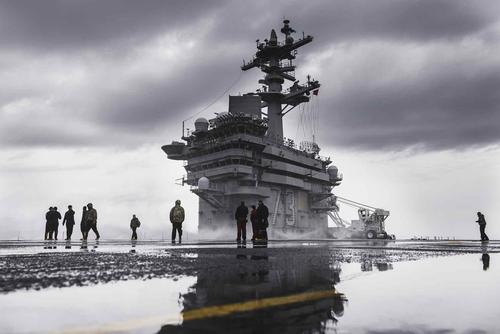



















ABOARD THE USS BATAAN — Few warships have been as busy as the USS Bataan
since the Sept. 11, 2001, attacks against the United States.
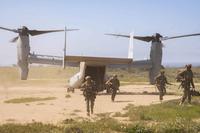
The Bataan is on its third deployment in three years, cruising through the
Red Sea this week toward the Persian Gulf region to drop off members of the II
Marine Expeditionary Force and their equipment. The Marines are headed to
Iraq as part of the largest rotation of U.S. troops since World War II.
Petty Officer 1st Class Josh Lubkeman, who joined the Bataan in 1998, has
gone on four deployments with it and has traveled at least 100,000 miles,
enough to travel around the world four times.
He has missed birthdays, anniversaries, holidays and times when his family
desperately needed him. He said he's grateful he has a strong marriage, but the
time away is a strain on the strongest relationships.
"Every deployment is a test," said Lubkeman, 23, an operations specialist.
"I've had friends that a month or two into it, their spouses couldn't do it
anymore. Either [they] got letters saying, ‘Hey, I cheated' or ‘Hey, I'm
leaving.' I've never had to go through that. And I count myself lucky."
Most of the Marines on board are from helicopter units. While the Marines
will be going for a seven-month tour, the Bataan deployment should end in
another one and half months.
It is the second unscheduled deployment to the region.
Last year, the Bataan deployed to the gulf as part of a seven-ship amphibious
task group to help support the war in Iraq. The ship carried only AV-8B Harrier
jump jets and was known as the "Harrier Carrier."
Tough on families
The deployments have tested crewmembers and their families,
but many said they take it in stride in this post-Sept. 11 world of no-notice
deployments and greater time at sea. Petty Officer 2nd Class Blake Hoyt, 22, of
Baton Rouge, La., said the greatest challenge on a cruise is "trying to keep
your sanity."
"You try and do so much," said Hoyt, an air traffic controller assigned to
the ship for the last 2 ˝ years. "Being out here, you want to also be the man
of the family still back home. And you got to realize that can't be done. You
can't take care of your business and work here as well as run your family."
Petty Officer 2nd Class Michael Tredway, 22, of Ashtabula, Ohio, worries
about his wife at home. Since they got married on Dec. 21, 2002, he figures he
has seen his wife for a total of about six months. He was on his honeymoon when
his chief petty officer called and told him the ship was heading to war.
"I told her before that we might be going," he said. "She was pretty mad,
obviously. But what can you do?"
Cmdr. Kieran Mandato, a Catholic priest who serves as the Bataan's chaplain,
often deals with the problems at home brought on by long sea duty. He is a
spiritual adviser and sometimes just someone sailors can go to and vent.
"The first few months we'd see literally eight to 10 people a day," he said.
"They'd be lined up until midnight."
The ship doesn't track the number of divorces its sailors go through, but
Mandato knows of at least a dozen last year.
Mandato and chaplain Lt. j.g. Dean Van Brunt are available for counseling and
help for the sailors. But marriage counseling can be difficult when the other
spouse is thousands of miles away.
"How do we counsel the two of them?" Mandato asked.
So, supervisors put an emphasis on solving personal issues before they deploy
and maintaining communication with loved ones back home. E-mail is available
during downtime, and there are phones available for sailors to make quick calls
with a calling card.
But some situations require more than a phone call or an e-mail.
During last year's deployment, Lubkeman's 3-year-old son got sick and later
died of an undetected virus.
On Feb. 17, his wife made the tragic discovery. She got up that morning after
taking him to the doctor and found their son in the living room lying on his
favorite pillow.
The ship allowed Lubkeman to go home, but it took four days to get to
Norfolk. On the anniversary of their son's death, the Lubkemans will be apart —
again. In addition, his wife is pregnant with their third child and caring for
their 1-year-old son.
"It's kind of heart-wrenching right now," he said. "I have no clue how's
she's going to be on that day … Nobody is there with her; just my son. She's
got her friends but it's about family."
During the difficult times, sailors said they rely on their onboard family.
Ready to go
Chief Petty Officer Jeffrey Niles said he doesn't dwell on
how much time he has been away from his wife and daughter. How long he has been
at sea only brings him down, he said.
He is the leading chief for the combat systems department, which is
essentially responsible for all the electronics on the ship. He supervises 42
sailors and does his best to keep them focused on the mission even though some
have been at sea more than they have been at home.
This is his third deployment in four years.
"I try and put a positive spin on pretty much everything we do," said Niles,
who has 18 years of military service. "We're in the Navy. It's not the Boy
Scouts."
The pace of deployments have had their advantages.
Capt. Earle Yerger, the Bataan's commanding officer, said the number of
deployments has made his job easier in some ways. He deals less with some of
the little things. Sailors don't get in trouble as much. The adjustments that
typically come with leaving a homeport are few. Sailors are more prepared for
what is ahead because they've been there.
"If anything, I would say as a whole I've watched a maturing process, from
‘Aw, how come we have to go?' to 'Yeah, that's what we do and that's who we
are,'" Yerger said.
One of the reasons the Bataan has gotten the call so much recently is because
of timing and the ship has been ready to go, he added.
"When you look at everybody else's schedule, they were either already
committed to something different than this or already planning on going into
the yards. And once the money is committed against a ship going into the yards,
it's very difficult for them to change their schedule to do something like
this."
Lubkeman, who will join the Joint Forces Command in Norfolk after his tour
with the Bataan this year, isn't soured by his experiences. He has gone from a
seaman pay rate to a first class petty officer in six years — a remarkable
accomplishment for most sailors.
He said he plans to stay in the Navy for 20 years, but welcomes shore duty
for a change.
"Being in the Navy has its days," he said. "You know you can have your good
days and your bad days. Sometimes I hate being here.
"But all in all, this has been a great learning experience. I've grown a lot,
both mentally and personally. I'm a better person because of it. I wouldn't
give it up for anything."
Sound Off...What do you think?
Join the discussion.
This article is provided courtesy
of Stars & Stripes, which got its start as
a newspaper for Union troops during the Civil War, and
has been published continuously since 1942 in Europe and
1945 in the Pacific. Stripes reporters have been
in the field with American soldiers, sailors and airmen
in World War II, Korea, the Cold War, Vietnam, the Gulf
War, Bosnia and Kosovo, and are now on assignment in the
Middle East.
Stars & Stripes Website
|
|
|
Copyright 2004 Stars and Stripes. All rights reserved. This material may not be published, broadcast, rewritten or redistributed.