



FIREBASE PURGATORY, Afghanistan — The war on terrorism began in
Afghanistan, and it will end here, said Capt. Joel Cunningham.
"Iraq," adds Cunningham, of the 10th Mountain Division, "was just a chapter
in the book."
Nearly 2½ years since Sept. 11, 2001, the war continues.
As the U.S. military prepares an offensive aimed at driving a stake through
the heart of Taliban and al-Qaida forces, those on the ground in Afghanistan
continue their daily fights.
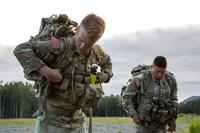
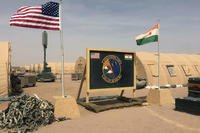
At Firebase Purgatory, 100 miles southwest of Kandahar, the war doesn't feel
like a sure thing.
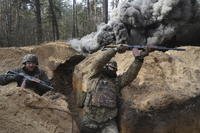
The war on terror is a low-key, often covert village-to-village struggle, the
soldiers say.
Like working a jigsaw puzzle "blindfolded and drunk," says Cunningham, the
officer in charge of Purgatory's maneuver forces, drawn mostly from the 10th
Mountain's 2nd Battalion, 22nd Infantry Regiment, or Triple Deuce.
Only 2 months old, Purgatory is part of the front line that zigzags through
remote Afghanistan along the Pakistan border.
The area around Purgatory is in transition between conventional war and messy
peace.
It's difficult sometimes for the thousands of U.S. soldiers serving in
Afghanistan to know who's who.
Insurgents probably include both Taliban and criminals, said Lt. Col. Joe
DiChairo, Triple Deuce's battalion commander at Kandahar Air Field.
It's taken his soldiers two months to get a feel for just how that area
works, DiChairo said.
"Can we tell Taliban and pro-American forces apart physically? No. But we can
start to determine who the Taliban players are, and who the pro-coalitions
players are," he said.
DiChairo likens Triple Deuce's job at Purgatory to the Taliban trying to tell
the Democrats from the Republicans back in the United States: "It would take a
long time to know what people's beliefs are."
Adds Capt. Phil Bergeron: "It's like being in a Mad Max movie here."
"Mad Max and Seinfeld," said Cunningham, referring to the popular TV comedy
show.
Everyone is armed and driving around in crazy vehicles, they said.
"Everyone in the country has a weapon and is not afraid to use it," said Sgt.
1st Class Kevin Aker, with Triple Deuce Headquarters Company.
Cunningham, with Bergeron as fire control commander, rotated last month to
this tiny base, a few hundred yards of concertina wire around two flat acres of
tents and one small mud building.
Purgatory's mission is disrupting Taliban and al-Qaida operators trying to
infiltrate across the mountains from Pakistan, said Cunningham and Special
Forces soldiers.
That doesn't distract soldiers from the thousands of other jobs they take on
every day.
Missions include everything from providing security for a new Provisional
Reconstruction Team to protecting crews building the $250 million Highway One
project that will connect Afghanistan's major cities.
"Are we [here] to alter a way of life? To stop tribal warfare? Or are we
stopping the enemy of our country?" Bergeron asked.
It's difficult to know whether they're winning or losing, say Triple Deuce
soldiers and officers.
"How do you measure disruption?" Cunningham wondered.
To neutralize the Taliban, Purgatory soldiers have to win over locals who
want stability, Aker said.
"We realize people can provide more intel than any of us could ever go out
there and find," he said. U.S. soldiers are not exactly trying to befriend
locals, "but they need an economy and [civil] structure, and we're going to
give it to them."
In return, Afghans have to prove their allegiance.
"Like joining an exclusive club. We don't know them. They don't know us. It
boils down to trust," Aker said.
If coalition soldiers leave, the Taliban and al-Qaida will come back, says
1st Lt. David Hawk, Cunningham's executive officer. "This country has
historically harbored terrorists. There are a million places to hide … and no
one to bother you."
In that sense, Purgatory's an emerging template, the first of dozens of
similar stabilization efforts around Afghanistan.
"We're a cog," Hawk said, "in a machine that's going to turn for the next 10
years."
Sound Off...What do you think?
Join the discussion.
This article is provided courtesy
of Stars & Stripes, which got its start as
a newspaper for Union troops during the Civil War, and
has been published continuously since 1942 in Europe and
1945 in the Pacific. Stripes reporters have been
in the field with American soldiers, sailors and airmen
in World War II, Korea, the Cold War, Vietnam, the Gulf
War, Bosnia and Kosovo, and are now on assignment in the
Middle East.
Stars & Stripes Website
|
|
|
Copyright 2004 Stars and Stripes. All rights reserved. This material may not be published, broadcast, rewritten or redistributed.