This article is provided
courtesy of Stars & Stripes, which
got its start as a newspaper for Union troops
during the Civil War, and has been published
continuously since 1942 in Europe and 1945
in the Pacific. Stripes reporters have
been in the field with American soldiers,
sailors and airmen in World War II, Korea,
the Cold War, Vietnam, the Gulf War, Bosnia
and Kosovo, and are now on assignment in the
Middle East.
Stars and Stripes has one of the widest distribution
ranges of any newspaper in the world. Between
the Pacific and European editions, Stars
& Stripes services over 50 countries
where there are bases, posts, service members,
ships, or embassies.
Related Links:
Current
Archive
Stars
& Stripes Website
Sound
off in our Discussion Boards
Have an opinion on the issues discussed in
this article? Sound off.
Get
Breaking Military News Alerts
|
|
|
|
August 26, 2004
[Have an opinion about the issues discussed in this article?
Sound
off in our Discussion Boards.]
By Fred Zimmerman,
Stars and Stripes Pacific Edition
MARINE CORPS AIR STATION FUTENMA, Okinawa — Ten steps. That’s how
close Lance Cpl. Christopher Teague came to possible death Aug.
13.
Teague, the first Marine
to respond to a helicopter crash just outside the base fence line,
had pulled a pilot out of the burning wreckage of a CH-53D Sea Stallion;
he was about 10 steps from the helicopter when it exploded.
Aug. 13 was a typical day for Teague and fellow Marines from the
1st Stinger Battery on Futenma. They were holding a 2 p.m. formation
when they saw the helicopter go down.
“We noticed the tail rotor came off,” said Teague, a stinger gunner.
“The first sergeant said to call 911 and told us to go help.”
More than 100 Marines instantly responded, said 1st Sgt. Darryl
Sisneros. With no nearby gate, the Marines scaled an 8-foot fence
inside their compound and a 15-foot fence to get off base to the
crash site.
The two barbed wire-topped fences claimed their own victims. Sisneros
said six Marines were hurt, most with cuts or twisted ankles. And
one Marine fractured his foot.
“I had Marines on crutches trying to hit the fence … they were
motivated” to try to help, Sisneros said.
A Marine public affairs officer said Wednesday that the 1st Stinger
Battery commander was engaged in an exercise and could not be reached
for comment.
The Marines ran about 500 to 600 yards to the crash site. Teague,
first on the scene, said he saw a pilot in the helicopter, his left
hand pinned. The rear of the helicopter was burning; Teague said
he went to work to free the pilot.
“I didn’t think about my own safety,” he said, adding that training
just kicked in and took over.
As Teague struggled to free the pilot, Sgt. Richard Cline found
another of the helicopter’s crew near the wreckage and learned three
Marines had been in the aircraft when it crashed. Cline said he
and three other Marines moved the crew member behind a wall and
began shouting for the third Marine, whom they found kneeling on
the ground away from the wreckage.
The pilot had been freed; Teague said he pulled him from the front
window. Another Marine helped Teague carry the pilot to a nearby
tree.
That’s when the wreckage exploded.
With all crew members away from the burning helicopter and transport
to U.S. Naval Hospital Okinawa on the way, Cline ordered Marines
to set up a security perimeter and direct traffic.
 |
|
|
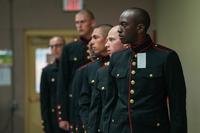
From left, Cpl. Thomas Joyce, Lance Cpl. Christopher
Teague, Sgt. Richard Cline and Cpl. Michael Knight stand in
front of one of the two fences they had to cross to get to
the crash site of a CH-53D helicopter Aug. 13. The Marines
from 1st Stinger Battery were in a formation when they saw
the helicopter go down. Teague, first Marine on the scene,
helped a pilot out of the wreckage just seconds before it
exploded. (Fred Zimmerman / S&S )
|
|
Cpl. Michael Knight arrived in time to help with security. He said
he helped establish the perimeter because some local citizens were
starting to gather and he wanted to ensure their safety by keeping
them from the burning wreckage.
As those Marines kept the area clear, Cpl. Thomas Joyce entered
the university administration building the helicopter clipped on
its way down to ensure everyone had gotten out safely.
“We went into all the offices to make sure no one was in there,”
Joyce said. “We only went about two or three doors in because the
smoke was so thick, we couldn’t get any farther.”Sisneros said the
Japanese police arrived quickly, as well as the fire department,
which began dousing the flames with foam.
Sisneros said he knows the area well and was surprised there were
no civilian casualties. “The pilot did an awesome job of controlling
the aircraft,” he said. Wednesday, all the wreckage had been cleared
away; just one crew member remained in the hospital. And those who
rushed to the rescue agreed they did only what other Marines likely
would have done.
“I don’t think I’ve done anything better than any other Marine,”
said Teague, who said he was “scared to death” when reflecting later
on the explosion. “If I hadn’t gotten there first, any other Marine
would have done the same thing.”
Said Cline, “We just did what we needed to do.”
Email
this page to friends
©2004 Stars & Stripes. All opinions
expressed in this article are the author's and do not necessarily
reflect those of Military.com.
|