This article is provided
courtesy of Stars & Stripes, which
got its start as a newspaper for Union troops
during the Civil War, and has been published
continuously since 1942 in Europe and 1945
in the Pacific. Stripes reporters have
been in the field with American soldiers,
sailors and airmen in World War II, Korea,
the Cold War, Vietnam, the Gulf War, Bosnia
and Kosovo, and are now on assignment in the
Middle East.
Stars and Stripes has one of the widest distribution
ranges of any newspaper in the world. Between
the Pacific and European editions, Stars
& Stripes services over 50 countries
where there are bases, posts, service members,
ships, or embassies.
Related Links:
Current
Archive
Stars
& Stripes Website
Sound
off in our Discussion Boards
Have an opinion on the issues discussed in
this article? Sound off.
Get
Breaking Military News Alerts
|
|
|
|
|
Your
Two Cents

Submit your stories, news items, or a benefits update
-- and help Military.com bring the best, most important
stories to your fellow servicemembers, veterans,
and family members. Contribute
here |
|
|
March 14, 2005
[Have an opinion about the issues discussed in this article?
Sound
off in our Discussion Boards.]
By
Fred Zimmerman
Stars and Stripes, European
Edition
IWO JIMA, Japan - Men once determined to kill one another met again this weekend, but this time in peace at a ceremony to pay tribute to warriors who never left this desolate island.
More than 60 U.S. veterans of the Battle of Iwo Jima and a handful of their Japanese counterparts met at the Reunion of Honor monument on a hill overlooking Yellow Beach, where many U.S. Marines landed on Feb. 19, 1945 — the first time during the war that U.S. ground forces set foot on Japanese soil.
This year was the 60th anniversary of one of World War II's bloodiest battles. More than 100,000 U.S. troops fought to take the island, suffering more than 26,000 casualties including more than 6,800 deaths. Fewer than 1,000 of the 22,000 Japanese defenders survived.
Iwo Jima was strategically important to the U.S. bombing campaign of Japan. Once taken, fighter planes could be based there to escort bombers on missions; bombers returning crippled could land there, possibly saving their crews from crashing or ditching at sea. By the war's end, 2,251 B-29s with 24,761 crewmen made emergency landings on the island.
During the ceremony, retired Lt. Gen. Larry Snowden, who fought on Iwo Jima, said the Japanese defenders fought to protect their homeland while the Marines “fought to bring the end of the war and go home.”
Snowden added that “hatred was the motivating force 60 years ago, but peace should breed friendship — and that's what happened in the years since.”
Gen. Michael Hagee, Marine Corps commandant, said during the ceremony, “Our first duty is to remember.”
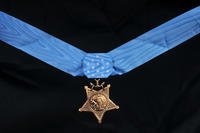
In World War II's four years, Hagee said, 353 Medals of Honor were awarded — 27 of them from actions during the 36 days of fighting on Iwo Jima. He recalled Adm. Chester Nimitz's words in praising those who fought that battle, saying, “Uncommon valor was indeed a common virtue.”
Kiyoshi Endo, the chairman of the Japanese Iwo Jima Veteran's Association, also spoke about remembering the past. Endo served as North Iwo Jima Division commandant until the end of the battle.
“Truly, memories of the tragic Battle of Iwo Jima have faded away through generations,” Endo said. “Our responsibilities and duties are to dedicate the rest of our lives to passing our memories on to our next generations so that a tragic battle of this kind would never be repeated.”
While all spoke of the tragedy of the battle, many also talked about the friendship that has been built since. Hagee said grandchildren of men who fought on the island as foes now stand together as allies in Iraq and elsewhere throughout the world.
Former Japanese Prime Minister Yoshiro Mori said the two countries are working together for world peace and security. “I believe that our cooperation is a great tribute to the spirits of Japanese and American soldiers who died on this island,” said Mori, who said he learned much about peace by witnessing the veterans gather in friendship.
After the speeches, U.S. and Japanese officials placed wreaths at the foot of the monument. Japanese officials made the symbolic offering to the fallen of pouring water over the marker. Rifles cracked in a 21-gun salute. The assembly then observed a 30-second moment of silence; the only sounds were of the wind blowing the grass and distant waves pounding the black beach.
As have so many other such gatherings on the desolate Pacific island, the ceremony ended with the echoing of taps.
Email
this page to friends
©2005 Stars & Stripes. All opinions
expressed in this article are the author's and do not necessarily
reflect those of Military.com. |