This
article is provided courtesy of Stars & Stripes,
which got its start as a newspaper for Union troops during the Civil War, and has been published continuously since 1942 in Europe and 1945 in the Pacific. Stripes reporters have been in the field with American soldiers, sailors and airmen in World War II, Korea, the Cold War, Vietnam, the Gulf War, Bosnia and Kosovo, and are now on assignment in the Middle East.
Stars and Stripes has one of the widest distribution ranges of any newspaper in the world. Between the Pacific and European editions, Stars & Stripes services over 50 countries where there are bases, posts, service members, ships, or embassies.
CAMP RED CLOUD, South Korea - The
2nd
Infantry Division wants lap dancing banned in Area I nightclubs
frequented by U.S. soldiers, according to documents to be presented
this week to the Korean Special Tourist Association and local mayors.
Club owners and mayors will have 30 days to respond to a proposed
association and 2nd ID Good Commerce Practices Guide, which sets out
standards expected of clubs near U.S. bases in Area I.
Last year lap dancing was explicitly authorized in an attachment to
the 2nd ID's 2002-2003 policy. The proposed guide states: "Though
lap dancing is authorized under 2nd Infantry Division policy, it has
not been defined. For the purposes of good order and discipline, lap
dancing will be defined here," and the definition integrated into
conduct standards.
The proposed guide defines lap dancing as an activity that occurs
"when a club dancer is approached by or offers to dance for a soldier
… typically of the opposite sex. This interaction between dancer and
soldier is typically done at very close quarters."
The guide then imposes such strict rules for the practice that it
effectively bans it, stating, "This type of behavior does not honor
either individual involved. Since soldiers are soldiers 24/7, they
are not at liberty to lower their professional bearing after hours."
It suggests lap dancing be treated as "client-focused exotic dancing"
and that club owners "prohibit any physical contact between dancers
and customers" and "ban the practice of customers placing money/bills
in dancers' garments: g-strings, bras, garters or other apparel."
The guide also would "require that private dances in remote areas
of the club be directly visible" to military police inspecting a club.
The man who wrote the guide, 2nd ID assistant chief of staff Lt. Col.
Chris Bailey, said he researched lap dancing laws in the United States
and Britain before preparing the policy.
"We are following trends in the U.S.,"
Bailey said. "Lap dancing has taken on a new level of interest in
the American media. It is outlawed in Los Angeles and Las Vegas."
He said lap dancing is associated with other undesirable activity
such as human trafficking, which the proposed guide also includes
measures to prevent. The 2nd ID also has imposed other rules and procedures
in recent years after media reports that suggested the military was
doing too little to prevent human trafficking in South Korea.
The new policy also states that clubs for
South Korean augmentees to the U.S. military should "not tolerate
prostitution or human trafficking."
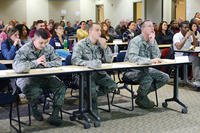
Sgt. 1st Class Stuart Greer, of the 2nd ID's Headquarters and Headquarters
Company, told soldiers gathered at Camp Red Cloud for New Horizon
Day earlier this month that hundreds of thousands of women are human
trafficking victims each year.
Lap dances will be banned under proposed new standards for bars near U.S. bases in Area I, such as these establishments near the main gate of Camp Casey. (Photo by Seth Robson / S&S)
The crime often involves women duped into
moving to a foreign country, then forced to become sex workers there.
Greer said he learned about human trafficking after meeting his Philippine
wife when she was working in a South Korean nightclub.
"When I was dating my wife, I found out her sister in Bahrain hadn't
been paid in 10 months. She was working 16 hours a day, six days a
week. Through many e-mails and telephone calls we took this guy to
court and he had to pay her and return her to the Philippines," he
said.
Southeast Asia is a major source of human trafficking, as is the former
Soviet Union, Greer said.
"In 2002, news organizations connected trafficking with the military
in South Korea," he said. They suggested that U.S. military "courtesy
patrols" were guarding establishments that engaged in human trafficking
and condoned prostitution. Indicators of trafficking include money
exchanged between soldiers and club employees for unexplained reasons
or employees that cannot leave clubs and have no access to their passports,
he said.
Greer said he is certain prostitution still happens at some clubs
in Area I.
"My wife came here as a dancer. She went to dance school. The club
owner said, 'You can dance and make $500 a month or you can sit with
the customers and if they buy you a drink you will make more.' But
I have heard of other people in clubs that actually engage in prostitution.
"In the club she sat next to me and talked," he said. "The other clubs,
they do lap dances."
The Good Commerce Practices Guide will be presented at a Jan. 30 dinner
to be attended by Brig. Gen. John Shortal, 2nd ID assistant division
commander for support, officials said.