Home
Benefits
News
entertainment
shop
finance
careers
education
join military
community


Page  1 | 2 | >>


SEA POWER

SEA POWER magazine and the Almanac of SEAPOWER (published in January) are the official publications of the Navy League of the United States (NLUS). Procurement decision-makers in the defense market, senior officials of the Navy, Marine Corps, Coast Guard, and U.S. Flag Merchant Marine, Congress, and the Departments of Defense and Transportation read SEA POWER magazine.

SEA POWER is the only audited monthly magazine that focuses exclusively on the nation's maritime defense news. Each issue's editorial content is geared toward updating sea service personnel, procurement specialists, executives in the defense industry, and decision-makers on Capitol Hill.

SEA POWER publishes a diverse range of authoritative and informative articles to educate the American people, their elected representatives, and industry on the need for robust naval and maritime forces.

Join the Navy League

SEA POWER Article Index


Marine Air Naval Gunfire Liaison Company

By SUE A. LACKEY
Associate Editor

Sea Power
December 2004


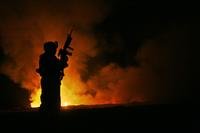
During Operation Iraqi Freedom, a small, ill-equipped, yet elite unit of Marines fanned out across Iraq, attached to U.S. Army 3rd Infantry Division, British Commandos and Marine Task Force Tarawa. The 46 men of 2nd ANGLICO, one of the Marine Corps’ Air Naval Gunfire Liaison Companies, were at the forefront of battle in every major battlespace of the war.

Unique to the Marine Corps, ANGLICO is the only unit qualified to plan, execute and control U.S. supporting arms fire for joint and combined forces worldwide. ANGLICO has a 50-year history within the Corps, but is virtually unknown to the public. Briefly deactivated in the 1990s, ANGLICO was reconstituted in 2003 and is in the process of re-inventing itself as an organization often associated with Special Operations, but with a mission and organizational structure unlike any other.

Since the start of the Iraq war, ANGLICO has grown to almost 500 men, with three active-duty companies and two reserves. The war’s original ANGLICO units were forced to borrow equipment from other services en route to Baghdad, but the Corps has invested greater resources in their training and support in advance of redeployment to Iraq next year.

Central to the company’s mission is specialized training that certifies Marines as Joint Tactical Air Controllers (JTAC). JTACs have highly specialized knowledge of ordnance, and familiarity with aircraft, that enables them to call close air support and naval guns on target accurately, and under any conditions. JTAC training and certification expands the basic knowledge of a forward air controller to its highest technical and professional level, and is recognized by all joint and combined forces. ANGLICO commanders have battalion authority, and field three-man teams that are attached to U.S. and coalition units to provide the technical knowledge needed to coordinate fire support and deconflict fire.

ANGLICO teams also must have the basic knowledge to patrol, observe and locate a target. Because ANGLICO teams may be attached to any unit, they must train to the standards of the highest level they may be called upon to support.


“We have the ability from within our own company to support whoever needs us, at whatever level,” said 2nd ANGLICO’s Staff Sgt. Johnny Pyles. “We could get attached to Army Special Forces and be able to support them, or we could get called from a mechanized Army unit and be able to support them. We have that ability because we train to that level. Whoever needs us, we can go, conventional to Special Operations.

“That’s what sets us apart — the entire organization is at that level. We’re more battlefield shapers than observers. We go out, we find, we kill, we report and then we go.”

Team members carry packs, or “rucks,” that may contain 80 to 120 pounds of gear, and are trained for deep insertion behind enemy lines. Each man goes through an ANGLICO Basic Course, receiving training in communications, scouting and insertion techniques, as well as fire-support coordination. ANGLICO is expected to regain its previous status as a jump billet, which will revert it to a volunteer unit with parachute qualifications.

ANGLICO teams employ the small-unit tactics of Special Operations, but unlike units such as Force Reconnaissance, their job is not to engage the enemy. Regimental commanders typically request an ANGLICO team to operate independently, often deep within the battlespace, locating a target and calling in immediate fire support from forward positions.

“If you engage [exchange fire with the enemy], something went wrong, you got compromised,” said Gunnery Sgt. Mike Heller. “Our main weapon is that radio.”

But the inherent danger of a small team operating deep within the battlespace remains. Teams carry only small unit weapons, operate without the support of platoons or companies and would be unable to sustain themselves in a firefight. To offset that risk, ANGLICO personnel undergo enhanced marksmanship training, requiring rifle skills superior to that of an infantry Marine, as well as Survival, Evasion, Resistance and Escape training.

Its special mission means the ANGLICO companies may be dispersed at any given time into small teams widely scattered across the battlefield. The teams are exposed in forward positions, but may be unable to access corpsmen, or be attached to foreign forces that do not maintain U.S. medical standards. With 90 days until redeployment to Iraq, 2nd ANGLICO is putting as many men as possible through EMT training in order to give each team basic medical skills designed to increase survivability.


Page  1 | 2 | >>


Member Center


FREE Newsletter


Military Report


Equipment Guides


Installation Guides


Military History