Urban Warfare Transforms
the Corps
1st Prize, Marine
Corps Essay Contest Sponsored by Raytheon Integrated Defense Systems
Major Kelly P. Houlgate, U.S. Marine Corps
Proceedings, November 2004
U.S. MARINE CORPS
(D. J. FOSCO)
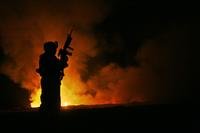
Combat is bloody, materiel-driven, and chaotic—here, Marines engaged
in Najaf, Iraq. The time has come for the Marine Corps to change the
perception that the high-tech U.S. war machine fights at a disadvantage
in urban areas. The focus must shift to urban warfare.
By 2020, 85% of the world’s inhabitants
will be crowded into coastal cities—cities generally lacking the infrastructure
required to support their burgeoning populations. Under these conditions,
long-simmering ethnic, nationalist, and economic tensions will explode
and increase the potential of crises requiring U.S. intervention.”[1]
Likely U.S. enemies include a wide array of possibilities: al Qaeda
terrorists;
dictatorial strongmen; drug cartels; or perhaps tribal/ethnic strife
leading to humanitarian crises. These potential adversaries realize
that fighting high-tech U.S. forces in open terrain is suicidal, and
thus enemies will tend to operate in cities and towns, attempting to
use the urban terrain to neutralize U.S. technology. Therefore, it appears
the most likely type of future conflict will be urban warfare.
Though Operations Desert
Storm and Iraqi
Freedom have dominated our nation’s view of modern warfare, post-Vietnam
conflicts have been characterized primarily by urban warfare. Of 26
conflicts fought over the past two decades, 21 have involved urban areas,
and 10 have been exclusively urban.[2]
The Corps’ experience in Lebanon, Panama, Khafji, Somalia, Liberia,
and the Balkans demonstrated the need to be able to conduct a wide array
of operations in close terrain. The battles for Iraqi cities such as
Nasiriyah, Najaf, and Fallujah show that high-intensity urban combat
has changed little since the days of Stalingrad, Seoul, or Hué. As the
global war on terrorism continues, it is increasingly necessary that
the Corps adopt an institutional focus on fighting and winning in urban
areas.
In light of our nation’s future strategic
requirements, the Marine
Corps needs redefining. It should focus the majority of its effort
on developing and disseminating urban warfare doctrine. While the Corps
is studying future urban warfare, it has yet to accept fully that urban
warfare is likely to be the Corps’ primary role in the future. Despite
a visionary warning from former Commandant General Charles Krulak concerning
the “Three Block War,” the Corps has done little to develop and advance
an urban-warfare ethos and mind-set.[3]
Problems in Teaching and Training
Corps-wide urban combat training remains
limited and very basic.[4]
The Basic School and the recruit training regiments give military operations
in urban terrain scant treatment. For the Corps to take on urban combat
as an all-encompassing focus, it must become second nature and fundamental
to entry-level training.
Fleet training is also limited and surprisingly unchanged over the
past 15-20 years, despite experience in urban conflicts. The capstone
unit training exercise is still the 29 Palms-based combined arms exercise,
which undeniably prepared the Corps for Operations Desert Storm and
Iraqi Freedom, but remains focused on operations in desert terrain and
on mechanized tactics, techniques, and procedures. The combined arms
exercise is superb training, and the Corps needs to retain mechanized
and combined arms excellence, but this is training for the last war.
Training facilities across the Marine Corps for military operations
in urban terrain are small U.S. suburban-style mock towns with concrete
construction and wide streets. While the infantrymen and engineers practice
“room-clearing” in these tiny facilities, logisticians, communicators,
and aviators, to list only a few specialties, get almost no training
and are left on their own to create training opportunities for urban
combat. Clearing an enemy from an urban defensive position is a crucial
skill for an infantryman or engineer, but it is just one of many skills
needed to succeed in urban combat. One would be hard-pressed to find
a logistician or intelligence Marine who, in training, has had to supply
a unit in simulated urban combat or collect against a changing urban
enemy for even two consecutive weeks.
Marine Corps urban training also lacks the most crucial component of
any training for war: live-fire combined arms. It is undeniable that
the application of firepower against an urban enemy is perhaps the most
challenging of tasks in modern warfare, but the Corps has no facility
or range to assist its warriors in the accomplishment of this task.
There are small-arms urban training ranges, and “Yodaville” at Marine
Corps Air Station Yuma is useful for air-to-ground urban combat training,
but nowhere is there an opportunity for doing what needs to be done
in combat—urban combined arms. As a result, Marines must relearn lessons
from past conflicts each time urban combat occurs.
Solutions
In terms of doctrine, the new (draft) Marine Corps Warfare Publication
(MCWP) 3-35.3 is an excellent start. The most important task for Marine
Corps leaders and educators is to disseminate this important document
throughout the Corps. This should include not only the MCWP itself,
but also supporting documents, such as cargo-pocket-sized field manuals
and “gouge cards.” In addition, subordinate publications, detailing
specific urban warfare roles, missions, tactics, techniques, and procedures
for specific military occupational specialties (MOSs), should be developed
and disseminated to the Corps. Though the new MCWP may never reach the
Corps-wide familiarity level of the ubiquitous Fleet Marine Force Manual
I (Warfighting), the goal should be to elevate MCWP 3-35.3 to that level
of familiarity and distribution.
At the heart of the MEU’s area of operations (AO) was Tarin Kowt, a
small town of 17,000. The lush vegetation that follows several watersheds
leading down to the town contrasts sharply with the steep, arid mountains
that surround it. At the bottom of the Tarin Kowt “bowl” (at 4,400 feet)
was an old abandoned dirt airstrip that became the centerpiece of the
22d MEU’s air-ground operations.
(continued)
© 2004 The Naval Institute. All rights reserved.