For
all who have earned and worn the eagle, globe,
and anchor, the Marine Corps Association is
the professional organization for all Marines
-- active duty, Reserve, retired, and Marine
veterans. The MCA understands and identifies
with the sacrifices made and the services
rendered as a Marine to this great country.
We strive to keep our members informed of
developments and future plans, while emphasizing
the rich history of the Marine Corps and keeping
everyone abreast of current operations. The
association achieves these goals primarily
through our cornerstone publications, Leatherneck
magazine and the Marine
Corps Gazette. These two great publications
foster the spirit and traditions of our Corps.
Demonstrate your commitment to the Marine
Corps and join the professional association
for all Marines today. Join
or subscribe now through August 31st,
and receive 15 issues for the price of 12
on your first year (please reference key code
NIMCOM04). Semper Fidelis!
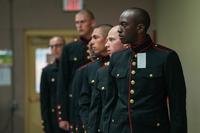
The body bearers will march as far as two miles from the Old Post
Chapel at Fort Myer, Va., to the grave site in all kinds of weather.
Shown (front to rear, left column) are LCpl Miguel A. Perdomo, LCpl
Sean M. Robinson, Sgt Aaron V. Williamson and (front to rear, right
column) Cpl Benjamin J. Watrous, LCpl Quentin C. Papenhausen and Cpl
Andrew C. Curtis. (Photo by Nancy Lee White Hoffman)
Six gloved hands grip the flag-draped casket bearing one of their
own. With ramrod posture and synchronized steps, the Marine Corps
Body Bearers ceremoniously carry the Marine veteran to his final resting
place. At the grave site, the body bearers stand perfectly still,
holding the flag taut above the casket while the chaplain speaks,
sometimes for more than an hour. Then silently the six Marines begin
to fold the flag. Their slow, deliberate motion magnifies the honor
and appreciation reflected in this final act for a fellow Marine.
This ceremony will be executed with the same degree of dignity and
expertise more than 500 times a year by the U.S. Marine Body Bearer
Section. This small but vital group of Marines, called the "World
Famous Body Bearers," currently is composed of 16 Marines within "Bravo"
Company, one of the ceremonial drill companies at Marine Barracks
(8th and "I"), Washington, D.C.
Their mission is to conduct funerals for Marines, Marine veterans
and Marine dependents at Arlington National Cemetery and other cemeteries
in the Washington, D.C., area. They also are called upon to perform
funerals for senators, members of Congress, heads of state and Presidents.
They have earned their reputation, and as all Marines do, they set
high standards and train hard to exceed them.
"Funerals are the most important thing we do here, and you have to
put that in the context of Presidential Support Duty, Evening Parades,
and many other highly visible ceremonial and security missions," proclaimed
Colonel Daniel P. O'Brien, Commanding Officer, Marine Barracks, Washington.
"This is a very visible symbol of Marines taking care of Marines.
We are bringing someone's hero to his or her grave."
Funerals are just one of the duties assigned to the Body Bearer Section.
It also is responsible for firing salutes with the 40 mm cannons on
the parade deck at 8th and "I" to render honors to visiting dignitaries
and foreign military personnel. Every year on the Marine Corps Birthday,
body bearers lay wreaths on the Arlington National Cemetery grave
sites of former Commandants of the Marine Corps and former Sergeants
Major of the Marine Corps. Between the funerals, cannon firing and
wreath laying, the body bearers, who are all infantrymen, must maintain
their military occupational specialty proficiency by attending classes
and going to the field for training.
Honoring Heroes
Sergeant Aaron V. Williamson, the noncommissioned officer in charge
of the Body Bearer Section, has participated in nearly 600 funerals
since joining the section in 2000. Bearing both the physical and emotional
weight of the funerals results in a teamwork and brotherhood that
Williamson, a native of Daytona Beach, Fla., said is "unparalleled
in anything I've ever experienced. It's so honorable, what we do."
In the four years that Williamson has served as a body bearer, he
has experienced history in an intensely personal way—through the lives
that have been lost. Now just 24 years old, he already has buried
many Operation Iraqi Freedom Marines, two with whom he previously
had served. In 2001 his unit participated in a two-day ceremony burying
the remains of 13 "Makin Island Raiders" of the 2d Marine Raider Battalion,
who were killed during a raid on Butaritari Island in 1942. When Central
Intelligence Agency agent and former Marine officer Johnny Micheal
"Mike" Spann was killed in Afghanistan at the hands of pro-Taliban
prisoners in late November 2001, the body bearers escorted his body
in a full honors burial at Arlington National Cemetery in December.
Also in 2001 the body bearers traveled to New York City to participate
in a memorial service for Sergeant Major Michael S. Curtin, USMCR
(Ret), a member of the New York City Police Department who perished
in the World Trade Center terrorist attack. In 2003 the unit provided
the funeral detail for Felix de Weldon, the creator of the iconic
Marine Corps War Memorial sculpture. Sgt Williamson's own family history
was touched by his Marine Corps duty when he served as a body bearer
at the burial of his grandfather, former Sgt Alex T. Bullinger, USMC.
Joining the Elite
Every Marine is handpicked for body bearer duty because of the unusual
standards he must meet. Co B First Sergeant Leon S. Thornton and Sgt
Williamson go on quarterly recruiting trips to Marine Corps bases
to conduct a selective screening process for potential candidates.
Since the training is intensive, the ideal candidate is one who is
early in his enlistment so he can perform the job and teach others
before it is time to leave. Marines with experience in the operating
forces also are recruited for leadership positions.
There are three initial criteria for candidates: they must be infantrymen
(0311), they must pass an initial strength test, and they must have
a recommendation from their command. Once these qualifications are
met, 1stSgt Thornton said he looks at the Marine's character. Does
he have a good attitude? Is he financially fit? Can he think on his
feet? Is he morally sound?
These young Marines shoulder an enormous responsibility to represent
the Marine Corps in an atmosphere of respect and honor. Being able
to maintain ceremonial composure is critical to their success. Captain
Torey S. Hinkson, Commanding Officer, Bravo Co, emphasized, "Their
job has virtually no room for error, so there has to be an extra level
of scrutiny. They must be able to show due respect."
Since the body bearers must carry caskets ranging in weight from 350
to 700 pounds with precision, physical strength is critically important
in performing their mission. The initial strength test requires that
Marines can bench press 225 pounds for 10 repetitions, do a military
press (behind-the-neck seated shoulder press with a barbell) of 135
pounds for 10 repetitions, and do 10 barbell curls with 115 pounds.
These are the minimum strength requirements. Once the Marine passes
the test, he is expected to continue to progress. There also is a
height range requirement, between 5 feet 11 inches and 6 feet 2 inches,
to enable the body bearers to carry the casket level.
Once a Marine has been accepted into the unit, he attends Body Bearer
Ceremonial Drill School for four months. According to Corporal Benjamin
J. Watrous, the Ceremonial Drill School instructor, the training targets
the three main aspects of being a body bearer: learning the proper
techniques necessary to conduct a funeral, working as a team and weight
training. By the end of the third month, a new body bearer is ready
to participate in funerals. At the completion of the school, he is
issued the "black and gold" official training uniform of the body
bearers: black shorts and a black tank top emblazoned in gold with
the words "World Famous Body Bearers, The Last to Let You Down."
Training for Excellence
Although the school lasts four months, the training never ends. The
body bearers drill for 15 hours a week in humble surroundings in the
lower level of the Marine Barracks parking garage. Overhead, amber
lights cast a dull glow on suspended industrial pipes. In a corner
there is an assortment of caskets and a caisson used for practice.
A wooden platform, which simulates the area around the grave site,
is placed in the center amidst the parked cars.
The Marines practice funeral scenarios as they carry the casket and
fold the flag. The training is "hard and heavy," Williamson said,
explaining that discipline and bearing in practice are critical to
success during an actual funeral. The Marines maintain ceremonial
composure during the drill from beginning to end despite any complications
that might arise.
During a funeral Marines often have to adjust to unexpected circumstances.
They may need to navigate around a large gravestone, be wary of uneven
surfaces around the grave site, or adjust to a flag that a funeral
home has placed on the casket incorrectly. All six Marines must react
to these anomalies in a heartbeat, often without commands. The training
is designed to hone their situational awareness so they can inconspicuously
adjust to these challenges while maintaining their military bearing.
Flag folding is a very precise and poignant procedure occurring at
the end of the funeral ceremony, and it is a "tedious and time-consuming
task to learn," according to Williamson. It requires many complicated
movements that must be executed in tandem with the Marine on the opposite
side of the flag. The slow, exaggerated movement must be fluid from
the first fold to the final triangular-shaped flag that is presented
to the next of kin.
In the large mirror mounted on the cinder-block garage wall, two Marines
practiced "hand waves," gestures used in the flag-folding process.
In perfect unison the Marines pantomimed the motions, critiqued each
other and began again. The movement is an example of "phasing" or
doing the exact same movement at the exact same time, usually without
the benefit of watching the other Marines. It relies on counting and
a lot of practice, according to Lance Corporal Todd J. Fox of Chicago,
who said that phasing is the hardest part of the drill.
Pulling Your Weight
Teamwork and dedication to drill are common among Marines, but the
third aspect of body bearer training, intense weightlifting, is an
additional requirement critical to the success of their mission. Unlike
the other services that mostly use eight men to carry a casket, the
Marine Corps always uses only six men to bear the weight of a casket,
which can be as much as 700 pounds. Additionally, Marines honor the
deceased by lifting the casket head-high, a move no other service
does, which requires great strength. Consequently, weightlifting is
an integral part of these Marines' training, averaging 10 hours a
week.
As in everything the body bearers do, they train as a team. When the
lifting gets tough, fellow Marines holler motivating words of encouragement—"Go,
Man! It's all you!"—and stand by to spot the lifter. Using mirrors
and fellow Marines' advice, the body bearers scrutinize their form
and work to maximize each exertion.
The average body weight of a Marine body bearer is 230 pounds. This
necessitates specially altered uniforms that are tailored to fit,
yet flexible enough to allow for the range of motion necessary to
lift the caskets. Marines must monitor their weight training to meet
the strength requirements, but still present the smart appearance
required of every Marine. Strength training is coupled with health
and nutrition classes to help the body bearers achieve their weightlifting
goals safely.
While weightlifting is a very large part of the Marines' training,
Williamson emphasized, "We are not just a bunch of big guys who lift
weights all day. We are a professional group of Marines who honor
fallen Marines with respect and dignity." To meet their mission of
upholding the history and traditions of the Body Bearer Section and
the Marine Corps as a whole, they train hard every day and execute
their duties with precision and perfection in honor of all who have
served the Marine Corps.
From the letters received from grateful families, the World Famous
Marine Body Bearers do indeed uphold the Marine Corps traditions of
honor and excellence. David S. Wininger penned these words in appreciation
to the body bearers who laid to rest his father-in-law, Robert K.
Dore:
"A former Marine myself, I cannot express the pride and honor I felt
as the funeral procession pulled into the cemetery and the Body Bearer
Detail came into view. ... I know the last thing these Marines wanted
to do on Christmas weekend was to stand in cold wind and bury an old
man. Express to them that they gave this old Marine the greatest farewell
he could have asked for."
Editor's note: If your unit has a Marine who has the potential to
serve with the Marine Corps Body Bearers, contact the Company B first
sergeant at (202) 433-3301/2113.