Marine Lieutenant
Colonel Eddie Ray (Barbarian 6) spearheaded
the 1st
Marine Regiment's charge to Baghdad as
commander of the 2nd Light Armored Reconnaissance
(LAR) Battalion last year in Operation
Iraqi Freedom. This was not his first
taste of battle. Ray is a decorated veteran
of Operation
Desert Storm. Read about Captain Eddie
Ray's heroic actions during Operation Desert
Storm in Richard S. Lowry's complete account
of the first war with Iraq, "The Gulf War
Chronicles."
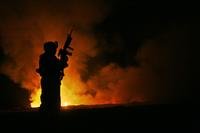
After twenty months of waiting, the city of Fallujah is finally under attack. General Richard Natonski's 1st Marine Division has finally surrounded the hornets nest and yesterday morning they moved to clear this Sunni Triangle city of the thugs, murderers, and terrorists who have threatened the stability of a new Iraq ever since Saddam's Statue was pulled down in Baghdad.
In April of 2003, elements of the Army's 3rd Infantry Division drove west to secure Fallujah. Soldiers of the 3 ID found a "Wild West" lawless city. They were stretched much too thin to apply the force necessary to establish law and order in this Saddam stronghold. So, they developed a fortress mentality and they moved into armed defensive positions in, and, around the city.
Soon, the Ghosts of the 2nd Armored Cavalry Regiment were tasked with maintaining law and order in Fallujah. They too did not have the manpower to clear the city of its vermin. So they established a Fort Apache defense in the center of the city. They too were forced out of the area by repeated terrorist attacks.
Then the Marines moved in. They adopted a whole new philosophy of containment while they tried to negotiate with the city's local leadership. By last March, Americans were not venturing into the lawless city. Then four Americans were slaughtered on the western outskirts of town. In a scene reminiscent of Somalia, the Americans were dragged through the streets and their bodies were strung up from the western bridge.
Military
Scholarships There is over $300 million in scholarship money for servicemembers,
veterans and dependants. Use the improved Scholarship Finder to help finance
your education. Search
for scholarships!
American patience only goes so far. The Marines of the 1st Marine Division attacked Fallujah with a vengeance. But victory slipped through our hands when the fledgling Iraqi government tried to negotiate a peace.
Now, Major General Richard Natonski is leading the 1st Marine Division in an all out assault on Fallujah. Natonski, a veteran of Iraqi urban warfare has moved against the enemy, using tactics that members of his Camp Lejeune Marines developed in the battle for An Nasiriyah.
Natonski's Task Force Tarawa spent more than a week wresting control of the dusty desert city of An Nasiriyah from Saddam's fanatics. And, they succeeded by using techniques and tactics new to the Marine Corps.
Small sniper teams were more important to the victory than companies of Marine Infantry. Human Exploitation Teams were more effective than anti-armor teams. Interpreters were more valuable than grenadiers.
Lieutenant Colonel Brent Dunahoe's Betio Bastards cleared southern Nasiriyah using small unit urban tactics. Marines of the 3d Battalion, 2nd Marine Regiment methodically cleared the south side of An Nasiriyah -- house-by-house and block-by-block. They moved forward cautiously -- first with sniper teams.
Dunahoe's snipers manned positions on rooftops that allowed them to see several blocks ahead. They did more watching than shooting. The Marine sentinels spent hours watching the city in their sites -- learning. They stayed until the got a feel for the city below. They learned which were the important buildings. They learned which were the homes of peaceful Iraqis. They learned where the dens of the enemy were.
Only after intelligent monitoring of his surroundings, did Dunahoe attack. First, he called in artillery and CAS on the enemy's strongholds and command centers. Then, under the watchful eyes of his snipers, he moved his infantry forward to occupy the area ahead.
Then, the snipers would move forward to their next vantage point to repeat the process all over again. Marine HET teams would quickly move to gather documentation and interview the law abiding Iraqis in the newly secured area. The Civil Affairs team would move in and assure the locals that the Marines were there to stay and that they were there to rid the city of the oppression that Saddam had imposed. Grateful Iraqis pointed out the houses and offices of Ba'ath Party officials and Saddam's thugs.
Armed with all of this new information, Dunahoe would attack the next district, focusing on enemy strongholds. These tactics limited the destruction and further won the local people's support.
Dunahoe's next bound would be even more successful as he defeated the enemy and slowly won the hearts and minds of Nasiriyah. On one of the battalion's last bounds, The Betio Bastards captured the headquarters of the Iraqi 11th Infantry Division. Nearby, there were warehouses filled to the rafters, some with weapons, and others with food. The Marines quickly distributed to food to the people of An Nasiriyah.
Hopefully, An Nasiriyah will become the prototype for the movement into Al Fallujah.
Richard S. Lowry is an author and military historian. Last year he published The Gulf War Chronicles which is a complete account of Operation Desert Storm. He is currently working on his next book, Marines in the Garden of Eden which will tell the story of The Battle of An Nasiriyah. Visit: www.gwchronicles.com.