









|
|
|
|
|
|
SOUND
OFF! |
| Join our
discussion here.
| | |
| Military Wants to Stop U.S.
Patrols
Associated Press January 14, 2002
WASHINGTON (AP) - The military is exploring ways to
stop the around-the-clock anti-terrorism patrols that fighter jets have
been flying over American cities since Sept. 11, defense officials said.
But four months after the devastating attacks on U.S. soil, any
decision on ending the combat air patrols may come down to largely a
political calculation of how safe Americans would feel without them, they
said.
As a part of heightened homeland defense, the missions began
after terrorist hijackers crashed jetliners into the World Trade Center
and the Pentagon. They have flown constantly over New York and Washington
since then.
Other patrols are flown randomly over other major
metropolitan areas and key infrastructure, and jets are on alert at 30
bases across the country to scramble if called.
The military also
has been authorized to order pilots to shoot down commercial aircraft if
necessary.
Officials have been looking to cut back on the program
for some time, knowing from the outset that the high-tempo use of
manpower, equipment and money couldn't be kept up for long with the
existing people and budget, one defense official said on condition of
anonymity.
Now that four months have passed and aviation security
has been improved somewhat, some wonder it if might be time to start
rethinking the patrols, the official said.
The operation uses
11,000 people and 250 aircraft, another official said, also in return for
anonymity. Those figures include maintenance crews, pilots for 100 F-15
and F-16 fighter jets, as well as crews for tankers needed for mid-air
refueling and AWACS - Airborne Warning and Control System - planes to
provide radar information.
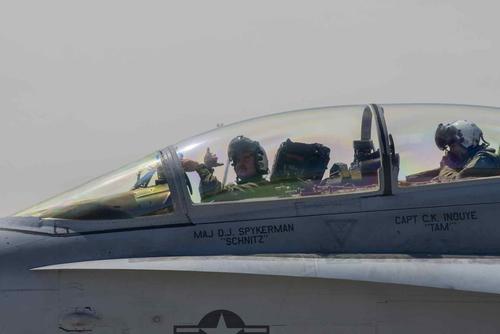
The pilots, mostly from Air National
Guard units, go up for flights of two to six hours. The jets are refueled
about every two hours, meaning some go through two mid-air refuelings on a
single sortie.
From Sept. 11 to Dec. 10, the operation flew 13,000
missions. The cost was $324 million, Defense Department spokeswoman Susan
Hansen said.
Air Force officials had no immediate comment Sunday.
The North American Aerospace Defense Command, which runs the
operation, said periodic review of missions is standard procedure in the
military.
``We continuously analyze our ongoing operations ... as
a matter of prudent military planning,'' said Maj. Barry Venable, a
spokesman for NORAD in Colorado Springs, Colo.
``We will continue
to execute our role (in homeland defense) until the national leadership
directs otherwise,'' he said.
NORAD says that through Dec. 10, its
jets responded 207 times to problems such as unidentified aircraft, planes
violating restricted air space and in-flight emergencies.
Not
included in the figure is the case in which two jets escorted a
Paris-to-Miami flight to Boston later last month after a passenger tried
to ignite what authorities said was an explosive hidden in his shoes.
In 92 of the cases, jets on alert on the ground were scrambled to
respond.
In the other 115 cases, NORAD diverted jets that already
were in the air flying combat patrols.
Pentagon officials said
privately that there is mounting stress on the people and planes that can
affect readiness for other missions.
And while they believe the
patrols are a deterrent to would-be attackers and give some Americans a
greater sense of security, they also argue that scrambling planes against
attacks is a measure of last resort. Security should be tightened on the
ground before problems become airborne in the first place, they maintain.
One alternative to constant patrols would be to keep planes on
ground alert, as was done before Sept. 11. They were on alert at a handful
of places before it was ordered at 26 bases, then grew to the current 30.
In addition, airliner and airport security has been tightened in
the last few months. Thousands of National Guard troops are on duty at the
nation's airports. Screening of passengers and carry-on baggage has been
increased.
And under a new aviation security law, airlines are
required starting next weekend to inspect all checked baggage for
explosives.
Many officials believe it's still not enough.
Homeland Security Director Tom Ridge noted Sunday that the nation
is still on high alert.
Though speaking about security in general
and not specifically about the sky patrols, Ridge said in a CNN interview
that much remains to be done. ``We still have to be very, very vigilant,''
he said.
The combat air patrols are the first of their kind to fly
over the United States since the Cuban missile crisis in 1962.
Copyright 2002 Associated Press. All rights
reserved. This material may not be published, broadcast, rewritten, or
redistributed.
|
|
|
|
|