



 |
| Taiwan worries
that the recent troubles between Washington and Beijing could
influience the new administration's decision
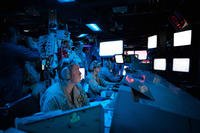
on whether to provide Taiwan with Arleigh Burke-class destroyers
equipped with the Aegis radar system. |
|
|
|
SOUND OFF!
|
| Join our discussion
here. |
|
|
|
Taiwan treads cautious line in superpowers'
spy plane row
Agence France-Presse
TAIPEI, April 8 (AFP) - Amid frantic efforts by the United
States and China to solve the spy plane row, Taiwan has taken a highly
cautious line, all too aware it has a lot to lose when the two superpowers
clash.
Local media have asked both Beijing and Washington to exercise restraint
in handling the standoff, which has now lasted a week despite signs
a compromise perhaps being worked out.
The US Navy EP-3 Aries plane made an emergency landing on China's
Hainan island last Sunday after colliding over the South China Sea
with a Chinese fighter jet, the pilot of which is still missing.
US officials in Hainan had a third meeting with the 24 crew members
of the plane early Sunday.
Amid all this the island is caught in delicate position between its
arch foe China and the United States, Taiwan's leading arms supplier
since Washington switched diplomatic recognition from Taipei to Beijing
in 1979.
"It seems that the best policy for Taipei is to keep tight-lipped,
although the government may really want to voice its moral support
to Washington," said Joseph Wu, deputy director of National Chengchi
University's Institute of International Relations.
Among reasons for sympathising with Washington, he said, was that
"Taiwan and the US share some interests militarily, including the
sharing of intelligence on China".
"The US military information is critical to Taiwan," Wu said.
The US helped Taiwan built electronic intelligence-gathering capacity
during the Cold War, and military analysts believe the bonds still
exist.
But as yet the Taiwanese government has strictly kept to its policy
of caution, with both the foreign and defense ministries declining
to comment on the dispute.
The low-key response is intended to not give Beijing anything to be
used against the government of the pro-independence Democratic Progressive
Party.
"The new government has been very careful not to enrage Beijing since
President Chen Shui-bian took power last year," said Yang Chih-heng,
deputy director of the Strategic and International Studies think tank
of the Taiwan Research Institute.
In his inaugural speech last year, Chen, the island's first head of
state not to come from the Kuomintang party, guaranteed he would not
seek independence nor press for a plebiscite during his four-year
term.
Beijing -- which sees Taiwan as a renegade province and has threatened
to use force to reunite it -- repeatedly lambasted Taiwan when it
was ruled by former president Lee Teng-hu, saying he was a trouble-maker
trying to sabotage Washington-Beijing ties.
And as negotiations inch ahead to tackle the crisis, Taiwan has voiced
concerns that its interests could be sacrificed by the US in the interests
of Sino-American relations.
At Wednesday's regular cabinet meeting, Premier Chang Chun-hsiung
urged the US to respect the Taiwan Relations Act, under which Washington
is committed to providing the island with the means to defend itself.
Experts have called attention to Beijing's more aggressive tactics
in intercepting US spy planes.
"It was a clear signal of China's significant achievements in modernizing
its forces, particularly the air defense capability," Yang said.
He said Washington's mere concern about Taiwan security was not enough,
and that the US should make "concrete guarantees" if it was to check
any invasion moves by Beijing.
The worries come as George W. Bush's new administration ponders the
decision on whether to provide Taiwan with Arleigh Burke-class destroyers
equipped with the Aegis radar system.
China has bitterly opposed such a deal, which it belie=ves could tie
into a future US missile defence system.
The White House insisted Friday that US arms and equipment sales to
Taiwan were not a part of negotiations aimed at resolving the standoff,
but the island nonetheless remains nervous.
COPYRIGHT 2001 Agence France-Presse. All rights reserved.
|