




|
|
|
 |
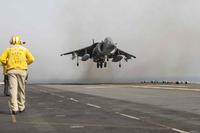
| The Navy will have the opportunity to
inspect its downed plane still held in China (U.S. Navy photo) |
|
|
|
SOUND
OFF! |
| Join our
discussion here.
| | |
| China: U.S. Can Inspect Spy
Plane
Associated Press
WASHINGTON (April 30) -- China will grant United States
inspectors access to a Navy surveillance plane grounded on Hainan island,
raising hopes that U.S.-China tensions will ease and that the disabled
aircraft will soon return home.
A team of U.S. military experts in
Okinawa, Japan, awaited clearance to travel to China, hoping to depart as
early as Monday.
``I see it as an encouraging sign that they're
willing to proceed,'' Vice President Dick Cheney said Sunday. The plane
cannot be flown now and may have to be taken out on a barge, Cheney said.
At the same time, top Bush administration officials reiterated
President Bush's tough stand that a military response from the United
States remains an option if China attacks Taiwan.
It has been
nearly a month since a U.S. Navy EP-3E surveillance plane with a crew of
24 collided with a Chinese fighter jet sent to intercept it over the South
China Sea.
The plane made an emergency landing at a military
airfield on Hainan island on April 1, and the crew was detained for 11
days. They were released after Bush said he was ``very sorry'' for the
loss of the Chinese pilot and for the U.S. plane's unauthorized entry into
Chinese airspace to make an emergency landing.
At April 18-19
talks in Beijing, American negotiators presented a written proposal for
U.S. experts to inspect the plane to determine whether to repair and fly
it out or ship it out in pieces.
``Having completed its
investigation and evidence collection involving the U.S. plane and in view
of international precedents in handling such issues, the Chinese side has
decided to allow the U.S. side to inspect its plane at the Lingshui
Airport,'' the official Xinhua News Agency said Sunday.
Cheney
said he was hopeful that China's decision would lay the groundwork for the
return of the plane, which was loaded with sophisticated eavesdropping
equipment.
``As we've said all along, we do want our aircraft
back. And the fact that they have now announced that they're willing to
have U.S. personnel go in and look at the aircraft and assess what it's
going to take to get it back, I think is very positive,'' he said on ``Fox
News Sunday.''
The president's chief of staff, Andrew Card, said
Washington was preparing to send a team to the island.
``We expect
them to get there as soon as their documentation is ready, their visas are
ready,'' Card said on ABC's ``This Week.''
White House spokesman
Ken Lisaius said an American team was ready to travel from Kadena Air
Force Base in Okinawa, Japan, to China.
Neither he nor a Pentagon
spokeswoman could say who was on the ``technical assessment team.'' They
were unsure how swiftly the plane might be returned, or even how it would
come back.
Cheney said the aircraft was not airworthy.
``The nose is gone from it, all of the instruments don't work, two
of the engines are out,'' he said. ``There isn't any way you're going to
fly that aircraft out of there. Somebody's going to have to go in and load
it on something and transport it out, probably a barge or something.''
Xinhua also said the United States has agreed to consider making a
payment to China. Card and Cheney said that would represent compensation
for any Chinese assistance in removing the plane. There will be no
additional compensation, they said.
The team will try to determine
what military and hardware secrets the Chinese may have collected in the
month since the plane has been on the ground. Crewmen aboard the U.S.
plane used hammers and other measures to try to disable intelligence
equipment, but some secrets still fell into Chinese hands, according to
U.S. defense officials.
``I would assume they got something,''
said Cheney, a former defense secretary.
While there was progress
on returning the plane, U.S. officials forcefully reiterated Bush's
warning last week that U.S. military force is an option if China invades
Taiwan. Bush's statements marked an apparent departure from the
long-standing American policy of ``strategic ambiguity,'' and further
inflamed U.S.-China tensions.
``We're very serious about defending
Taiwan,'' Cheney said on Fox.
Added Card: ``It's important that the United States live up to its obligations
to help Taiwan defend itself and that's what the president reiterated.''
|
|
|
|
|