









|
|
|
 |
|
|
|
SOUND OFF!
|
| Join our discussion
here.
|
|
|
|
Bush to China: Return
Plane, Crew
United Press International
WASHINGTON (April 2) -- Three U.S. destroyers lingered around
Hainan Island Monday and President George W. Bush called on the Chinese
to allow U.S. diplomats access to the Navy personnel in custody after
a reconnaissance plane made an emergency landing following a collision
with a Chinese aircraft.
A Navy EP-3 reconnaissance aircraft with a
crew of 24 collided with a Chinese fighter jet early Sunday. The Navy
plane made an emergency landing at a Chinese military base on Hainan
Island. U.S. officials have not been able to contact the crew since.
Bush called for the prompt return "without further damage or
tampering" of the crew and plane, which was equipped with sensitive
surveillance equipment.
CNN reported Monday that Chinese
authorities boarded the U.S. aircraft soon after it landed in Hainan. The
news network also said that 24 people on the crew were being held
individually.
A former Pentagon intelligence official told United
Press International the crew would have "zeroed" out the crypto analytic
equipment and other software on landing, essentially wiping their memories
clean. Although the Chinese might have access to the hardware, the
software that runs it would be almost impossible to penetrate. The
official said the shut down of all the software on board the aircraft
would explain why there was only brief contact with the crew on landing.
He said once the aircraft is back in American hands, the software would
have to be reloaded onto the EP-3.
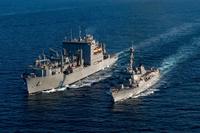
The United States ordered two
Arleigh Burke-class destroyers, which have more firepower per ton than any
other class ship in the world, and one Spruance, which is a high-speed
anti-submarine destroyer that is also built to engage ships, aircraft and
shore targets and can provide naval gunfire support in conjunction with a
Marine amphibious landing, to the area. Navy officials would not say how
far off Hainan the ships, that had been in Hong Kong on a routine visit,
were.
U.S. diplomats headed to Hainan, off China's southern coast,
where the Navy plane landed at the Lingshui military airport. U.S.
Ambassador Joseph Prueher, a retired admiral and former commander in chief
of the U.S. Pacific Command, said China's refusal to allow U.S. officials
to talk with the crew was "inexplicable and unacceptable." It was unclear
whether the diplomats' presence on Hainan would change China's position.
Bush said the U.S. government had been in contact with the Chinese
government since shortly after the planes collided. U.S. officials said
they were trying to get access to the crew of the Navy plane.
"I
am troubled by a lack of timely Chinese response to our request," Bush
said.
Senate Majority Leader Trent Lott, R-Miss., told reporters
he had talked to both the president and the vice president Monday about
the collision. Lott emphasized a quick resolution predicated by immediate
access to both the aircraft and the crew. He said the United States should
remain calm.
"I think for us ... to keep a calm atmosphere is the
right way to proceed," Lott said. "We want good, strong relations with
China."
Prueher said Beijing insisted that the U.S. crew was
responsible for the collision and said that as the crew members have been
kept incommunicado, U.S. officials have no information from the Navy
personnel regarding the allegation.
Chinese authorities assured
U.S. officials that the crew members were safe. The crew was almost
certainly off the plane, a Pacific Command official said. The EP-3 is
equipped with only a latrine -- similar to a bus -- and does not have
sufficient water or food to support 24 people for long. The official would
not say what instructions EP-3 crew were given in the event they land in
what can be considered unfriendly territory, but said most decisions are
up to the crew. If the aircraft were sufficiently damaged to make it
dangerous for the crew to remain on board or if the crew sustained
injuries, they may decide to leave the craft.
A Chinese Foreign
Ministry spokesman said the United States had "total responsibility for
this event." The ministry on Sunday accused the U.S. Navy EP-3 plane of
suddenly veering and bumping the F-8 fighter jet, causing the fighter to
crash into the South China Sea. The incident occurred shortly after about
9 a.m. Sunday about 62 miles southeast of Hainan. The Chinese pilot was
still missing Monday and China had a fleet of 11 ships and more than 20
planes searching, the state-run Xinhua news agency reported.
A
U.S. diplomatic mission comprising two military officers and one State
Department official arrived at Hainan but had not yet met with the crew,
Pacific Command said Monday morning.
The EP-3 could not have
landed in a better place for China or a worse one for U.S. military
intelligence. Hainan island is host to one of China's largest
electronic-signals-intelligence complexes and is manned by experts who can
glean critical information on the aircraft's capabilities if they gain
access to the Navy's EP-3, also a "SIGINT" collector, Pentagon sources
said. Hainan is also home to a major Chinese satellite-communications
intercept facility.
The U.S. Navy said the plane was on a routine
surveillance mission in international airspace when it was intercepted by
two Chinese fighters and bumped by one of them. The EP-3 was forced to
land in southern China. The Navy said the plane, fitted with
high-technology listening devices and an advanced radar system, had been
badly damaged. The pilot put in a distress call and landed on Hainan.
Lt. Cmdr. Sean Kelly of Pacific Command at Camp Smith, Hawaii,
said the crew contacted Navy officials after the aircraft had been damaged
in the collision but since that initial message, "We haven't heard a peep
... as far as we know they (crew members) are still in Hainan and that the
Chinese government is taking care of them."
Commander in Chief of
the U.S. Pacific Command Adm. Dennis Blair criticized China Sunday at a
news conference in Hawaii saying that "Chinese fighters over the past
couple of months have become more aggressive to the point that we felt
they were endangering the safety of the Chinese and American aircraft."
A spokesman for the Pacific Command said the Navy plane should be
regarded as sovereign U.S. territory.
"We expect that their
government will respect the integrity of the aircraft and well-being and
safety of the crew in accordance with international practices, and that
they'll expedite any necessary repairs to the aircraft and that they'll
facilitate the immediate return of the aircraft and crew," said Lt. Col.
Dewey Ford, a spokesman at Fort Smith in Hawaii.
--
(Mark Kukis at the White House and Katherine Arms in Hong Kong contributed
to this report.) |
|
|
|
|