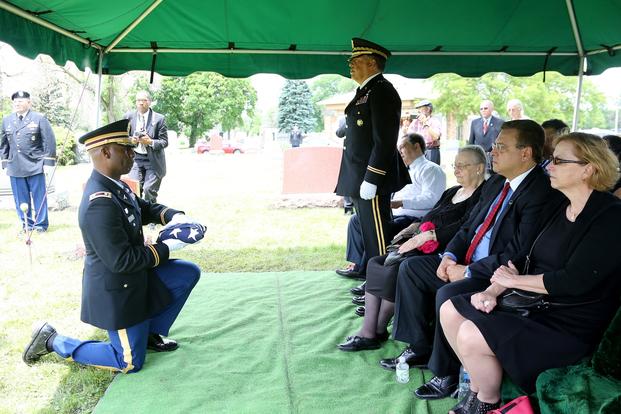
The Survivor Benefit Plan (SBP) ensures a military retirees dependents receive a continuous lifetime annuity. Find answers to your SBP questions with our FAQ page.
Survivor Benefit Plan (SBP) Questions
- Upon my death how does my surviving spouse apply for SBP?
After Defense Finance Accounting Service (DFAS) is notified of your death a SBP application form will be mailed to your surviving spouse.
- When will I start receiving my monthly SBP annuity?
If the administrative aspects are handled properly by DFAS and the potential SBP annuitant, the annuity will begin about 45-60 days after the death of the retired member.
- I'm on active duty with more than 20 years of service creditable towards retirement. If I die before retirement, is my spouse covered under SBP?
Yes. You are covered under SBP if you die while on active duty, are married, or have dependent children and have completed 20 or more years of active service, at time of death.
- I do not have a spouse and will elect child-only coverage. If I die while the children are still eligible for the annuity, how long will they receive the annuity?
Children are paid the annuity in equal shares until they reach age 18 (or 22 if full-time students). An incapacitated child will receive the annuity for life without any reductions for Social Security, provided the child never marries. As each child reaches the age when entitlements no longer exist, the annuity is divided equally between the remaining eligible children.
- How much of my military spouse's retired pay will I receive at his or her death if we participate in SBP at the maximum level?
You will receive 55% of gross retired pay.
- If I'm receiving an SBP annuity and I remarry, is the SBP annuity lost forever?
No. If remarriage occurs before age 55, the annuity is suspended and can be reinstated if the remarriage ends by death or divorce. If remarriage occurs at age 55 or older, the annuity continues uninterrupted for the duration of the spouse's life.
- Can a surviving spouse receive both the uniformed service SBP annuity and a civil service/FERS SBP annuity?
Yes, provided the military member did not waive military retried pay for a combined civil service annuity.
SBP with Death, Divorce, and Remarriage
- Must I continue to pay SBP costs if my spouse dies?
No. SBP spouse premiums are not owed for any month that you do not have an eligible spouse beneficiary. You must notify DFAS of your spouse's death.
- If my spouse dies before me, do I get a refund for all the years that I paid SBP premiums?
No, there is no refund for paid SBP premiums.
- What are my SBP options if I remarry?
If you remarry, you have three options:
- Resume coverage. Your new spouse automatically becomes the eligible spouse beneficiary on the first anniversary of the marriage or upon the birth of a child of your new marriage, unless within one year after remarriage you elect not to enroll. You should provide DFAS with the name, social security number, date of birth, and the marriage certificate for your new spouse as soon as possible.
- Increase the level of SBP coverage. Upon remarriage you may increase the level of coverage up to and including full-retired pay, if you are currently providing less than maximum coverage.
- Terminate coverage. You may elect not to resume spouse coverage. If you elect not to resume SBP participation for your new spouse, your new spouse is notified and any SBP coverage is terminated. An election to terminate spouse coverage must be made within one year of remarriage and is irrevocable. If your original SBP participation is for spouse and child, and you elect to terminate spouse coverage upon remarriage, your children continue to be covered.
Note: Any election under Options 2 or 3 must be in written form. Notice of remarriage as well as an election to increase coverage or to terminate spouse coverage may be submitted on DD Form 2656-6 .
- If my spouse has passed away and I have not remarried, will my children receive my SBP annuity when I die?
Your children will receive the SBP annuity if you elected coverage for spouse and children and they are eligible "dependent child" beneficiaries at the time of your death. An eligible dependent child must be:
- Unmarried;
- Under age 18, or at least 18 but under 22 and a full time student, or incapable of self-support because of physical or mental incapacity; and
Note: There are special rules that may apply to foster children, school attendance for students, and children serving on active duty.
- If I elected not to participate in the SBP for my spouse when I retired, may I elect spouse coverage now?
No.
- I wasn't married when I retired, so I did not make an election under SBP. If I get married after retirement, may I elect coverage for my spouse under SBP?
Yes. You may get SBP spouse coverage for the first spouse you acquire after retirement. However, you must elect the coverage before the first anniversary of your marriage.
- My spouse and I didn't have any dependent children when I retired and I didn't elect child coverage. We now have a child. May I cover the child?
Yes, you may elect to cover a child as long as you elect to cover the first child acquired after you retired, within one year of the child's birth or adoption etc. Subsequent eligible children will automatically be covered under SBP.
- My divorce decree requires that I keep SBP coverage for my ex-spouse. What do I have to do?
Spouse coverage under the SBP stops on the date of divorce, since the status as spouse ends on that date. Termination of the divorced spouse's eligibility is automatic under the law, even if DFAS isn't notified of your divorce. If you wish to keep your former spouse as a beneficiary of your SBP, you should send DFAS a copy of the divorce decree, and a written request to change coverage to former spouse coverage. You must do this within one year of the divorce date.
- Will my former spouse's SBP coverage be stopped, if I remarry, and want to provide coverage for my new spouse?
It depends. If you voluntarily elected former spouse SBP coverage then you may make a written election to change the coverage to your new spouse or dependent child anytime after you remarry or within one year of acquiring a dependent child. However, former spouse SBP coverage that is based upon a court order or written agreement cannot be stopped at your request alone. Court-ordered former spouse coverage may be changed to spouse coverage, only if you remarry, and you furnish DFAS a certified copy of a court order that modifies the provisions of all previous court orders and removes any requirement to provide former spouse SBP coverage. Former spouse coverage can also be changed if your former spouse dies.
If the former spouse SBP is based on a written agreement that has not been incorporated or ratified or approved by a court order, you must furnish DFAS a statement that is signed by you and your former spouse, which proves your former spouse's agreement to the change. In addition, you must certify either that the court order is valid and in effect or that the statement is current and in effect.
Survivor Benefit Plan Election Options
- Who is eligible for Survivor Benefit Plan coverage?
Spouse; Spouse & Children; Children only; Former spouse; Former spouse and children; or Persons with an insurable interest
- Are grandchildren eligible for coverage under the SBP Program?
Yes, but only if the grandchildren live with and are supported by the military grandparent.
- What is an insurable interest election?
This is an election that can be made by the unmarried retiree who might want to provide for a relative (including dependent children) or other person who could be hurt financially if the retiree dies.
- Although I am eligible to participate in SBP as a member of the uniformed services, does my nonmilitary spouse have any say in the election process?
Yes. Your nonmilitary spouse can veto your election should you elect to not participate in SBP or elect not to participate at the maximum level. Every retiring member is automatically enrolled in SBP for full coverage unless the spouse consents in writing to reduced coverage or no coverage.
- If, as an eligible SBP participant, I elect not to participate (with my spouse's consent), can I participate at a future date subsequent to retirement?
No. The election you make prior to retirement is irrevocable after you retire.
- Let's say I am an eligible SBP participant, married with children at the time of retirement, and, with my spouse's consent, choose children-only coverage. May I elect spouse coverage in the future or, should my spouse predecease me, for a new spouse acquired in the future?
No. If you were married with children and elected (with the spouse's consent) children-only coverage, the current spouse or a new spouse can never be covered under the plan.
- If, as an eligible SBP participant, I am married with children at the time of retirement, and with my spouse's consent choose spouse-only coverage, may I elect children coverage in the future should my spouse die before me?
No. Once an election is made, it cannot be changed.
Making changes to SBP Elections
- Can I terminate SBP spouse coverage after I retire?
Yes. You may submit a request to voluntarily discontinue participation in SBP during a one-year period beginning on the second anniversary of the date of commencement of retired pay. For the purposes of this policy, the date of commencement of retired pay is defined as the date the retiree became entitled to receive retired pay. Subsequent recall to active duty following retirement does not alter this date.
- Can an insurable interest election be changed?
Yes, to cover a newly acquired spouse or child. The change must take place within one year after marriage or acquiring a child anytime during the same year. An insurable interest election can also be canceled at any time except for an insurable interest election that covers a former spouse. No refund of payments are made at any time if an insurable interest election is canceled.
- Can SBP coverage be terminated because of a service-connected disability rated as total by the Department of Veterans Affairs (VA) and the certainty of Dependency and Indemnity Compensation (DIC) for my spouse being payable by the VA?
Yes, with the consent of your spouse. In cases where DIC is involved (DIC reduces the SBP annuity dollar for dollar), if the DIC amount is more than the SBP annuity, the surviving spouse is entitled to a refund of all SBP payments. If SBP exceeds the DIC amount, the surviving spouse will receive the difference between the SBP annuity and DIC, plus a refund of SBP payments for that portion of the SBP annuity not received.
SBP Premiums
- How do I compute SBP costs where a spouse-only coverage is elected at the maximum amount?
The cost for spouse-only coverage is 6.5% of gross military retired pay if the maximum election is made.
- How is the monthly cost calculated for child coverage?
Additional costs of children are based on the age of the youngest child and the ages of both spouses and therefore varies.
- How are costs for an insurable interest election calculated?
The cost for an insurable interest election is 10% of the gross retired pay plus an additional 5% for each full five years the beneficiary is younger than the retiree up to a maximum of 40% of your gross retired pay.
- Are SBP costs affected by cost-of-living increases to military retired pay?
Yes. SBP costs, as well as the value of the SBP annuity and the annuity itself, increase with cost-of-living increases for military retired pay.
- I have waived my entire military pay in favor of VA compensation. I am enrolled in SBP and make direct payments to DFAS. Why can't I have the payments deducted from VA?
You can. You must contact the VA to do this.
SBP & Taxes
- Can the cost of the SBP be entered as a deduction on my federal income tax return?
No. Form 1099-R issued to you by the DFAS will show your net taxable pay after deducting the SBP cost.
- I am eligible to receive an SBP annuity. Is it subject to federal income tax, and if so, how do I arrange for a monthly tax withholding from my payment?
Yes. Obtain Form W-4P from any IRS office, fill it out and send it to your DFAS.
Stay on Top of Your Veteran Benefits
Military benefits are always changing. Keep up with everything from pay to health care by subscribing to Military.com, and get access to up-to-date pay charts and more with all latest benefits delivered straight to your inbox.