This article is provided
courtesy of Stars & Stripes, which
got its start as a newspaper for Union troops
during the Civil War, and has been published
continuously since 1942 in Europe and 1945
in the Pacific. Stripes reporters have
been in the field with American soldiers,
sailors and airmen in World War II, Korea,
the Cold War, Vietnam, the Gulf War, Bosnia
and Kosovo, and are now on assignment in the
Middle East.
Stars and Stripes has one of the widest distribution
ranges of any newspaper in the world. Between
the Pacific and European editions, Stars
& Stripes services over 50 countries
where there are bases, posts, service members,
ships, or embassies.
Related Links:
Current
Archive
Stars
& Stripes Website
Sound
off in our Discussion Boards
Have an opinion on the issues discussed in
this article? Sound off.
Get
Breaking Military News Alerts
|
|
|
Your service may have earned you great education
benefits. Get over $1000 per month to pay
for your undergraduate, graduate or technical
degree.
Find military-friendly schools today.
|
|
|
|
December 20, 2004
[Have an opinion about the issues discussed in this article?
Sound
off in our Discussion Boards.]
(See Secretary Rumsfeld's statement at end of
story)
By Leo Shane III,
Stars and Stripes European edition
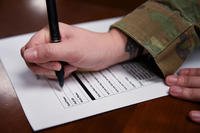
WASHINGTON — Secretary of Defense Donald Rumsfeld will begin personally
signing condolence letters sent to families of troops killed in
Iraq
and Afghanistan,
after receiving criticism over his use of mechanical signatures.
In a statement provided to Stars and Stripes on Thursday, Rumsfeld
tacitly admitted that in the past he has not personally signed the
letters, but said he was responsible for writing and approving each
of the 1,000-plus messages sent to the fallen soldiers’ families.
“I have directed that in the future I sign each letter,” he said
in the statement.
“I am deeply grateful for the many letters I have received from
the families of those who have been killed in the service of our
country, and I recognize and honor their personal loss.”
In a separate statement, Pentagon spokesman Lawrence Di Rita said,
“In the interest of ensuring timely contact with grieving family
members, he has not individually signed each letter.”
Department of Defense officials for the past few weeks had said
only that the content of the letters was private.
But several families of troops killed overseas said they were sure
the notes they received had not been signed by hand, and said they
were angry that Rumsfeld was not paying attention to their loss.
“To me it’s an insult, not only as someone who lost a loved one
but also as someone who served in Iraq,” Army Spc. Ivan Medina told
Stripes.
“This doesn’t show our families the respect they deserve,” said
Medina, a New York resident whose twin brother, Irving, was killed
in a roadside bombing in Iraq this summer.
Illinois resident Bette Sullivan, whose son John was killed in
November 2003 while working as an Army mechanic in Iraq, was incensed
when she, her son’s wife and her grandchildren received the exact
same condolence letter with the apparently stamped signature.
“If each family receives two copies, how many signatures does that
amount to?” she asked in an e-mail response to Stripes. “I can understand
the use of stamped signatures for his brothers’ mementos, but for
those of his wife and children and mother? No, no, no.”
Retired Army Col. David Hackworth, an author and frequent critic
of the Department of Defense, publicly criticized Rumsfeld in a
syndicated column earlier this month for not reviewing each KIA
letter personally.
He called the fake signatures “like having it signed by a monkey.”
“Using those machines is pretty common, but it shouldn’t be in
cases of those who have died in action,” he said. “How can [DOD
officials] feel the emotional impact of that loss if they’re not
even looking at the letters?”
Hackworth said he objected to using the stamped signatures for
promotion and commendation letters as well, but said not personally
handling the condolence letters is a much more serious offense.
Family members had expressed similar concerns to Stripes about
President Bush’s signature on his condolence letters, but Allen
Abney, spokesman for the president, said that Bush does personally
sign the letters sent from the White House.
Secretary Rumsfeld's Statement
Statement by Secretary of Defense Donald Rumsfeld on condolences
to servicemembers and their loved ones, as provided to Stars and
Stripes:
“It is a solemn privilege of the many of us in the Department to
meet with U.S. forces and families who have experienced injury or
death in the defense of our country.
“During visits with wounded forces and their families at Walter
Reed Army Hospital or at the Bethesda Naval Medical Center, I have
drawn inspiration from the dignity and resolve of these wonderful
young Americans and their loved ones.
“Over the past years, my wife, Joyce, and I have met with several
hundred wounded troops and their families during visits to intensive
care units, therapy facilities, and their rooms in military hospitals
in the United States and abroad.
“During visits to military installations, I have met with still
others during their visits to the Pentagon.
“Joyce and I also have met together and individually with spouses
and children of those killed in action.
“At the earliest moment in the global war on terror, I determined
that it is important that military families who have lost loved
ones in hostile actions receive a letter from me directly.
“I wrote and approved the now more than 1000 letters sent to family
members and next of kin of each of the servicemen and women killed
in military action. While I have not individually signed each one,
in the interest of ensuring expeditious contact with grieving family
members, I have directed that in the future I sign each letter.
“I am deeply grateful for the many letters I have received from
the families of those who have been killed in the service of our
country, and I recognize and honor their personal loss.”
Email
this page to friends
©2004 Stars & Stripes. All opinions
expressed in this article are the author's and do not necessarily
reflect those of Military.com.
|