This article is provided courtesy of Stars & Stripes, which got its start as a newspaper for Union troops during the Civil War, and has been published continuously since 1942 in Europe and 1945 in the Pacific. Stripes reporters have been in the field with American soldiers, sailors and airmen in World War II, Korea, the Cold War, Vietnam, the Gulf War, Bosnia and Kosovo, and are now on assignment in the Middle East.
Stars and Stripes has one of the widest distribution ranges of any newspaper in the world. Between the Pacific and European editions, Stars & Stripes services over 50 countries where there are bases, posts, service members, ships, or embassies.
Related Links:
Current Archive
Stars & Stripes Website
Sound off in our Discussion Boards
Have an opinion on the issues discussed in this article? Sound off.
Get Breaking Military News Alerts
|
|
|
|
|
Your Two Cents

Submit your stories, news items, or a benefits update -- and help Military.com bring the best, most important stories to your fellow servicemembers, veterans, and family members. Contribute here |
|
|
August 8, 2005
[Have an opinion about the issues discussed in this article?
Sound
off in our Discussion Boards.]
By Russ Rizzo
Stars and Stripes European edition

Texas National Guard Pvt. Luke Guiette, background, Pfc. James Harris, center, and Pvt. Jedediah Higgins fire blanks from M-16 rifles at snipers hunkered in plywood buildings. |
|
“Hail-o, hail-o infantry, Queen of battle follow me.”
BABADAG TRAINING AREA, Romania — The words boom from the mouths of soldiers as they march in the orange glow of a new sun. Gravel crunches under their black boots, punctuating each line as they move in unison. It is early still, and the hill awaits.
The cadence is unfamiliar for some in the platoon. These are mechanics, tankers, cooks and medics, not infantrymen. At least, they weren't.
As they make their way to the trucks that will take them to infantry training at the Babadag Training Area near the Black Sea coast of Romania, the 29 Texas National Guard soldiers find themselves marching toward something much bigger than another day of running through brush and firing blanks from M-16s.
They are at the forefront of two major shifts in the Army as it becomes lighter and faster. In coming years, members of the 1st Battalion, 112th Armored Regiment, along with other battalions in the 36th Infantry Division, will be retrained as the brigade sheds the tanks of its Cold War past. Some will become infantrymen fighting battles in cities using just their rifles and their wits, rather than tanks.
They are beginning that transformation in a country at the cusp of becoming a key U.S. training hub.
After two weeks of training in Romania, it is clear that the push to move training from traditional locations such as Grafenwöhr, Germany, to more remote locations such as Romania, Bulgaria and Poland could prove popular with soldiers. They rave about the temporary base's accommodations, including an Internet cafe, hot showers and air-conditioned tents, and opportunities to experience a new country.
Under a new model for more expeditionary fighting, the Army could use these training areas as “lily pad” bases, giving soldiers deployed from the United States a place to stop on their way to more remote locations.
Less clear is how much success the Army will see as it molds infantrymen out of veterans trained in other fields. The experience of these National Guard soldiers shows the risks of leaning on an older, less-experienced force to fight urban wars, an inevitable result of limited active-duty forces during wartime.
“They put me in a barber chair, Spun me around, I had no hair.”
Unlike most Guard units, the 1-112 completed its annual training alongside members of the 7th Army Training Command out of Grafenwöhr, using the group's high-tech gear. Members of three other Texas National Guard battalions also took part in the two-week training exercise called ROMEX '05, organized by the 1st Armored Division and which wrapped up last week.
But the added help came with a not-so-welcome twist: the hill.
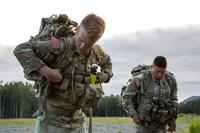
At first glance, the hill isn't imposing. The slope seems gradual, even gentle. But for troops loaded down with 40 pounds of ammunition, body armor and other gear, it becomes a daunting challenge to run up two or three times a day.
After the first day of urban training, talk in the platoon was of the hill. One soldier twisted an ankle stepping in a hole. Others complained of sore muscles, wondering aloud if they could make it another day.
“It's a killer,” said Spc. Brad Salomon, who at 44 years old is the oldest member of his platoon.
Salomon is determined not to show his age. He takes offense when younger soldiers offer to carry his medical bag.
It's an experience shared by many Texas National Guard soldiers in the 36th Infantry Division, which until recently was the 49th Armored Division.
It is an uncomfortable change for some. Some soldiers said they felt too old to run up hills and shoot at insurgents. Others simply miss their old jobs.

Members of the 4th Platoon, 1st Battalion, 112th Armored Regiment of the Texas National Guard charge a mock city during urban combat training. |
|
“A lot of the younger soldiers like this gung-ho stuff,” said Staff Sgt. Rodrick Boykin, a squad leader. “Older guys, they're stuck in their ways. They'll do it for a month, but they want to get back to their old jobs.”
Both circumstances apply to Sgt. Terry Blackburn, a 39-year-old tanker who joined the National Guard because of the rage he experienced after the Sept. 11, 2001, terrorist attacks.
Unlike others in his unit who will likely go back to their old jobs in other units after ROMEX '05, Blackburn knows he is a prime target to become an infantryman.
“I'll probably go infantry,” Blackburn said with a shrug. “I'm too old.”
Blackburn said he enjoyed the infantry training, but 20 years working as a carpenter and five years working in tanks have left his body unable to sustain its rigors.
“It sucks,” said Blackburn, who points to the leftover adhesive on his left shoulder where his 49th AD patch used to hang. “I don't want to give up my tank.”
Others, like 36-year-old Staff Sgt. Brian Beauchamp, are more complacent about the change.
“I'm not champing at the bit to do it,” said Beauchamp, a mechanic whose last infantry experience came during basic training 17 years ago. “[But] if the president of the United States wants me to do it, then here I am. I signed up.”
“I used to wear faded jeans, Now I'm wearing Army greens.”
For soldiers facing the infantry after years of doing something else, there are concerns other than just physical conditioning. There is the inexperience, too.
Master Sgt. Penny Patrick compared the transition to someone with only rudimentary kitchen skills becoming head chef at a restaurant.
“Yeah, you can scramble eggs, and probably watched your mamma baking some biscuits,” Patrick said. “But this is a whole new ball game.”
Members of the 4th Platoon, 1-112 formed a cohesive group with clear leadership lines and motivated soldiers. On their off time, they joked and shared stories. During exercises, they were all business.
But early in their urban combat exercises, inexperience showed.
Squad leaders drawing a map in the sand debated where they were located in relation to the city. They had trouble deciding where to put their medics and large guns. Failing to come up with the name of a machine gun, one squad leader referred to it simply as “the long one.”
Walking up the hill, a soldier squawked over the radio that a vehicle was approaching from 12 o'clock, which would have been directly in front of him. It was behind him.
The platoon's approach to the city of six plywood buildings at the top of the hill was slow but managed to impress the trainer-observers. The soldiers appeared organized, offering suppressing fire from one side as another squad approached the first building. Early shots proved accurate, as Salomon, the platoon's medic, bagged the first kill from 470 feet away, and 35-year-old Spc. James Riden, one of the platoon's few experienced infantrymen, hit enemies from 256 feet and 100 feet.
Once the soldiers reached the city, though, they scattered in no particular order, exposing communication problems that plagued the platoon all week.
“Nobody looks like they know what they're doing,” Sgt. 1st Class Thomas Welch, an observer with 7th ATC, said during a replay later of the approach.
Welch took the soldiers to task for loitering outside before buildings were clear.
“If you've got nothing to do, don't do it outside,” Welch said. “That's when you get killed.”
The soldiers accomplished one objective — capturing the leader of the terrorist cell — but failed two others. They did not win popularity with the locals or legitimize the local government by getting the mayor and local police involved.
Twice during an after-action review, Welch made references to Iraq. He stressed the importance of using translators in a foreign country and of keeping insurgents alive to extract intelligence.
Welch said an active-duty platoon would have completed the exercise in 10 minutes. It took the Texas National Guard platoon one hour.
“They're not bad soldiers,” Boykin said. “It's just that they don't have much experience with this infantry stuff.”
“Mamma, mamma don't you cry, Your little boy ain't going to die.”
During a visit to ROMEX '05 last month, Romania's defense minister said he expected to complete negotiations by September to give the U.S. military more access to the country's military bases. U.S. officials say they want more frequent training here to transform to a more expeditionary fighting force and reclassify soldiers in jobs more fit for modern warfare.
It is early still, and the hill awaits.
Email
this page to friends RSS feed
©2005 Stars & Stripes. All opinions
expressed in this article are the author's and do not necessarily
reflect those of Military.com.
|