Home
Benefits
News
entertainment
shop
finance
careers
education
join military
community


Air Force Rescue Crews Ready to Save Lives Anywhere, Anytime

Air Force Rescue Crews Ready to Save Lives Anywhere, Anytime


Stars and Stripes
This article is provided courtesy of Stars & Stripes, which got its start as a newspaper for Union troops during the Civil War, and has been published continuously since 1942 in Europe and 1945 in the Pacific. Stripes reporters have been in the field with American soldiers, sailors and airmen in World War II, Korea, the Cold War, Vietnam, the Gulf War, Bosnia and Kosovo, and are now on assignment in the Middle East.

Stars and Stripes has one of the widest distribution ranges of any newspaper in the world. Between the Pacific and European editions, Stars & Stripes services over 50 countries where there are bases, posts, service members, ships, or embassies.

Related Links:

Current Archive

Stars & Stripes Website

Sound off in our Discussion Boards
Have an opinion on the issues discussed in this article? Sound off.

Get Breaking Military News Alerts


Related Links


Military Opinions


Your Two Cents

Submit your stories, news items, or a benefits update -- and help Military.com bring the best, most important stories to your fellow servicemembers, veterans, and family members. Contribute here

August 2, 2005

[Have an opinion about the issues discussed in this article? Sound off in our Discussion Boards.]

By Erik Slavin
Stars and Stripes
Pacific edition


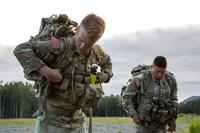
A 31st Rescue Squadron “PJ” descends a rope ladder during an insertion exercise at northern Okinawa's Jungle Warfare Training Center on Tuesday.


KADENA AIR BASE, Okinawa — On an island where F-15s routinely dart through the sky, the 31st and 33rd Rescue Squadrons' Pave Hawk helicopters may not be this air base's flashiest rides.

But should a mission ever go terribly wrong, those helos and their highly trained crews may be a downed pilot's best friends.

In peaceful situations, the 33rd's “Jolly Greens” perform missions from humanitarian aid to medical evacuations. In combat, they must fly well within range of surface-to-air missiles, even small- arms fire, to try to rescue fellow servicemembers.

In either role, their goal is clear: Save lives on the ground.

“I know everybody says they have the best mission,” said Lt. Col. Vic Dallin, 33rd Rescue Squadron operations officer. “But to … save fellow servicemembers from harm's way — it's easy for everybody to stay motivated.”

At Kadena are 65 airmen and nine Pave Hawks; another 21 airmen and one Pave Hawk are at Osan Air Base, South Korea.

During a recent training day, the squadron practiced providing insertions/extractions and cover fire with the 31st Rescue Squadron's “PJs,” the pararescuemen trained to recover people on the ground and in the water, whatever the weather.

Target practice

“Things can happen fast during the flight,” says Airman 1st Class Jeffrey Layton, explaining before takeoff that his mid-air instructions might seem brusque from someone of his rank. But passengers should know few such junior airmen have trained at their jobs for almost two years.

Layton and Staff Sgt. Brian Stamey man their machine guns on opposite sides of the aircraft as it heads for Nakajima, a small island off Okinawa's west coast.

It's a short trip for Capt. Chris Lacouture's highly maneuverable Pave Hawk, an Army Black Hawk modified to carry extra communications equipment.

The Pave Hawk normally flies at about 125 mph but can dash up to more than 160 mph. Its defenses include an automated flare and chaff system and a choice of gunnery: Two weapons fire high-speed 7.62 mm rounds while newly ordered .50 caliber guns provide a bigger bang.

Layton and Stamey will be firing the fast rounds this day. After circling Nakajima to check for nearby boaters, the helicopter banks sharply on its side.

Layton opens fire. The weapon's whirling cylinders spit dozens of casings on the chopper's floor as the bullets leave a plume of white smoke rising from a small metal object lying in the island's tall grass.

The chopper whips around for another pass for Stamey's turn. When the firing ends, a stick-figure man painted on the metal looks as if he's seen better days.

Hitting the ground

The Pave Hawk then flies to the Jungle Warfare Training Center in northern Okinawa, where another crew practices dropping off and extracting 31st Squadron's pararescuemen.

Staff Sgt. Jeffrey Hedglin and Tech Sgt. Derek Docter take just a few eye blinks to slide about 60 feet down a “fast rope,” wearing friction-resistant gloves.

They use several methods to insert and extract, including rappelling, rope ladders, litters and conical-shaped “forest penetrators.”

“The fast rope is good for getting out quick if you're exposed,” Hedglin said. “But, for example, if you're in mountainous terrain, you might want to rappel to control your descent.”

Simply landing is preferred. But the nature of rescues means enemies usually are in the area and ready to fire at your aircraft.

What it takes

Hedglin, with 23 other enlisted PJ's and six officers at Kadena, is a member of one of the military's most selective forces.

Training attrition rates of 80 percent or higher are common in this grueling specialty, which takes almost two years' schooling.

It begins with 10 weeks of indoctrination at Lackland Air Force Base in Texas.

The physical training is intense, said Maj. Chuck Metrolis, 31st commanding officer. “But it's more of a mental challenge. The instructors will find a weakness you have and exploit it.”

Few can handle the stress. Operations officer Maj. Andrew Reisenweber says that of his 81-man class, just 19 graduated.


Graduates move to combat diving school, then Army Airborne School for static line parachute jumping experience. They also must learn free-fall parachuting from 2,000 to 35,000 feet into water, at night.

They become proficient with several weapons and learn how to operate in environments from oxygen-poor mountaintops to deserts and jungles.

Pararescuemen then usually train as emergency medical technicians. Enlisted trainees spend an additional six months to become registered paramedics.

The rescuers carry extensive medical gear with them on missions, including chest tubes and minor field surgery equipment.

Pararescuemen are among the Air Force's most oft-deployed members. Reisenweber says he has personnel who are deployed 270 to 300 days a year.

In addition to taking part in humanitarian missions in Southeast Asia and seeing action in Iraq, the PJs recently returned from the Horn of Africa as part of Operation Enduring Freedom.

Despite the rigorous schedule — or possibly because of it — several PJs and 33rd Rescue squadron members said they couldn't imagine gaining a greater sense of fulfillment from their job.

“It's the immediate gratification,” Hedglin said. “When you're actually looking a guy in the eyes, it feels good to save a life and know you've made a difference.”

Email this page to friendsRSS feed

©2005 Stars & Stripes. All opinions expressed in this article are the author's and do not necessarily reflect those of Military.com.


Member Center


FREE Newsletter


Military Report


Equipment Guides


Installation Guides


Military History