This article is provided
courtesy of Stars & Stripes, which
got its start as a newspaper for Union troops
during the Civil War, and has been published
continuously since 1942 in Europe and 1945
in the Pacific. Stripes reporters have
been in the field with American soldiers,
sailors and airmen in World War II, Korea,
the Cold War, Vietnam, the Gulf War, Bosnia
and Kosovo, and are now on assignment in the
Middle East.
Stars and Stripes has one of the widest distribution
ranges of any newspaper in the world. Between
the Pacific and European editions, Stars
& Stripes services over 50 countries
where there are bases, posts, service members,
ships, or embassies.
By Rick Emert, Stars and Stripes European Edition
BAGHDAD — This election year, the U.S. military is taking extra steps to give deployed servicemembers the means to cast a vote that counts.
In 2000, many absentee ballots from servicemembers deployed or stationed overseas did not arrive in time to be counted. Now, in post-Sept. 11, 2001, America, with servicemembers fighting terrorism on two fronts, a revamped voting process should ensure that the voices of deployed troops are heard clearly from the Middle East and Southwest Asia.
The Army is taking lessons learned from the 2000 election, and affording soldiers the opportunity to register and get their absentee ballots in earlier, according to 2nd Lt. Kyle Missbach, 1st Cavalry Division voting assistance officer.
"[Absentee voting] for the last presidential election was a debacle," Missbach said. "I want to ensure that soldiers are given the opportunity to register and vote and have their say."
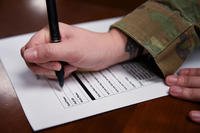
The 1st Cavalry Division has distributed Standard Form 76 to all its units in Iraq. From there, unit leaders got the federal voting postcard into the hands of individual soldiers last month, according to Missbach.
The postcard is used both to register to vote and request an absentee ballot from the state a servicemember plans to vote in, he said.
The form also can be printed from the Federal Voting Assistance Program Web site: www.fvap.gov.
Missbach recommends that soldiers complete and mail the form by Aug. 15.
Even those who are already registered to vote should send in the card, because it's the simplest and surest way to get an absentee ballot, he said. Within three to five weeks after mailing the card, soldiers should receive absentee ballots, which in turn should be filled out and mailed by Oct. 11.
"That's not a hard and fast date," Missbach said. "If they miss that date, it's just not as much of a certainty that their vote will be counted."
Soldiers can vote in their home state of record or in a state where they have an established residency. Each state has different procedures for how the absentee votes are tallied, Missbach said.
Another step the Army is taking to ensure soldiers are getting the chance to vote comes in the form of a massive census of all soldiers. Army leaders will physically meet with every soldier to verify their name and Social Security number and that they have been given a chance to register and vote, Missbach said. That survey runs Tuesday through Aug. 15.
Yet another check for the 1st Cav included an inspector general's inspection of the division's Voting Assistance Program before it left Fort Hood, Texas, for Iraq, Missbach said.
Finally, Armed Forces Vote Week, from Sept. 3-11, raises awareness about the absentee ballot election process at installations throughout the Department of Defense, Missbach said.
In Afghanistan, officials staked out dining areas, setting up voting registration booths at entrances where troops line up to eat.
"Most said they had already taken care of registering," said Maj. Bryan Jacobson, the voting registration officer for North Dakota National Guard's 109th Engineer Group, who helped with the effort a few weeks ago.
"A surprising number, however, said 'no thanks, my vote doesn't count.' It was kind of discouraging," he added.
The Army will not - and cannot - track who has registered or voted.
"Every citizen has the right to register and vote if they so choose, or not to register and vote if they choose," Missbach said. "We don't have any kind of command influence on whether they vote."
All the effort seems to be paying off.
In Aghanistan, hundreds registered with voting assistance officers. Capt. Lindy White was one of them.
"I just got my absentee ballot for the primaries last week," said White, a staff officer for the Hawaii-based 25th Infantry Division.
Supply specialist Sgt. Alma Lewis, from Houma, La., said she's registered, but plans to boycott the presidential elections.
"I don't like either candidate," Lewis said. "Bush is the reason we're over here, and Kerry hasn't said anything promising at all."
Sgt. Robert Whitney, an Indiana reservist with the 221st Ordnance Company stationed at an outpost along Afghanistan's border with Pakistan, said he intends to register, but hasn't yet.
"I feel strongly about voting, because I want Bush to win," said Whitney.
Some soldiers completed the federal voting postcard before they deployed.
"I have registered to vote in Texas," said Sgt. DeForest Robinson, Headquarters Distribution Company, of the 1st Cav's 115th Forward Support Battalion, in Baghdad. "I fully intend to vote. We're the ones out here on the front line, and we need to have some input on the election."
"I haven't missed an election in 18 years," said Staff Sgt. Leigh Toland, 81st Brigade Combat Team, Logistical Supply Area Anaconda in Balad. "My wife will forward my absentee ballot. Will it count? I think as much as it ever does."
Staff Sgt. Clifford Banta, also from the 81st, is on his first deployment, but will cast his vote as he does every year.
"If they receive my ballot in time, I don't know why it wouldn't count," Banta said.
Other servicemembers, such as Air Force Capt. Tom Bucci, a Central Criminal Court of Iraq lawyer, are seasoned veterans when it comes to casting absentee votes.
"I'm stationed in Ohio, and vote in Connecticut, so I've voted by absentee ballot for years," Bucci said. "It will be a little bit tough here [because of possible mail delays]. I'm more concerned about the soldiers, Marines and airmen out in the field being able to get their ballots in."
With all of these tools in place to give soldiers an opportunity to vote - even the most remote forward operating base in Iraq has a voting assistance officer - all troops should get the chance, Missbach said.
"I think most soldiers feel that it is important to vote," Missbach said. "In part, that is because of what happened in the last [presidential] election and, in part it is because they are over here fighting for our rights that are so important - like the right to vote."