This article is provided courtesy of DefenseWatch,
the official magazine for Soldiers For The
Truth (SFTT), a grass-roots educational organization
started by a small group of concerned veterans
and citizens to inform the public, the Congress,
and the media on the decline in readiness
of our armed forces. Inspired by the outspoken
idealism of retired Colonel
David Hackworth, SFTT aims to give our
service people, veterans, and retirees a clear
voice with the media, Congress, the public
and their services.
Related Links:
Article
Archive
Military
Base Guide
Hot
Discussions
Have an opinion on this commentary? Sound
off.
DefenseWatch
Website
Get
Breaking Military News Alerts
|
|
|
Get
$1004 a Month!
Your service may have earned you great education
benefits. Get up to $1004 per month to pay
for your undergraduate, graduate or technical
degree. Find out about military-friendly schools
today.
|
|
|
|
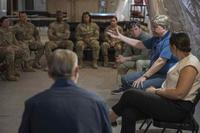
He intimidates reporters and pundits alike with a quick wit and
blunt talk, but Secretary of Defense Donald Rumsfeld was momentarily
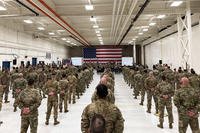
stumped during a "Town Hall" meeting on Wednesday at Camp Buehring,
Kuwait, when confronted with questions by an equally blunt and outspoken
sergeant:
"Why do we soldiers have to dig through local landfills for pieces
of scrap metal and compromised ballistic glass to up-armour our
vehicles and why don't we have those resources readily available
to us?" asked Army
Spc. Thomas Wilson to an uproar of cheers from the approximately
2,300 soldiers in attendance.
Rumsfeld asked to hear the question again, an unusual reaction for
the usually quick-on-his-feet Secdef. But then he provided his answer.
And it is important to reiterate the full text, because the edited
version being shown on TV news provides a misleading representation
of his reaction. This is what Rumsfeld actually said:
"I talked to the general coming out here about the pace at which
the vehicles are being armored. They have been brought from all
over the world, wherever they're not needed, to a place here where
they are needed. I'm told that they are being - the Army is - I
think it's something like 400 a month are being done. And it's essentially
a matter of physics. It isn't a matter of money. It isn't a matter
on the part of the Army of desire. It's a matter of production and
capability of doing it.
The SecDef then went on to say:
"As you know, you go to war with the Army you have. They're not
the Army you might want or wish to have at a later time. Since the
Iraq conflict began, the Army has been pressing ahead to produce
the armor necessary at a rate that they believe - it's a greatly
expanded rate from what existed previously, but a rate that they
believe is the rate that is all that can be accomplished at this
moment."
Rumsfeld was close on production rates, the actual number of Humvees
being up-armored stands at about 450 per month according to Robert
Mecredy, President of Armor Holdings, Inc., which produces the up-armored
Humvees. This is up from a production rate of about 15 per month
last year.
So Rumsfeld's response was not the flip remark widely reported.
Now it comes to light that imbedded reporter Edward Lee Pitts of
the Chattanooga (Tenn.) Times Free Press, put up Spc. Wilson to
asking that question. This is indeed unfortunate, because it casts
doubt upon the veracity of the soldier's claim and by extension,
the entire armored Humvee shortage issue.
So, ignoring this new bit of information for the moment, what is
the exact situation with Humvee armor production?
There are two actual armor programs for Humvees, the up-armor HMMWV
or XM1114, which is a standard variant of the basic design, and
add-on kits. The up-armored version includes an air-conditioned
cab and modifications to vehicle suspension to handle the added
weight, whereas the kits are simply attached to existing vehicles.


|
To put it in hard numbers, of 8,105 up-armored Humvees initially
requested, more than 5,900 have so far been produced. The rest are
expected to be ready by March 2005. These are the vehicles most
widely discussed and are those supplied by Armor Holdings. Additionally,
to date 9,146 armor kits have been installed of 9,776 produced.
According to DoD, Humvees that lack armor are carried into Iraq
atop flatbed trucks and, once there, are used only inside the relative
safety of U.S. bases.
Concerns regarding Humvee armor are justified given the enemy's
tactic of choice and the widespread perception of a shortfall in
armor. But I don't believe that Rumsfeld's "go to war with the Army
you have" comment was inappropriate or ill considered.
First of all, he was correct. We have never gone into battle with
the Army we wanted. Since World War II, we have entered conflicts
with woefully unprepared, poorly equipped and undermanned armies.
It is also fair to say that big-ticket items like new aircraft,
missiles and warships have pretty consistently faired better in
the appropriations process than the equally important, but much
less politically sexy items like ammunition, training and gear.
Indeed, Soldiers for the Truth was originally formed in an attempt
to ameliorate this age-old problem.
During the late 1980s and into the 1990s the defense budget underwent
drastic cuts in (I believe premature) reaction to the "collapse"
of the Soviet Union. President George H.W. Bush cut our active duty
Army to eighteen divisions. At the time, I felt that was too low.
Then Bill Clinton came along and reduced it to a mere ten. While
reducing defense spending to hollow force levels, Clinton expanded
the military mission abroad, pushing us to the snapping point. If
one didn't know better, one might be tempted to call it deliberate
sabotage.
So the Bush II administration came into office saddled with the
disastrous consequences of Bill Clinton's eight years. I am not
making excuses for Rumsfeld, but one cannot look at our current
situation honestly without taking this fact into account.
Also, there have been a number of debates regarding the appropriateness
of using Humvees at all as fighting vehicles. For example, to avoid
hand grenades being lobbed into the vehicle from local crowds, troops
must leave the windows up, but with the windows up, troops inside
the vehicle cannot return fire if ambushed. It's also hotter than
hell if they don't have air conditioning. Perhaps Humvees are better
suited to escorting top brass and hauling personnel and supplies
around the rear areas, just like the glorified jeep they were originally
intended to be.
Then there are the debates on the relative merits of the Stryker
Combat Vehicle, the Bradley Fighting Vehicle and even the M-113,
all more capable than the Humvee, armored or not, of withstanding
roadside blasts from an IED and definitely better as warfighting
vehicles.
But, as Rumsfeld said: "You go to war with the Army you have," and
in this war they decided to use the Humvee extensively. Since its
vulnerabilities are widely recognized, it is indeed unfortunate,
some might say tragic, that the need for additional armor was not
dealt with sooner.
Okay, so now that the need has been unambiguously recognized, albeit
belatedly, DoD has ramped up armor production significantly, but
is it, as Rumsfeld said, "all that can be accomplished at this moment"?
Not surprisingly, there is a program in charge of making sure "all
that can be accomplished at this moment" is actually being accomplished.
It is called the Defense Priorities and Allocations System Program
(DPAS). This program, run out of the Commerce Department, is supposed
to "(1) assure the timely availability of industrial resources to
meet current national defense and emergency preparedness program
requirements; and (2) provide an operating system to support rapid
industrial response in a national emergency."
I spoke with people at the U.S. Army Tank, Automotive and Armaments
Command (TACOM) in Warren, MI, which is responsible for contracting
the armor plate for humvees. They told me that in some cases, resorting
to the DPAS procedure does not accelerate the process. More often,
suppliers voluntarily comply.
In one case, a previous TACOM commanding general directly contacted
steel suppliers and requested they voluntarily make production of
armor steel for the Humvees their top priority. According to my
sources, the suppliers complied. Furthermore, they claim that the
production bottleneck for armor is with the steel manufacturers
that produce the raw material.
Armor Holdings, who install the armor kits, claimed yesterday in
an article published in Bloomberg News that they could immediately
increase output by 22 percent, up to 550 per month. They are awaiting
orders from the Army.
Steel shortages notwithstanding, TACOM acknowledged that it had
orders pending but had not yet received monies appropriated by Congress
for that purpose.
So it appears that much has now been done to provide armor at an
accelerated pace. Everything? Maybe not.
It is also fair to say that the administration underestimated the
difficulty we would have in dealing with this enemy. I raised this
issue repeatedly before the initiation of the conflict and in its
early stages (see "Regime Change Means Eradicating the Ba'ath Party,"
DefenseWatch Feb, 19, 2003).
In so doing, the administration provided a window of opportunity
for the enemy in Iraq to exploit our weaknesses, and this has cost
lives. To the extent that it exists, however, the shortage of up-armored
Humvees is more a symptom of the problem than the actual problem
itself.
The main problem is that the U.S. military is of inadequate size
to deal with the missions it is being asked to accomplish. Fissures
are appearing everywhere: ammunition shortages, spares, extended
deployments; these problems are no secret. What we couldn't do with
those eighteen divisions now, eh?
Also, we remain behind the eight ball in dealing with the enemy's
chosen tactics. This administration, despite its fits and starts,
has given the military greater free reign in conducting battle maneuvers
than any administration in recent history. The operation in Fallujah
was a case in point - late, but better late than never.
We remain hamstrung nonetheless, by the Vietnam syndrome, which
places an almost impossible standard of conduct on U.S. troops,
including an overcautious concern for "collateral damage" regardless
of the subhuman tactics employed by the enemy.
Let's face it. The enemy is doing a fine job of wracking up "collateral
damage" no matter how careful we are. And the longer we allow this
to go on, the greater will be the civilian death toll. It is grim
comfort to reassure ourselves that it isn't us doing the killing.
We need to get over this PC mindset once and for all. The terrorists
will take their entire country down with them if given the chance.
We need to use every resource at our command to obliterate these
deviants, and hopefully thereby discourage future would-be combatants.
This means getting more aggressive on intelligence collection. This
means putting more restriction on civilian travel. It means instituting
curfews. It means rough interrogations. It means identifying and
isolating these thugs then hunting down and killing them before
they can set off their IEDs.
Terrorists everywhere need to be convinced that these tactics won't
work. They need to get Sun Tzu's age-old message: If you can't win,
don't fight!
We haven't yet succeeded in convincing them they can't. That's the
real problem, not the armored Humvee production rate.
One of the basics of the PPBS is that operational personnel must
review and validate all financial decisions. That is yet another
"workable lie." The reality is that the review by uniformed personnel
is cursory or done by those who have grown up in the comptroller
system and have succumbed to its groupthink. At most levels of review
the civilians wield great power because of their time on the job.
In a column in The Washington Post last May 9, David Broder described
how Secretary Rumsfeld was then facing a "McNamara Moment" in being
blinded by a "technocratic-bureaucratic … mindset."
What happened in Kuwait this week was your second wake-up call,
Mr. Secretary. If you wish to put your name in the history books
as more than just a sharp administrator, you need to can the PPBS
system once and for all. The rest of the federal government, which
had adopted it by the mid-60s based on its apparent utility under
Secretary McNamara, had dumped PPBS by 1973.
The rationale is simple and compelling: PPBS only works well in
a world where soldiers rarely fight real wars and rarely die.
Ultimately, the same guy who brought this nation the Edsel was the
guy who sent unarmored Humvees to Iraq. Only the blame will ultimately
fall on Don Rumsfeld.
[Have a comment on this opinion article? Sound
off in the Hot Issues with Defensewatch Forum.]
Jim Simpson is a Contributing Editor of DefenseWatch. He can
be reached at one.wonders@verizon.net.
Please send Feedback responses to dwfeedback@yahoo.com.
©2004 DefenseWatch. All opinions expressed in this article are the
author's and do not necessarily reflect those of Military.com.
|