Ed
Offley, Editor of DefenseWatch magazine, has
been a military reporter and defense specialist
for 22 years in a variety of journalism assignments
throughout the United States. DefenseWatch
is an online magazine that addresses military
and security issues from the viewpoint of
active-duty and reservist component personnel
and veterans.
Offley previously served as Editor-in-Chief
of The Stars and Stripes after the civilian-owned
newspaper was acquired by Stars and Stripes
Omnimedia Inc. in March 2000. A 1969 graduate
of the University of Virginia, Offley served
in the U.S. Navy in Vietnam before joining
The Virginia Gazette, Williamsburg, Va., as
a reporter in 1972. He worked as an editorial
writer at three newspapers in Virginia during
1977-85 before joining The Seattle Post Intelligencer
as an editorial writer in 1986.
Offley, 55, lives in Panama City Beach, Fla.,
with his wife, Karen, and daughter, Andrea.
Contact: dweditor@yahoo.com.
|
|
|
|
July 26, 2004
[Have an opinion about the views expressed in this article? Sound
off in the Hot Issues with Defensewatch Forum.]
By Ed Offley
Love him or the opposite, everyone who serves in or works with the
Defense Department knows that Secretary of Defense Donald H. Rumsfeld
is an exceptionally smart man.
That's why a comment he made to Fox News interviewer Cal Thomas
last week is so thoroughly baffling. Even as a throwaway line in
an encounter with a rare "friendly" journalist, Rumsfeld's description
of the state of the U.S. military today was so insufficient and
incomplete that it suggests the Secretary has become totally disconnected
from the troubled institution over which he presides.
Here's the exchange from the interview (the full transcript can
be accessed at DefenseLink, the DoD web portal):
Q: And welcome back to "After Hours." We're here tonight
with my exclusive interview with Donald Rumsfeld, the Secretary
of Defense. Mr. Secretary, I know you don't get into politics, but
Senator Kerry has been saying if he is elected, he will work hard
to strengthen our military. That implies that our military is weak
and I wonder if you'd like to comment on what you regard as how
strong our military is?
SEC. RUMSFELD: Well, the United States military is the finest
military on the face of the earth. It is more capable than at any
time in our country's history in terms of the ability to do its
job and to put precision weapons on precise targets in an effective
way and in a way that is agile and able to penetrate long distances
on relatively short notice. … The victory in Iraq
is another demonstration of the capabilities of the United States
military. They were able to do a terrific job in a relatively short
period of time with a minimum loss of civilian lives.
In strictly semantic terms, Rumsfeld's four sentences accurately
depict several very narrow slices of reality. Compared with, say,
the Russian Army, the North Korean Air Force or the Belgian Navy
, the U.S. military today is "the finest military on the face of
the earth." His line about putting "precision weapons on precise
targets" is factually supported. The last two sentences about the
combat takedown of the Iraqi army last year summarize what happened
in the Euphrates Valley.
It's what Rumsfeld did not say - or acknowledge - that I find troubling.
Consider a sampling of news articles on the state of the U.S. military
during the past two months:
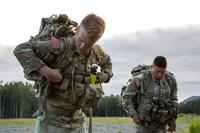
* The over-stretched Army:
On June 2, The New York Times reported:
"The Army announced Wednesday that it would require all soldiers
bound for Iraq and Afghanistan
to extend their active duty at least until their units have returned
home from duty there, a move that could keep thousands of troops
in the service for months longer than they expected over the next
several years." This affected both active-duty and reserve component
troops "who had planned to retire, move to other Army jobs or
leave the military when their enlistments expired," the newspaper
added.
* Declining Air
Force fighter performance: The industry newsletter Inside The
Air Force on June 4 revealed a potentially troubling development
following a force-on-force training exercise involving F-15s from
the Alaska-based 3rd Fighter Wing and Russian-built fighters operated
by the Indian Air Force. The publication reported:
"The surprising sophistication of Indian fighter aircraft and
skill of Indian pilots demonstrated at the Cope India air combat
exercise Feb. 15 through 27 at Gwalior Air Force Station, India,
should provide a reality check for those who had assumed unquestioned
U.S. air superiority, service officials who participated in the
exercise said this week."
In most of the aerial encounters, the Indian Air Force pilots defeated
their American counterparts.
* Strains on the National Guard: On June 6 The Washington Post
revealed that a growing number of National Guard adjutants-general
were warning the Pentagon their units were nearing a breaking point
as a result of multiple activations for duty in Iraq, Afghanistan
and in homeland security missions.
"Some Guard commanders are beginning to say they simply can't
deploy any more troops," the article noted. " 'As far as New Hampshire
goes, we're tapped," said Maj. Gen. John E. Blair, that state's
adjutant general, or Guard commander. Of his 1,700 Army National
Guard troops, more than 1,000 are in Iraq, Afghanistan or Guantanamo
Bay, Cuba, or on alert for deployment. And to get units fully
manned to head overseas, he said, 'We've had to break other units."


|
* From Korea
to Iraq: The manpower crunch in the Iraqi occupation prompted the
Pentagon to shift a brigade of the 2nd Infantry Division from its
longstanding deterrence mission near the Korean demilitarized zone
to duty in Iraq. Nearly one-third of the 37,000 troops in South
Korea may ultimately be redeployed, officials told The New York
Times on June 8.
* Shortage of Trained MPs: On June 15, the newspaper USA Today disclosed
that one of the root causes of the Abu Ghraib prisoner abuse scandal
in Iraq was a shortage of trained Army prison guards:
"In a scramble for personnel, commanders wound up staffing Abu
Ghraib with reserve military police who had never taken the
Army's four-week course for prison guards," the newspaper reported.
"And because the military intelligence unit sent to Abu Ghraib
was short of interrogators, commanders patched together substitutes
from other military units and from private contractors."
* Navy
leadership problems: Navy officials announced on June 19 that the
service will launch a formal study to determine why so many of its
commanding officers have been fired in the last 18 months. Officials
told The Virginian-Pilot 17 commanding officers were relieved of
command in 2003 and 10 more in the first six months of 2004. "Vice
Chief of Naval Operations Adm. Michael G. Mullen has asked the Navy's
inspector general to see whether there are any similarities among
the firings, Navy officials in Washington confirmed Friday," the
newspaper added.
* Ammunition shortage: The Associated Press reported on July 6 that
the pace of military operations overseas has seriously depleted
Army stockpiles of ammunition and other key spare parts. The report
noted, "U.S. troops are firing so much ammunition that the military's
largest supplier of bullets can't keep up. Tanks that log 800 miles
a year in peacetime are grinding through that many miles in a month,
wearing out their treads faster."
* Installation budgets squeezed: To pay for ongoing operations in
Iraq and Afghanistan, the military services are being forced to
squeeze the budgets of their bases and facilities. Navy Times on
July 7 reported on how this was impacting the Navy's Mid-Atlantic
Region:
"Of the $300 million [in reallocated funds], about $199 million
was pulled from operations and maintenance, about $78 million
was produced by suspending certain repair and demolition projects,
and $23 million came from delaying planned facilities maintenance
projects such as painting and equipment repair, CNI spokeswoman
Rachelle Logan said."
* Hemorrhage of SOF troops: The U.S. Special Operations Command
is experiencing a high level of early retirements among its seasoned
commandos, the Associated Press reported on July 21:
"Just when the U.S. military needs them most, senior Green Berets,
Navy SEALs and other elite forces are leaving for higher-paying
jobs," the wire service reported. "After getting years of training
and experience in the military, they leave for other government
jobs or for what defense officials said Tuesday has been an explosion
in outside contractor work."
By all quantifiable standards, the U.S. military today outmatches
any competitor. But the armed services are also in serious trouble.
Consider what one former military leader recently said of the state
of the military:
"We have a topflight force that is running on empty, performing
admirably with a growing number of weapons systems - including
tactical fighter aircraft, Navy warships, and military transport
helicopters - that are twenty to twenty-five years old and are
becoming obsolete. Our men and women are suffering burnout as
they are deployed in one crisis after another because our political
leaders cannot understand the stress their policies have created.
This situation cannot go on much longer without dire results."
That was how retired Adm. Bill Owens, former JCS Vice Chairman,
described the state of the force in April 2000 - 17 months before
the 9/11 attacks and the wars in Afghanistan and Iraq that followed.
Secretary Rumsfeld does the U.S. military and its overworked personnel
no favor by engaging in self-deceptive and evasive rhetoric about
how well everything is going. He would better serve our people in
uniform by being candid about the military's resource crisis that
has gone from bad to worse during his tenure.
I have a confession: Like every other journalist, I love a good
train wreck. I also take a secret pleasure when someone in an office
of serious responsibility steps on a rake and meets the handle on
his forehead with a loud klong.
In the case of Kenowa Hills School District and Barry Bernhardt,
we got neither. Instead, we have a supportive and enlightened employer
going above and beyond the requirements of the law to help a teacher
and part-time trooper who himself is serving us all.
That's not as much fun as a 10-car derailment. It is a much better
story.
Ed
Offley is Editor of DefenseWatch. He can be reached at dweditor@yahoo.com.
©2004 DefenseWatch. All opinions expressed in this article are the
author's and do not necessarily reflect those of Military.com.
|