Ed
Offley, Editor of DefenseWatch magazine, has
been a military reporter and defense specialist
for 22 years in a variety of journalism assignments
throughout the United States. DefenseWatch
is an online magazine that addresses military
and security issues from the viewpoint of
active-duty and reservist component personnel
and veterans.
Offley previously served as Editor-in-Chief
of The Stars and Stripes after the civilian-owned
newspaper was acquired by Stars and Stripes
Omnimedia Inc. in March 2000. A 1969 graduate
of the University of Virginia, Offley served
in the U.S. Navy in Vietnam before joining
The Virginia Gazette, Williamsburg, Va., as
a reporter in 1972. He worked as an editorial
writer at three newspapers in Virginia during
1977-85 before joining The Seattle Post Intelligencer
as an editorial writer in 1986.
Offley, 55, lives in Panama City Beach, Fla.,
with his wife, Karen, and daughter, Andrea.
Contact: dweditor@yahoo.com.
|
|
|
|
June 10, 2005
[Have an opinion about the views expressed in this article? Sound
off in the Hot Issues with Defensewatch Forum.]
By Ed Offley
When it comes to expressing support for our troops serving in harm's
way, sometimes the simplest idea is the best. Let me explain:
I was out early this morning pumping gas for the car, when I noticed
the magnetic sticker on the minivan at the next pump over. The out-of-state
tags on the vehicle and its rear cargo area crammed with luggage
suggested a family on an early summer holiday to the Florida Panhandle
beaches.
The yellow-ribbon-shaped sticker read, "We support the troops."
Rather than uplift my mood, the bumper sticker made me stop and
think: Is that all we're doing? Is this commonplace gesture a 2005
version of the picket sign I saw back in the early 1970s - "Honk
your horn for peace" - that conjures up a warm and fuzzy feeling
inside while accomplishing, in actual terms, nothing at all?
Back at the office, I scanned the news. In Iraq,
our troops and their Iraqi counterparts continue to launch massive
sweep operations from Baghdad to the northern provinces, rounding
up suspected terrorists and their supporters. Throughout Iraq, IEDs
and car bombs continue to go off, and the steady trickle of soldiers
killed in action also continues.
An even smaller headline from Afghanistan
revealed that two more American grunts recently perished in the
drive-by conflict that still simmers there with enough intensity
to put flag-draped coffins on the cargo plane for Dover. One recent
report in The New York Times caught my eye. It spelled out an uptick
in violence by remnants of the Taliban movement that our forces
displaced from power nearly four years ago, noting:
"But the intensity of the fighting here in Zabul Province, and
in parts of adjoining Kandahar and Uruzgan Provinces - roughly 100
square miles of mountain valleys in all - reveals the Taliban to
be still a vibrant fighting force supplied with money, men and weapons."
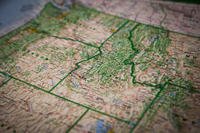
It occurred to me that neither I, nor probably the out-of-state
family whose car I had seen at the filling station, could point
out Zabul, Kandahar or Uruzgan on a map of Afghanistan if we had
to - or locate the towns of Bayju or Ubaydi in Iraq, for that matter.
And in a balmy summer morning, with the salt breezes wafting in
from the Gulf of Mexico, the last thing most people would likely
want to do is spend time poring over a map of the Hindu Kush or
the Euphrates River Valley looking for locations they never heard
of.
Except that our young men and women are serving, fighting and dying
on our behalf in those far-off places.
There is nothing unusual in this. When the U.S. military launched
its initial raids into Afghanistan in late 2001, most people were
riveted to the TV screen for the first few days. I clearly recall
the video images of the Rangers' mass parachute assault on Tarnak
Farm. Less than two years later, the nation also sat transfixed
as live TV shots via videophone and satellite uplinks tracked the
march of the 3rd Infantry Division and II MEF toward Baghdad.
But as the days, weeks and months go by, we become inured to the
repetitive news. Afghanistan devolves from a hybrid SOF-air power
success to a low-level occupation. Iraq transforms from a textbook
AirLand- Battle-"Shock-and-Awe" assault to a bloody occupation and
insurgency. The words and images begin to blur in their sameness.
Each day's news seems but a replay of the last. Our attention wanders.
"Support the troops," the sticker reads. But how?
Of course, there are numerous volunteer and nonprofit organizations
that have sprung up over the years to provide the means by which
ordinary Americans can express their support for the troops - ranging
from monetary contributions that go to purchase gift boxes, to "adopt
a unit" websites that allow individuals to get in contact with groups
of soldiers to exchange letters, cards and gifts. All of these are
good vehicles to channel our feelings of support into concrete actions.
(SFTT
and DefenseWatch have compiled a roster
of website links to organizations dedicated to helping the troops
and their families. And our comrades at Military.com
also have an excellent list
on their site. Of particular note is a new DoD-sponsored website,
AmericaSupportsYou.com,
that provides multiple ways in which to express your thoughts or
to organize your own group efforts on behalf of the troops.)
But thanks to a Louisiana communications professor, I propose a
more direct, tangible way of supporting the troops for folks who
desire to do so.
Writing in The Christian Science Monitor several weeks ago, David
D. Perlmutter offered this simple way in which individual Americans
can get in on the act:
"Politicians, generals, and bureaucrats debate over compensation
packages and death benefits for servicemen and women, and we should
encourage our leaders to be as generous as possible. But something
more is needed: personal gratitude expressed in small, everyday
acts of support."
Perlmutter calls the concept, "Treat the Troops." He described it
like this:
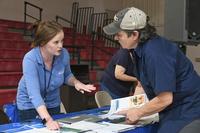
"I started my campaign two months ago when I was in a local toy
store. A young man in an Army uniform was shopping for some toy
cars, presumably for his kids. As he stepped up to the counter,
I tapped him on the shoulder and said, 'Let me take care of that.'
He blinked. I asked the clerk to put his purchases on my bill. I
shook the young man's hand and told him, 'Thanks for serving your
country.' … That was it. No big deal - or big cost. Just a token
of thanks."
The Bush administration and Congress overall have taken steps to
provide the troops with pay, benefits and other things that demonstrate
the value of their service (although far more needs to be done,
from covering VA benefits
to providing adequate body armor). So too, numerous state legislatures
have in recent years passed special bills that provide for financial
protection and direct support for military personnel and their families.
And the organized support-the-troops organizations continue to proliferate
and merit our strongest backing.
But Perlmutter's one-man campaign struck me as equally important.
As he wrote in the Monitor, "In a democracy … the morale of men
and women in uniform is the people's responsibility, too - whatever
one's feelings about this particular war. … Imagine the effect if
millions of Americans expressed their gratitude with a little cash
and kindness. That would show we support the troops better than
any yard sign or bumper sticker."
So the next time you're in line at the store, grabbing a meal in
a downtown restaurant, or sitting in an airport lounge - and you
see someone in uniform - grab the bill for that small item; have
the waiter put his or her meal on your account; send over a round
on the house.
It's the least we can do for them.
Ed Offley is
Editor of DefenseWatch.
He can be reached at dweditor@yahoo.com.
Please send Feedback responses to dwfeedback@yahoo.com
© 2005 Ed Offley.
All opinions
expressed in this article are the author's and do not necessarily
reflect those of Military.com.
|