

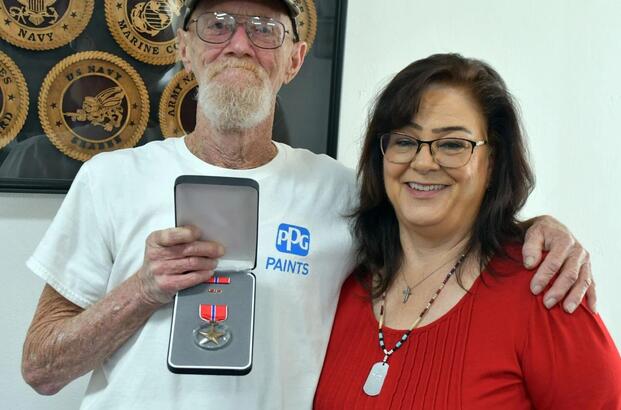
The wait is finally over for Army veteran George Layman.
While he doesn’t consider himself a hero, what Layman did during the Vietnam War and the bloody battle of Hamburger Hill should have given him a Bronze Star decades ago. But the Arizona veteran was finally honored with the medal in an event hosted by the organization Honoring/Hiring/Helping our Heroes of Pinal County (HOHP) on Nov. 25 at its headquarters.
Jeff Timm, a liaison officer from Congressman Eli Crane’s office, presented Layman with the Bronze Star and additional service medals.

Life of a Radioman
Layman’s tour of Vietnam lasted from 1968 to 1970. As a radio operator, he was in the thick of one of the war’s most infamous battles, Hamburger Hill in May 1969. The battle, which raged along the slopes of the Dong Ap Bia mountain, got its name from the carnage it inflicted. Hill 937 is in central Vietnam, not far from the western border of Laos. During the week-long conflict, 56 U.S. soldiers were killed in action.
While Layman had proper credentials to receive a Bronze Star based on his service record, he wasn't quite sure why it took more than five decades to get his medals. The Bronze Star is given to soldiers who display “heroic or meritorious achievement or service in a combat zone.”
Layman thinks his work with HOHP helped him gain the recognition needed to finally be honored.
“I don’t think I was a hero,” Layman told PinalCentral. “It’s nice to have them (the medals), because I’ve always wanted them, but I just never did anything about it until getting involved with the HOHP.”
The story of Hamburger Hill was adapted into a film released in 1987. However, Layman has never watched it. After all, he lived it.
“I still haven’t seen that movie,” he said.
Combat Record Earns Medal
As a radio operator in the field, Layman played a vital role in combat operations. Radiomen relayed communications on enemy movement back to commanders. It also made him practically a bull’s eye for the North Vietnamese Army.
“It took over four companies to go up (the mountain), and that’s 60 to 80 people in a company, and we lost ... 60 guys. We got up there, and there was supposed to have been at least 2,000 enemy on top,” Layman said. “We got up there after a week and found nobody but this big hole at the top going straight down. We left three days later and never went back.”

Kim Vandenberg, HOHP director, said the organization was very pleased to watch Layman receive the Bronze Star. Vandenberg plans to track down Layman’s nomination papers for receiving the medal.
“George earned the Bronze Star for a reason; they’re simply not just given out,” Vandenberg said. “We will find out about the circumstances of the medal award and get the write-up for that.”
Still Humble
The fact that Layman was humble in receiving such a high honor doesn’t surprise Vandenberg. Vietnam veterans tend to have a complicated view of the war.
“They all have a different feel for what it means to them,” Vandenberg said. “You may have some veterans that don’t want them, and they push them to the side because of whatever they experienced. Everybody has a different outlook.”
Abraham Ortega, another Bronze Star recipient, was on hand to see Layman receive his medal. Ortega also served in Vietnam, and while he and Layman never met during their service time, he said all veterans who spent time there share a certain brotherhood.
“We stepped up when we were young men, and we signed a blank check to do a job, and we did it with honor, we did it with pride,” Ortega said. “We stepped up to the line and we did it because socialism was spreading out and we went over to stop socialism as young men to do our jobs. Knowing that I did that and then some made me feel highly honored. I didn’t know I was gonna feel that way over the years. Looking at George today, I say, ‘Boy, we could have been related.’ We never met each other, but he was there, and he did what he had to do.”





