

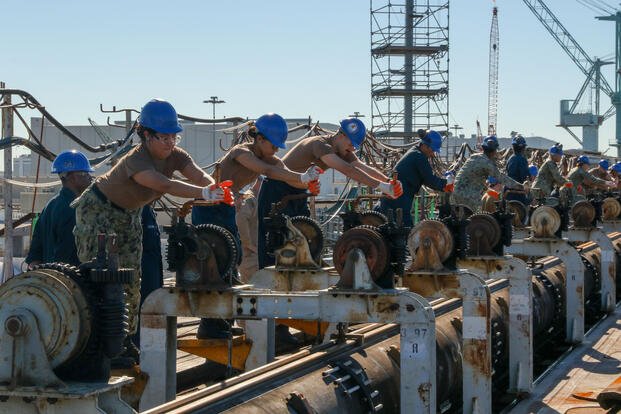
The U.S. Navy and AI software and data giant Palantir are now intertwined in a nearly half-billion-dollar investment to accelerate artificial intelligence and autonomy technologies to develop what officials described as the complex, data heavy environment of shipbuilding.
The $448 million strategic initiative in the Shipbuilding Operating System (Ship OS) unveiled Tuesday will be managed by the Maritime Industrial Base (MIB) Program in collaboration with Naval Sea Systems Command (NAVSEA), aggregating data from enterprise resource planning systems, legacy databases, and operational sources “to identify bottlenecks, streamline engineering workflows, and support proactive risk mitigation, providing a unified, data-driven approach to production management that enables faster, more informed decisions.”
The initial investment will focus on Submarine Industrial Base shipbuilders, shipyards and critical suppliers, officials said, with future expansion being “systematic” and using learned lessons to adapt similar strategies for surface ship programs.
The Navy says the initiative is designed to deliver measurable cost savings over time through improved schedules, reduced delays, and increased production efficiency. Even with the high price tag, officials say productivity gains will offset the financial amount and establish a more capable and resilient industrial base.

“This investment provides the resources our shipbuilders, shipyards, and suppliers need to modernize their operations and succeed in meeting our nation's defense requirements,” Secretary of the Navy John Phelan said in a statement. “By enabling industry to adopt AI and autonomy tools at scale, we're helping the shipbuilding industry improve schedules, increase capacity, and reduce costs. This is about doing business smarter and building the industrial capability our Navy and nation require.”
Phelan was joined at the official announcement, occurring during the first Department of the Navy Rapid Capabilities Office Industry Day, by Palantir CEO Alex Karp.
Military.com reached out to Palantir for comment.
Pilot Deployments Provided Long-Term Confidence
A Navy spokesperson told Military.com that the investment is specifically for implementing the Ship OS platform using Palantir's commercial software. Palantir, which was also founded by investor and entrepreneur Peter Thiel, will provide the commercial software foundation for Ship OS and leverage $2.5 billion in prior private sector investment in AI and data integration technologies.
Officials said it allows the Navy to focus its investment on integrating shipyard and supplier systems into this Ship OS architecture rather than developing a new platform from scratch.

“Ship OS is designed as an integrative capability, not a replacement for the tools already used across the industrial base,” the spokesperson said. “Shipbuilders, shipyards and suppliers will continue using their existing systems, and Ship OS will aggregate data from those tools to provide a unified, data-driven view of production performance.
“As the capability expands, additional AI and automation technologies may be incorporated where needed, as long as they meet Navy cybersecurity and interoperability requirements.”
The initiative was put to the test earlier this year with pilot deployments of Ship OS capabilities at locations including General Dynamics Electric Boat and Portsmouth Naval Shipyard, where officials said they “demonstrated significant improvements in planning and material review timelines.” The results were viewed as a sign to proceed with the investment.
While specific details about negotiation timelines or contract discussions are not being released to the public, the Navy spokesperson said the award turnaround to Palantir “was very quick” and that the pilot deployments’ outcomes were viewed as validation for maximizing efficiency.
The Navy is developing a prioritized list of up to 100 critical suppliers from across the U.S. for inclusion in early phases of deployment.
‘New Era of Dominance’
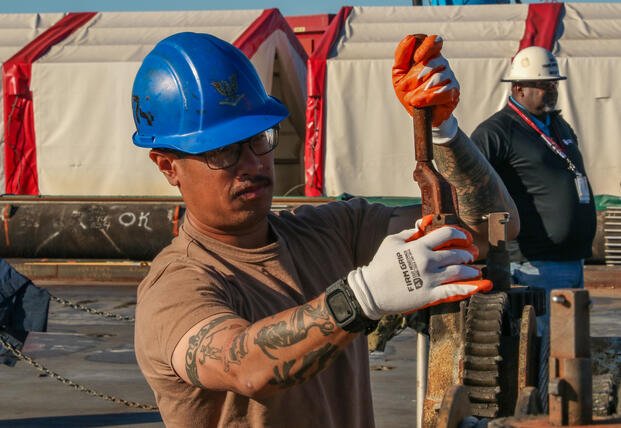
As the Defense Department “is all-in on leveraging the power of artificial intelligence to enhance our warfighting capabilities,” the Navy Ship OS is specifically focused on improving shipbuilding and repair operations.
That will be accomplished by AI providing real-time visibility and predictive insights across production, supply chains and maintenance schedules.
“The Department of War is unleashing a new era of operational dominance, where every warfighter wields frontier AI as a force multiplier."
“Advanced algorithms forecast bottlenecks weeks in advance, enabling rapid decisions that previously required months of manual coordination,” the spokesperson said. "These improvements in shipbuilding efficiency and schedule performance will directly support fleet readiness, providing more ships and submarines on time to meet Navy operations.”
“The Department of War is unleashing a new era of operational dominance, where every warfighter wields frontier AI as a force multiplier. The Department of the Navy sees AI as a very positive tool, especially for shipbuilding and the maritime industrial base,” they added.
AI Push in the US Military
The announcement of the Navy-Palantir investment comes as the United States military gets more aggressive about AI utilization within its ranks.
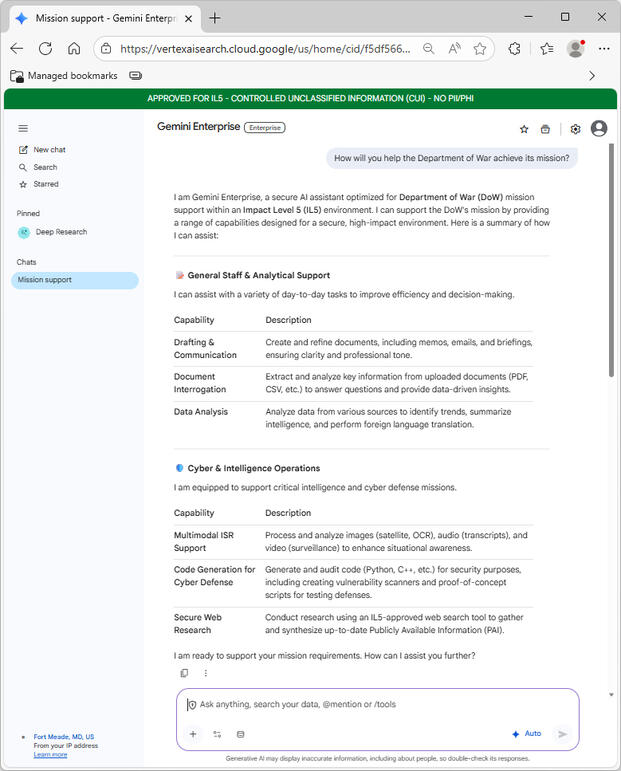
Also on Tuesday, Defense Secretary Pete Hegseth and his department announced that DoD employees began using GenAI.mil, a secure generative AI platform for every department member that is described as a specialized version of the Google AI tool Gemini called “Gemini for Government.”
All military personnel, civilians and contractors, according to Hegseth, will use the Gemini tool to handle controlled unclassified information—aided by a green banner at the top of the page reminding users of what can and can't be shared on the site.
"The future of American warfare is here, and it's spelled A-I," Hegseth said in a video posted on X.
Access to the site is only available to personnel with a common access card and who are on the Defense Department's non-classified network.
Down-The-Road Aspirations
Navy officials said the AI implementation will begin with submarine programs, where the need for improved schedule performance and capacity is most urgent. Expansion to additional shipbuilders, surface shipyards and suppliers “will follow a systematic, conditions-based approach and is planned to continue through 2026.”
Lessons learned from early deployments will guide a broader rollout, they added, with the long-term goal of creating a maritime industrial base where AI and autonomy are standard tools across shipbuilding and repair programs.
Systematic expansion to additional shipbuilders and suppliers are planned by the end of 2026, they added.





