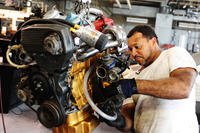
1978. General Motors believes it has found the golden ticket to solve the world's fuel crisis: a cheap-to-develop, naturally-aspirated V8 diesel engine. The result? One of the greatest automotive blunders in the history of the car. This was no flash in the pan either. This blunder continued to haunt GM for several years, affecting not only the Oldsmobile brand, but also Buick, Cadillac, Chevrolet, GMC and Pontiac.
This is the unfortunate story of the Oldsmobile Diesel V8... an engine that promised to the world, but only managed to deliver a massive disaster. Truth be told, this disaster would go on to haunt the US auto industry for decades.
Ah-Hah! The Golden Ticket!

General Motors has been around since 1908. Throughout the company's existence, it has pushed the envelope of car design. Faster, stronger, more efficient, more reliable, more affordable... you can tick all the boxes, and then some.
In the Seventies, with an international fuel crisis looming and the US auto industry in turmoil, General Motors invested in the research and development of alternative propulsion technology. From an intensive program developing its own Wankel engine for the upcoming Vega, to turbine-powered cars and trucks, to a coal-powered engine, fitted in a Cadillac Eldorado. The coal-powered mill was actually not a new concept... a German called Rudolph Diesel had experimented with coal dust powering his engine designs more than 50 years before GM's engineers had a go at it.
In short, coal didn't work out. Coal may have been much cheaper than gas, but burning coal also produces ash and smoke, while also emitting high levels of sulfur and other pollutants. But as far back as 1973, the link to Diesel's engine design also sparked another idea to offer a solution to the international oil crisis: a naturally-aspirated V8 diesel engine, offering plenty of torque and much improved fuel consumption over periodic gasoline V8s.

Brilliant idea, right? Indeed. But it all went horribly wrong during the development of this revolutionary engine. In an apparent effort to save development costs, GM's engineers based their game-changing new V8 diesel engine on the company's very successful 350 V8 gasoline engine. This theory, again, seemed to hit the nail on the head (er, excuse the pun). The 350 gas engine was well proven, and well-loved. And why reinvent the wheel? But a diesel engine operates at a much higher compression ratio than gasoline engines, requiring a more resilient design that can handle the additional pressure.
Wearing their short-sighted glasses, GM engineers retained the gasoline engine's head bolt design and pattern, ensuring that the same tooling could be used for the diesel V8, saving the costs to develop new tooling. It would prove to be a massive mistake. But the erroneous head bolt design would prove to be only the tip of the iceberg. The scandal would even include the supposed side-lining of the engineer that was responsible for the development of the Oldsmobile Diesel V8 after he insisted the engine was not production-ready. Oh, the drama!
The Wheels Start Coming Off

| 1979 Cadillac Eldorado Diesel V8 | |
| Engine | 5.7-liter V8 diesel |
| Power | 120 hp |
| Torque | 225 lb-ft |
| 0-60 mph | 15 seconds (estimated) |
| MPG | 25 (estimated) |
General Motors launched the Oldsmobile Diesel V8 in a number of its products in 1978. This included the Cadillac Eldorado, Cadillac Seville, GMC pickup, and many more. Touted as a revolutionary engine that would solve the world's oil crisis by offering a much cheaper alternative to gasoline engines, but also providing reasonable performance, cars fitted with the diesel V8 engine sold like hotcakes.
But it didn't take long for the euphoria to wear off, and for the bubble to burst. GM cars powered by the engine soon started breaking down. The inferior head bolt design proved to be the main culprit. After GM had ignored fundamental engineering principles in an effort to save costs, the much higher compression of the diesel engine saw the head literally being blown off the top of the engine.
In the gasoline version, spark plugs are used to create an explosion, igniting a fuel-and-air mixture, which results in compression being created. A diesel engine has no spark plugs. Instead, it compresses air to a point where the heat generated through this compression is enough to provide the spark that ignites the fuel-and-air mixture. In short, a diesel engine's compression (or pressure, if you like) runs up to three times higher than a gasoline engine. The Oldsmobile Diesel V8 head simply couldn't deal with that pressure, simply because it was never designed to do so.
Sources: General Motors R&D, Diesel World Magazine.
Read the full article on CarBuzz
This article originally appeared on CarBuzz and is republished here with permission.