The Army has expanded eligibility for combat patches, allowing more soldiers deployed in the Middle East and Africa to wear the insignia traditionally associated with wartime service. The move reflects a broader shift in how the Army recognizes deployments in environments that carry real risk but do not fit neatly into traditional definitions of combat.
New Policy Extends Combat Patch Eligibility
In March 2026, the Army approved a new policy authorizing combat patches for soldiers supporting operations tied to the conflict with Iran in areas under US Central Command and US Africa Command. The memo, signed by Army Chief of Staff Gen. Randy George, applies to active-duty soldiers, the National Guard, and the Reserve.
The authorization covers soldiers “assigned or attached to units supporting military operations” in those regions and runs from late February 2026 through a date that has not yet been determined.
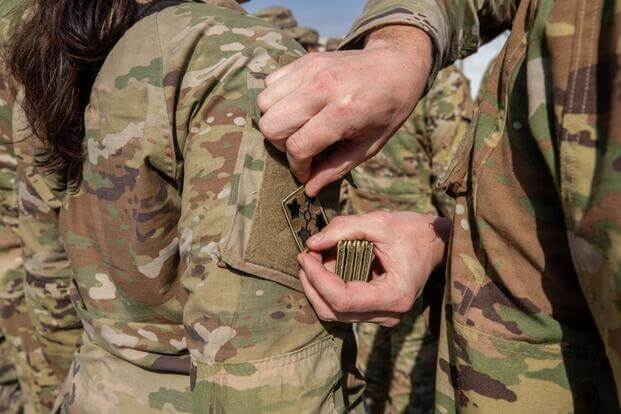
Combat patches, also known as the Shoulder Sleeve Insignia–Military Operations in Hostile Conditions (SSI-MOHC), are worn on the right sleeve and signify that a soldier has deployed to a qualifying hostile environment. They serve as a permanent marker of that service.
A Continuing Trend of Expanded Recognition
The 2026 authorization builds on a significant policy change from 2025, when the Army expanded combat patch eligibility across multiple countries in the Middle East and Africa. That earlier decision applied to deployments between October 2023 and June 2025 and covered a wide range of locations where US forces faced persistent threats.
Unlike earlier standards, the Army waived traditional requirements tied to combat zone designations, such as hostile fire pay or combat zone tax exclusion. Instead, the Army relied on its own determination that soldiers in those areas faced meaningful operational risk.
Together, the 2025 and 2026 decisions mark a clear shift away from rigid eligibility rules and toward a more flexible approach based on real-world conditions.
What a Combat Patch Actually Means
Combat patches carry significant cultural weight within the Army. Soldiers wear their current unit’s insignia on the left sleeve. When authorized, they may wear a deployed unit’s insignia on the right sleeve for the rest of their career.
Unlike individual awards such as the Combat Infantry Badge or Combat Action Badge, combat patches do not require direct engagement with enemy forces. Instead, they recognize service in a designated operational environment.
That distinction allows the Army to acknowledge a broader group of soldiers who operate in dangerous conditions without equating that service with direct combat.
Why the Army is Changing the Standard
The expansion reflects a broader reality: US forces are frequently deployed in environments that involve real risk but fall outside traditional definitions of war.
Modern operations often include drone attacks, missile strikes, and indirect fire, even in locations that are not formally designated as combat zones. As a result, soldiers in support roles or dispersed units may face threats similar to those in declared war zones.
The Army’s updated policy recognizes that reality by shifting from a narrow definition of combat service toward a broader recognition of operational risk.
Not the Same as Combat Awards
Despite the expansion, the Army has maintained a distinction between combat patches and individual combat awards.
Badges such as the Combat Infantry Badge or Combat Action Badge still require direct engagement with enemy forces and remain more selective markers of individual combat experience.
Combat patches, by contrast, signal participation in a qualifying operational environment rather than direct combat.
A Cultural and Institutional Shift
The growing use of expanded combat patch authorizations signals a shift in how the Army defines and recognizes service.
For decades, eligibility was closely tied to clearly defined combat zones such as Iraq and Afghanistan. Today, operations span multiple regions with varying levels of intensity and visibility. As a result, the Army has increasingly relied on policy adjustments to ensure that soldiers operating in dangerous environments receive recognition.
At the same time, the expansion has sparked debate within the force. Some view it as an overdue acknowledgment of modern operational risks, while others argue that broader eligibility could dilute the significance of the combat patch.
Where the Line is Being Redrawn
The expansion of combat patch eligibility reflects a larger shift in military policy. Recognition is no longer tied strictly to declared wars or traditional battlefields.
Instead, the Army is moving toward a model that acknowledges the risks of modern deployments, even when those deployments fall into gray areas between peace and war.
Combat patches once marked clear participation in major wars. Today, they increasingly reflect a broader spectrum of military service shaped by persistent conflict, dispersed operations, and evolving threats.