

Petraeus: Months of Tough Combat Ahead

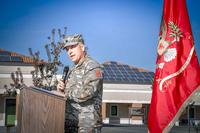
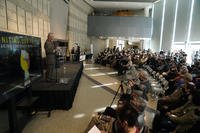
SEATTLE -- Tough months are ahead and "difficult fighting will be necessary" for U.S. troops in Afghanistan, Gen. David Petraeus told a Seattle audience Wednesday night.

Speaking before the Seattle World Affairs Council, the head of the U.S. Central Command said this summer's military campaign in Afghanistan will focus on the 10 percent of provinces that are the source of about 70 percent of a sharp escalation in violence.

Much of this hostile territory is in southern Afghanistan, he said, and the goal is to secure as much ground as possible before mid-August presidential elections there.

In an hourlong presentation, Petraeus spoke about the strategies that helped reduce violence in Iraq, and the challenges ahead as the U.S. tries to employ some of those tactics in Afghanistan.

As leader of the Central Command, Petraeus, 56, oversees the wars in Afghanistan and Iraq that America has undertaken since the 9/11 attacks launched by Osama bin Laden.

Petraeus did not mention the al-Qaida leader, but some of the first questions from the audience were about why it's so hard to find him.

"I ask myself this question every morning. I ask a few other people, too," Petraeus said. "The bottom line is that manhunts are tough."

Bin Laden's location is likely in a rugged mountain area in Pakistan, where U.S. forces are not on the ground, Petraeus said.

The purpose of the Afghanistan campaign is to combat the Taliban and keep that nation from once again becoming a haven for terrorists who seek to harm the U.S., he said.

Petraeus has emerged as the most high-profile military commander of his generation. He is a slender man with a passion for jogging who graduated from West Point and went on to earn his Ph.D. at Princeton. His doctoral dissertation was titled "The American Military and the Lesson of Vietnam."

Petraeus led the 101st Airborne Division during the invasion of Iraq in 2003 and later helped rewrite the Army's counterinsurgency manual.

In 2007, as the United States military faced an increasingly lethal Iraqi insurgency, Petraeus was tapped by President Bush to lead the war effort. Fortified by an increase in troops, U.S. military and Iraqi troops succeeded in reducing violence that had killed thousands of Iraqis and undermined the post-Saddam government.

Petraeus' strategy in Iraq involved redeploying U.S. troops from protected bases to smaller neighborhood posts and reaching out to forge new alliances with Sunni groups that previously had taken up arms against the U.S. troops.

"We had to get past this, and we worked very hard on it," he said.

With President Obama focusing on Afghanistan, Petraeus is taking a key role in overhauling the U.S. military campaign there. During questions Wednesday, Petraeus was asked to compare his experiences with Presidents Bush and Obama.

"I think that both commanders-in-chief have been deadly serious about what it is they are doing -- truly committed to the welfare of the country and the men and women who serve in uniform," he said. "Both of them are fine leaders."

"... But what I will say is that the [military review] processes we have gone through with Obama and his administration have been very good, frankly."

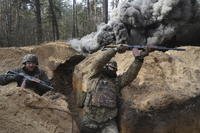
In Afghanistan, Petraeus is trying to turn around a faltering U.S. military effort with an infusion of new troops, including more than 3,800 Soldiers from a Fort Lewis-based Stryker Brigade who are now en route there.

Petraeus said the armored Stryker vehicles performed well in Iraq and that commanders were keen to have them in Afghanistan. He expected they would be deployed in Kandahar province -- a major focal point of Taliban violence -- as well as in some surrounding areas.

U.S. forces in Afghanistan are scheduled to rise to 68,000 by the fall, more than double the number in 2008, but there are concerns that there still may not be enough troops to secure Afghanistan and that the U.S. campaign may end up flushing the Taliban out of some areas and into others with fewer U.S. and NATO troops.

Petraeus' speech was targeted by a sidewalk protest organized by the Seattle-area chapter of Veterans for Peace.

© Copyright 2012 Seattle Times. All rights reserved. This material may not be published, broadcast, rewritten or redistributed.

Add Your Comment:

More Headlines

Latest Stories

   Latest Stories | RSSIcon RSS

What's Hot

Editor's Pick

   Editors Pick | RSSIcon RSS