





Three years ago, the Defense Department set out to increase sharply the number of military personnel who speak strategically important languages. Progress has been slow, and the military has not determined how to reach its goal - or what exactly that goal is.
Figures from the department indicate that only 1.2 percent of the military receives the bonus paid to those who can speak languages judged to be of critical importance for the conflicts in Afghanistan and Iraq, as well as for other areas of strategic concern.
John Nagl, a retired lieutenant colonel who is co-author of the U.S. Army's new counterinsurgency field manual, said in an interview that the military had been moving too slowly, and he questioned its assertion that language needs were difficult to assess since they were subject to changing global security conditions.
The military by now should "have a pretty good idea of what countries we're fighting in," he said.
Nagl, a fellow with the Center for a New American Security, said the army understood the value of having more foreign language speakers in its ranks. But, he said, it had not "done the math on what it means" and had yet to "build the programs and provide the leader development to get there."
He noted that after the Soviet Union launched Sputnik in 1957, the United States urgently worked to develop a cadre of Russian speakers and scholars. But after the Sept. 11, 2001, terrorist attacks on the United States, he said, neither the military nor other government agencies executed a similarly ambitious program for Arabic speakers.
The services have adopted a number of programs that have had some success. The army developed a program to recruit native speakers of strategically important languages to serve as translators; so far, more than 600 have graduated.
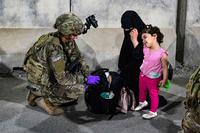
One of them, Sergeant Mohammed Lamaffar, earned a law degree in his native Morocco and enlisted in the U.S. Army, where he is an Arabic linguist working with an infantry company commanded by Captain Eric Nelson.
"Having a soldier who speaks Arabic is a huge asset," Nelson said in an e-mail message from an outpost near Baghdad. "A patrol with a good interpreter is 10 times as valuable as one with a lousy one."
The need is not just for Arabic speakers. The Defense Language Institute, in Monterey, California, has increased its number of students in Arabic, Chinese and Persian to 2,171, from 1,144 in 2001.
The military has also increased the number of Foreign Area Officers to more than 1,600, from 1,164 in 2001. These officers receive advanced language and cultural training for their designated region.
Because not enough soldiers speak foreign languages, the military has had to rely on more than 10,000 civilian contract linguists, many local Afghans and Iraqis of widely differing abilities. Nelson said that his 120-man infantry company had 11 Iraqi interpreters but that only 9 were capable of doing the work.
But some individual units are taking it upon themselves to generate language capabilities. The 4th Stryker Brigade, based at Fort Lewis in Washington State, has established an intensive, 10- month Arabic course for 125 of its soldiers, said Gail McGinn, a senior language authority at the Department of Defense.
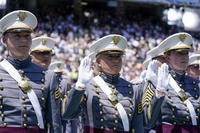
The military has also made efforts to increase the number of cadets and midshipmen enrolled in language programs at the service academies and ROTC programs. Still, the army reports that only 106 of its 24,000 ROTC cadets are majoring in a strategic language.