



|

|
|
|

|


|

|

|
Don't waste your time trying to find the recruiter near you. Let us do the work.
|

|

|
|

|
|

Light Years Ahead
|
Story and Photos by JO1 Robert
Benson
|
Thinking about Serving?
Get
the information you need to decide if a military
career is right for you. No obligation -- just free
information from the branches of service that interest
you.
|
|
|
|
They come with IQs off the charts
and ASVAB
scores that number higher than their life expectancy, but that's what
a 22-year-old needs to succeed when he's asked to run a nuclear power
plant on a U.S. Navy warship.
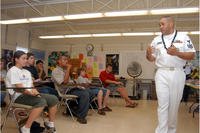
Gibberish. To the average "idiot," this talk is nothing more than gibberish:
"Twenty k is 2R and 20k in parallel with 20k is 10k," says the man in
a white lab coat, scribbling on a chalkboard as fast as he talks. Twenty-five
students look on, seemingly absorbed. "To determine the voltage out we
consider that the step is Vin over 3R, times one half to the N, times
feedback resistance. N is equal to the number of nodes slash digits; therefore,
the Vstep is equal to (Vin/3R)(1/2)n(RFB). Based on that, who knows what
the step voltage is?"
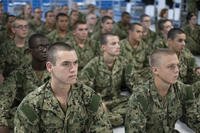
A dozen hands go up. For these young men and women - students at the Naval
Nuclear Power Command, Charleston, S.C. - the gibberish is decipherable;
for them, digital to analog conversion is easy. They could do it in their
sleep.
But we digress. Two months earlier most of these dungaree-clad students
were in high school. Many of them got satisfaction from $15 lawn mowing
jobs or quarter tips on a newspaper delivery route. But now, as they scribe
notes on atomic and nuclear physics, it's clear they're preparing for
something monumental: an education that will teach them how to run a nuclear
power plant aboard a U.S.
Navy submarine or aircraft
carrier.
AFTER 18 MONTHS OF SCHOOL, THEY ENTER THE SECRET CONFINES OF ENGINEROOMS
ABOARD SUBMARINES AND AIRCRAFT CARRIERS AROUND THE WORLD. WHAT THEY DO
THERE IS NOTHING SHORT OF WHAT MANY CALL MIRACULOUS...
Yeah, they're way beyond high school math and science now.

SN Rick Merman, a student at the NNPTC School, is just getting started
in a Navy course that will last a year and a half. Afterwards, he
will report to a carrier or a submarine and be charged with the
daunting task of running a nuclear power plant.
|
|
"The weight of the digital input is accomplished
by a resistance ladder that acts as a current and voltage divider," continues
Electronics Technician 1st Class (SS) Charles Bushovisky - a genius in
a Sailor's outfit. "Our output equation is going to be a little different.
If the inputs are all zero, are these resistors in parallel?"
A seaman's hand shoots up.
BUT WAIT, WAIT! Are you sure you know the answer? Will it be your final
answer? Do you want a lifeline? Maybe willing instructors in the lab after
class for one-on-one help or a review program on computer available at
your leisure? Before you answer, remember that this is for $60,000! You
got the first question right when you answered yes to "do I want to join
the Navy as a nuke?" and scored the $12,000 reenlistment bonus. But your
reenlistment bonus will pay off up to 60 grand! So think hard. This is
for the money!
His answer is right, of course. The students here, training to become
machinist's mates, electrician's mates or electronic technicians, represent
the top 10 percent of the nation's high school graduates.
"The majority of our students are 63 days removed from high school," said
CAPT Bill Hicks, the school's commanding officer. "They're bright people
who have never been challenged. The importance of what happens to them
here is awesome. Graduates of the nuclear program make up only 3 percent
of the Navy, but they fit into the top 10 percent of the Navy. I'm very
proud of them!"
Hicks and his staff are especially proud, perhaps, of the top grads. Students
like Machinist's Mate 3rd Class Robert Kilgore, who dumbfounded the staff
with his blistering 99 ASVAB score and 3.95 grade point average, which
made him the No. 1 grad in the early part of 2000. "No class in particular
was tougher than the rest," said the Tulsa, Okla., native, who even compared
the school to his college experience at the University of Arkansas. "The
pace is really fast. Studying takes up a lot of your time. You have to
put in more time here than you would at college."
They're bright people who have never been challenged. The importance of
what happens to them here is awesome. Graduates of the nuclear program
make up only 3 percent of the Navy, but they fit into the top 10 percent
of the Navy.
Kilgore said he would go to New York to continue his nuclear training,
and then report to a submarine.
Based on a student's rate (MM, EM or ET), the initial "A" school varies
from 13 to 26 weeks. From there, students go to the more advanced Nuclear
Power School in the same building, followed by the six-month Nuclear Prototype
School. By that time, enlisted personnel have a knowledge of operation,
maintenance and supervision of a naval nuclear propulsion plant.
The Charleston schoolhouse itself is brand new. Opened in 1998, it includes
six barracks, a galley called the "refueling complex," an activity center,
a central energy plant and a three-story, 250,000 square-foot training
center. In June, the 100,000th Sailor will complete Navy nuclear propulsion
training, which began more than 50 years ago with the development of USS
Nautilus (SSN 571).

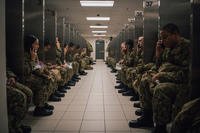
EM3 Charles Houston reviews notes during a study hall period at
the U.S. Navy's Nuclear Power School in Charleston, S.C.
|
|
"This school is everything a Sailor could dream
of," said MM3 Robert Connelly. "I was in the Marines, but then as I got
a family, I started looking for other career-orientated jobs. Once I heard
about this nuclear school it was a no-brainer."
Chief Electrician's Mate (SW) Michael Mills, a section advisor and former
instructor at the school, said part of the attraction of the school is
the challenge itself. "This school is very demanding and the pressure
to do well is intense; we keep our attrition low with instructors who
know their stuff dead cold and are willing to help everyone succeed.
"The best thing we have here is a dedicated staff. If someone comes to
you saying they need help, how can you turn 'em down? Anyone of us will
bust our butt for 'em."
Mills suggested that the school and the naval nuclear field have a certain
standard they live up to. "On carriers [nuclear-trained Sailors] are relied
on for just about everything. This job is an endless pursuit of perfection
- a mindset. Training is a way of life in the Naval Nuclear Propulsion
Program."
And it's clear the training has begun here at the Naval Nuclear Propulsion
School, and electrode by electrode, node by node, resistor by resistor,
the secrets of nuclear power are unfolding.
© 2000 All Hands magazine. All opinions
expressed in this article are the author's and do not necessarily reflect
those of Military.com.
Use
your GI Bill benefits to get ahead. Get free information from military-friendly
schools.

|

|

|

|

|

|
EDUCATION
CENTER

Further your career
with education! Use your GI Bill and Tuition
Assistance benefits. Find schools that want
you! |
 |
|

|
 |

|

|
USE
YOUR VA LOAN BENEFIT

Mortgage rates are
at 30-year lowsnow's the time to consider
using your VA home loan. Get pre-approved!
|
|
|

|

|
|

|

|
|

|

|
|
|

|
|
|