






















 |
William Sturgiss Lind,
Director of the Center for Cultural Conservatism
at the Free Congress Foundation, is a native
of Cleveland, Ohio, born July 9, 1947. He
graduated magna cum laude, Phi Beta Kappa
from Dartmouth College in 1969 and received
a Master's Degree in History from Princeton
University in 1971. He worked as a legislative
aide for armed services for Senator Robert
Taft, Jr., of Ohio from 1973 through 1976
and held a similar position with Senator Gary
Hart of Colorado from 1977 through 1986. He
joined Free Congress Foundation in 1987.
Mr. Lind is author of the Maneuver Warfare
Handbook (Westview Press, 1985); co-author,
with Gary Hart, of America Can Win: The Case
for Military Reform (Adler & Adler, 1986);
and co-author, with William H. Marshner, of
Cultural Conservatism: Toward a New National
Agenda (Free Congress Foundation, 1987). He
has written extensively for both popular media,
including The Washington Post, The New York
Times, and Harper's, and professional military
journals, including The Marine Corps Gazette,
U.S. Naval Institute Proceedings and Military
Review.
Mr. Lind co-authored the prescient article,
"The Changing Face of War: Into the Fourth
Generation," which was published in The Marine
Corps Gazette in October, 1989 and which first
propounded the concept of "Fourth Generation
War." Mr. Lind and his co-authors predicted
that states would increasingly face threats
not from other states, but from non-state
forces whose primary allegiance was to their
religion, ethnic group or ideology. Following
the events of September 11, 2001, the article
has been credited for its foresight by The
New York Times Magazine and The Atlantic Monthly.
Mr. Lind is co-author with Paul M. Weyrich
of the monograph: "Why Islam is a Threat to
America and The West." He is the author of
"George W. Bush's `War on Terrorism': Faulty
Strategy and Bad Tactics?" Both were published
in 2002 by the Free Congress Foundation.
William
Lind Article Archive
Discussion
Board
Have an opinion on this article? Sound off.
|
|
|
|
August 18, 2005
[Have an opinion on a William Lind column? Sound off in the Discussion
Boards.]
The past couple weeks have been a hard time here in my home town of Cleveland, Ohio. Third Battalion, 25th Marines, a reserve unit headquartered just ten minutes from my house, lost 20 guys in two days in Iraq. It was a kick in the stomach for the whole city.
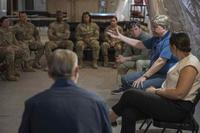
Those Marines were our neighbors and sometimes our friends. The battalion commander of 3/25 is an old friend of mine, from his days as a captain. Last winter, before they deployed, I held a seminar on Fourth Generation war for him and some of his officers and staff NCOs. The FMFM 1-A was barely in draft form then, but I did get them a pre-publication copy of John Poole's Tactics of the Crescent Moon. It is probably the best thing out there on the Islamic way of war. I hope it helped. Like everyone in Cleveland, I am frustrated that there is so little we can do for our own guys over there.
There is one thing I can do, and that is use this column to raise a question: why are units such as 3/25 being used to conduct sweeps? It was on a sweep that the 14 Marines were killed when their Amtrack was hit. The battalion took a similar hit last May in another sweep.
I am not criticizing 3/25 here. The policy of conducting sweeps is set at a level far above battalion. Maybe these things are decided in the Emerald City in Baghdad, maybe in Washington. In either case, it is in some vast headquarters where everything is reduced to Powerpoint briefs
and spoon-fed to generals who know more about promotion politi c s than they do about war.
In a sweep, a conventional military unit, designed to fight other units like itself, is sent into bad guy country. It is not going to stay there; it's just passing through. Inevitably, the insurgents know for days if not weeks beforehand when and where it is coming. Most of the bad guys simply leave. Enough stay behind to set some ambushes and plant mines and booby-traps. The unit doing the sweep comes through like ducks in a shooting gallery. It gets hit, sometimes hard. Maybe it picks up a few insurgent weapons dumps. Typically, it rounds up any young men it finds as "possible insurgents" (units like 3/25 now report that they find no young men on their sweeps -- no surprise). Then it leaves. The insurgents come back. Nothing has changed, except places like Cleveland hold a lot of military funerals. In the end, it's us that gets swept.
So why do we keep doing it? The standard answer is that we don't have enough troops in Iraq to occupy the place. That is true. But instead of wasting the troops we do have by conducting sweeps, why don't we adopt the "ink-blot strategy" where we can? Deriving from British experience in Malaya and what American Special Forces and Marines did in the early stages of the Vietnam war (and it was working when we abandoned it), the ink-blot strategy uses however many troops we've got to come into an area and stay. They move right into the towns and villages. They live with the local people. They provide long-term security, so local people can work with us without getting their throats cut three days later once we've gone.
No, we do not have enough troops to do this in all of Sunni Iraq. But we can start with part of it. Yes, that will give the insurgents a free hand elsewhere, for a time. But sweeps don't change that fact; they only change the appearance, which may be what is wanted for briefings back in Washington but means nothing on the ground. Over time, our ink-blots can slowly expand, as areas become genuinely secure and can be turned over to someone else (probably local militias willing to take American dollars).


|
The root problem here is one I have pointed to many times before: the seeming inability of the American military's higher echelons to learn. The officers and men of units like 3/25 learn and adapt quickly. But our vast, overstaffed and under-led headquarters seem to live on another planet. They don't learn from the experiences of others, through history, and they also don't learn from the experience of 3/25 and other similar units. They just keep ordering the same failed tactics, like sweeps or dropping bombs on populated towns and cities, over and over again.
Yet on another level their behavior is rational.
American generals become senior commanders by pleasing politicians. They please politicians by telling them what they want to hear.
The Bush administration wants to be told that what we are doing is working, so that is what the generals tell them. And it's so much easier to tell someone else that it's working if you believe it yourself. It all makes perfect sense -- in a closed-system fantasy-land that has no relationship whatever to the war units like 3/25 are fighting.
If the people of Cleveland and other places like Cleveland ever figure out what's really going on, there's going to be hell to pay. Anger is a short step from grief.
Email
this page to friends RSS feed
© 2005 William S. Lind. William S. Lind
is Director for the Center for Cultural Conservatism for the Free
Congress Foundation. All opinions expressed in this article are
the author's and do not necessarily reflect those of Military.com.
|