























Home
Benefits
News
entertainment
shop
finance
careers
education
join military
community


William S. Lind: Are Iraq's Insurgents Losing?


About the Author

William Sturgiss Lind, Director of the Center for Cultural Conservatism at the Free Congress Foundation, is a native of Cleveland, Ohio, born July 9, 1947. He graduated magna cum laude, Phi Beta Kappa from Dartmouth College in 1969 and received a Master's Degree in History from Princeton University in 1971. He worked as a legislative aide for armed services for Senator Robert Taft, Jr., of Ohio from 1973 through 1976 and held a similar position with Senator Gary Hart of Colorado from 1977 through 1986. He joined Free Congress Foundation in 1987.

Mr. Lind is author of the Maneuver Warfare Handbook (Westview Press, 1985); co-author, with Gary Hart, of America Can Win: The Case for Military Reform (Adler & Adler, 1986); and co-author, with William H. Marshner, of Cultural Conservatism: Toward a New National Agenda (Free Congress Foundation, 1987). He has written extensively for both popular media, including The Washington Post, The New York Times, and Harper's, and professional military journals, including The Marine Corps Gazette, U.S. Naval Institute Proceedings and Military Review.

Mr. Lind co-authored the prescient article, "The Changing Face of War: Into the Fourth Generation," which was published in The Marine Corps Gazette in October, 1989 and which first propounded the concept of "Fourth Generation War." Mr. Lind and his co-authors predicted that states would increasingly face threats not from other states, but from non-state forces whose primary allegiance was to their religion, ethnic group or ideology. Following the events of September 11, 2001, the article has been credited for its foresight by The New York Times Magazine and The Atlantic Monthly.

Mr. Lind is co-author with Paul M. Weyrich of the monograph: "Why Islam is a Threat to America and The West." He is the author of "George W. Bush's `War on Terrorism': Faulty Strategy and Bad Tactics?" Both were published in 2002 by the Free Congress Foundation.

William Lind Article Archive

Discussion Board
Have an opinion on this article? Sound off.


Related Links

Military Opinions Index

Get Breaking Military News Alerts


Get $1004 a Month!

Your service may have earned you great education benefits. Get up to $1004 per month to pay for your undergraduate, graduate or technical degree.

Find out about military-friendly schools today
.


Your Two Cents

Submit your stories, news items, or a benefits update -- and help Military.com bring the best, most important stories to your fellow servicemembers, veterans, and family members. Contribute here

April 7, 2005

[Have an opinion on a William Lind column? Sound off in the Discussion Boards.]

The last few weeks have seen a spate of press reports suggesting that Iraq's insurgency is on the ropes. A combination of the Iraqi elections and relentless U.S. military pressure has brought the resistance to the point of ineffectiveness, if not disintegration. Larry Kudlow, writing in the New Republic, summed it up:

"Depending on which official you ask, insurgent attacks have dropped by either a third or nearly half. The number of Americans killed in action has declined. Civilians have begun killing terrorists. Over the last week alone, U.S. forces have killed scores of insurgents in lopsided battles -- in the latest, Iraqi forces spearheaded the offensive."
Is this actually what is happening in Iraq? From this remove, it is impossible to tell.

Could it happen? Certainly. Wars do not move in straight lines, most of them anyway. The fortunes of war shift back and forth, favoring one party today, another tomorrow. Just as we have blundered, so have the insurgents. Just as we face vast obstacles, so do they. As I have said from the outset of this strategically disastrous war (America's Syracuse Expedition), I think it will end with an American failure if not outright defeat. But the path to that end is likely to have ups as well as downs, for all parties.

More importantly, I think Fourth Generation theory enables us to gain a better perspective on the current situation than we obtain from arguing who is ahead on points. From a Fourth Generation perspective, we need to remind ourselves that the terms we all use, myself included, such as "the insurgency" or "the resistance," are an inherently misleading shorthand.

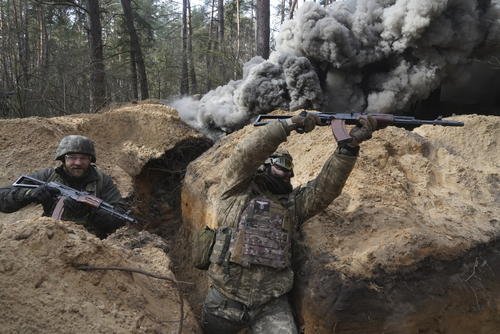
In Malaya or Algeria or Vietnam, one could speak of the opponent as a something. In Fourth Generation situations such as Iraq, one cannot. There is no single opponent. Rather, what we face is a vast array of armed elements operating outside the control of the state. They range from true insurgents, such as the Ba'athists, through kidnappers, gangs of robbers, hostile tribes, foreign mujaheddin seeking martyrdom and party or faction militias to men out to avenge their family's honor.

The essence of the problem is not that they are fighting the American occupation -- some are, some aren't -- but that they are armed elements not controlled by the state. Their very existence undermines the state to the point where it becomes a fiction.

Looking at the other side of the coin, we see that the American challenge is not merely defeating an insurgency but re-creating an Iraqi state. Attaining that goal can be very far away even if "the insurgents" lose.

If "the insurgency" were defeated tomorrow, remaining obstacles would still include a general breakdown of order in Iraqi society, mutual hatreds among Sunnis, Shiites and Kurds (one possible turn of events is that the Shiites and the Sunni "insurgents" might unite against the Kurds over Kirkuk), basic services such as power and water that don't work, a dead economy that leaves most Iraqis un- or under-employed and an unworkable political system imposed by foreigners (how did Bremer & Co. forget that in our political system, we require two-thirds majorities when we want to make any action almost impossible?).


Looming over everything is the question of legitimacy: How can a state be legitimate when its government is a foreign creation propped up by foreign troops?

For America to win in Iraq, it has to leave behind a real state. Further, that state must not be an enemy to America. The chance of meeting just the second requirement is small, given the Iraqi people's resentment toward the occupation and the strongly Islamic character of any likely new regime. It is improbable that we will meet the first requirement either.

We may leave behind us the form of a state -- a capital, a parliament, a government, etc. -- but in most of the country, the real power will remain where it is now, in the hands of armed elements operating outside the state. That is true whether we defeat "the insurgency" or not.

Contrary to what a number of writers on 4GW have said, Fourth Generation war is not merely a new name for insurgency or guerilla warfare. What is at stake in 4GW is not who rules the state, but the fate of the state itself.

  Email this page to friends

© 2005 William S. Lind. William S. Lind is Director for the Center for Cultural Conservatism for the Free Congress Foundation. All opinions expressed in this article are the author's and do not necessarily reflect those of Military.com.


Military Opinions Index


Member Center


FREE Newsletter


Military Report


Equipment Guides


Installation Guides


Military History