


















 |
H. Thomas Hayden
recently concluded over 35 years of service,
which included the Agency for International
Development, the Marine Corps, defense industry
and the Pentagon. His specialties are Intelligence,
Counterinsurgency Operations, Counter-terrorism,
and Joint Concepts Development and Experimentation.
His Marine Corps assignments have included
command of two separate battalions; AC/S G-2,
4th MARDIV & AC/S G-2 FMFEurope; Branch Head,
HQMC, Special Operations and Low Intensity
Conflict (SO/LIC); Special Assistant to the
Assistant Secretary of Defense for SO/LIC;
and, Senior Program Analysts at HQMC with
the Joint Staff and DoD at the Pentagon. Overseas
assignments included Vietnam, Japan & Okinawa,
Europe, Central America, Saudi Arabia and
Kuwait, Somalia, Singapore, Philippines, and
Colombia. He has an MBA (Pepperdine) and an
MA in International Relations (University
of Southern California). He has written two
books and is working on a third.
Thomas
Hayden Article Archives
Sound
Off! - Have an opinion about this
article? Visit the discussion forum.
|
|
|
|
February 4, 2005
[Have an opinion on this column? Sound off in the discussion
forum.]
Almost everyone agrees that the recent Iraqi elections for a constitutional assembly were a resounding success. This should go a long way in reestablishing an Iraqi government and facilitate U.S. withdrawal. Make no mistake about it; the insurgency will not end any time soon. The insurgency is first and foremost anti-American. As long as we are in Iraq, there will be insurgents.
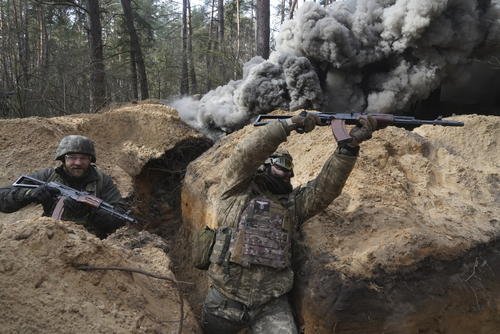
The U.S. military authorities must now set new priorities in creating an advisory effort and increased trainers at training centers to transform the Iraqi army into an effective fighting force for counterinsurgency. As we learned in Vietnam, the U.S. advisory effort started to train the South Vietnamese army to fight conventional wars. It took almost five years before there was an effective military-civilian organization called Military Assistance Command-Vietnam/Civil Operations for Revolutionary Development (MACV/CORDS) to fight a counterinsurgency campaign.
Having served two tours as an advisor with South Vietnamese forces (1967-1969), and later served as an advisor to other foreign military forces both in and out of uniform, I want to share some thoughts on the challenges facing this effort.
The American military's greatest shortcomings have been in language proficiency, cultural and religious awareness, information operations and psychological warfare, and most importantly, all facets of intelligence and counterintelligence. This needs to improve. Intimate knowledge of the enemy's motivation, organization and tactical methods, and his cultural environment are an imperative.
Trainers for military boot camps or advance combat training have long been part of the American military toolbox. The composition and training of U.S. advisors who have walked into combat in a counterinsurgency with foreign troops have had varying degrees of success. Success stories can be found in Greece after World War II, the Republic of Korea in the 1950s, the Republic of Vietnam in the 1960s, El Salvador in the 1980s, etc.
In Vietnam, the U.S. Marine Corps had a very successful effort called the Combined Action Program (CAP) where they took a Marine rifle squad and embedded them into a Vietnamese Popular Forces platoon. All during the Vietnam War, not one CAP village was every lost to the Viet Cong or North Vietnamese.
Counterinsurgency is fought at the platoon level, not the battalion or regiment level. Rapid reaction forces of company size or larger have to be on call for reinforcement if the enemy ever makes the mistake to emerge in strength to fight.
As a minimum, a normal advisory team needs an officer of equal rank to his opposite number, a senior non-commissioned officer, a radioman, and a corpsman or medic. Foreign Special Forces or elite units will need varying specialists as required.
Foreign language proficiency by at least one member of the advisory team is very important. All advisory team members need rudimentary language training in daily greetings and casual conversation. Interpreters should be used as a last resort.
All Muslim military forces will stop what they are doing and pray at the appointed time five times a day - even on combat patrols. The Five Pillars of Islam must be understood and appreciated: their faith, prayers, the pilgrimage, the fast and zakat (tithe to the mosque or Muslim charity).
The projections for properly training the Iraqi forces have been identified in a military planning document called the "Matrix," which suggested that Iraqi forces will not be capable of taking the lead in securing Baghdad until January 2006 at the earliest. It has to done sooner than that.
U.S. military analysis have said that they have already achieved some measure of "local control" in 14 provinces, and are moving the Iraqis toward taking the lead in carrying the security burden in another, Salahuddin, which includes the hot spots of Tikrit, Samarra and Baiji.
Nineveh Province in the north, where many policemen in Mosul abandoned their posts in face of heavy fighting with insurgents last November, according to the Matrix assessment, could see Iraqis taking the lead in security in the near future.
Anbar, a Sunni province in the north, where U.S. troops and Iraqi forces fought a major battle in November to destroy insurgents in Falluja, will be far more difficult. U.S. forces occupy Falluja, and Iraqi security forces in Anbar's other major city, Ramadi, are working to establish local control.
"Local control" is defined as when Iraqi forces, with limited support from foreign troops, can "plan, direct and conduct operations independently" at the platoon level, and "react and respond to local threats and incidents" with coalition forces ready to respond as reinforcements. Regional control will be achieved when Iraqi forces can operate at the battalion level with coalition forces in support.
General John Abizaid, Commander of U.S. Central Command, last week told The Houston Chronicle: "There's a shortage of trained officers that will respect the government, be loyal to the government and support the government over the long term." He added: "The missing link is a steady chain of command and a command-and-control system that allows the minister of defense to say, 'I want those Iraqi units to go here, do this,' and have his intent communicated up and down the chain of command."
In addition to the challenge mentioned above by Gen Adizaid, there is one important consideration for the advisors and trainers for Iraqi forces. Most Arab armies do not have a tradition for adequately training and giving leadership opportunities to non-commissioned officers. NCOs are the backbone of the U.S. Army and Marine Corps, and there will be a need to develop the Iraqi NCOs like they have never been trained before.
Propaganda can be mightier than the sword. Mistakes and miscues by advisors and trainers will be blown out of proportion and used against the Americans. Cultural and religious sensitivities are paramount in the new priorities to train Iraqis in order for the coalitions force to leave Iraq. Any talk of significant disengagement from Iraq before next year is mostly political rhetoric, and not sound military strategy.
Email
this page to friends
[Have an opinion on this article? Sound
off here.]
© 2005 H. Thomas Hayden. All opinions
expressed in this article are the author's and do not necessarily
reflect those of Military.com.
|